Skip to content
CalcGospel 國際數學圖譜
返回

CIE 9709 2024 June Paper 33 Q6

A Level / CIE / P3

CIE 9709 2024 June Paper 33 Paper · Question 6

题目

Problem

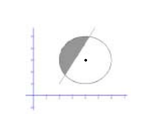
(a) On an Argand diagram shade the region whose points represent complex numbers zz which satisfy both the inequalities ∣z−4−3i∣≤2|z-4-3\mathrm{i}|\le2 and arg⁡(z−2−i)≥13π\arg(z-2-\mathrm{i})\ge\frac13\pi.

(5)

(b) Calculate the greatest value of arg⁡z\arg z for points in this region.

(2)
题目中文翻译

(a) 在 Argand 图中,用阴影标出满足不等式 ∣z−4−3i∣≤2|z-4-3\mathrm{i}|\le2 和 arg⁡(z−2−i)≥13π\arg(z-2-\mathrm{i})\ge\frac13\pi 的复数 zz 所对应的点组成的区域。

(5)

(b) 计算此区域内各点所对应的 arg⁡z\arg z 的最大值。

(2)
原卷通用作答要求

Answer all questions. You should use a calculator where appropriate.

You must show all necessary working clearly; no marks will be given for unsupported answers from a calculator.

Give non-exact numerical answers correct to 3 significant figures, or 1 decimal place for angles in degrees, unless a different level of accuracy is specified in the question.

请回答所有题目。适当时应使用计算器。必须清楚展示所有必要的计算过程;仅给出计算器答案而没有过程,不予评分。除非题目另有精度要求,非精确数值答案保留 3 位有效数字,以度为单位的角度保留 1 位小数。

解答

(a)

解法一

思路

展开

第一个条件表示圆心 (4,3)(4,3)、半径 22 的闭圆盘。第二个条件的角是从点 (2,1)(2,1) 出发量起的;圆盘完全位于该点的右上方,因此取斜率 3\sqrt3 的射线上方部分。

答题过程

展开

Write z=x+yiz=x+y\mathrm{i}. The condition ∣z−4−3i∣≤2|z-4-3\mathrm{i}|\le2 is the closed disc

(x−4)2+(y−3)2≤4.(x-4)^2+(y-3)^2\le4.

Draw its boundary circle with centre C=(4,3)C=(4,3) and radius 22.

For arg⁡(z−2−i)≥π/3\arg(z-2-\mathrm{i})\ge\pi/3, mark P=(2,1)P=(2,1) and draw the ray from PP at angle π/3\pi/3 to the positive real direction:

y−1=3(x−2),x≥2.y-1=\sqrt3(x-2),\qquad x\ge2.

All points in the disc have x≥2x\ge2 and y≥1y\ge1. Shade the part of the disc on or above this ray, including both boundary arcs/segments.

(b)

解法一

思路

展开

从原点向圆作上方的切线,切点给出最大的辐角。由圆心方向角加上直角三角形中的角求解,并确认切点落在已涂区域内。

答题过程

展开

Let OO be the origin and TT the upper tangency point from OO to the circle. Then

OC= 42+32=5,CT= 2.\begin{align*} OC=&\,\sqrt{4^2+3^2}=5,\\[4mm] CT=&\,2. \end{align*}

Also CT⊥OTCT\perp OT.

Thus

∠COT= sin⁡−125,arg⁡C= tan⁡−134.\begin{align*} \angle COT=&\,\sin^{-1}\frac25,\\[4mm] \arg C=&\,\tan^{-1}\frac34. \end{align*}

The upper tangent touches at approximately (2.260,3.986)(2.260,3.986). Relative to P=(2,1)P=(2,1), this point has argument approximately 1.48>π/31.48>\pi/3, so it belongs to the required region.

Consequently, the greatest argument is

max⁡arg⁡z= tan⁡−134+sin⁡−125= 1.055017….\begin{align*} \max\arg z=&\,\tan^{-1}\frac34+\sin^{-1}\frac25\\[4mm] =&\,1.055017\ldots. \end{align*}

Thus max⁡arg⁡z≈1.06 radians\boxed{\max\arg z\approx1.06\text{ radians}}.

解法二

思路

展开

把从原点出发的直线写成 y=mxy=mx。与圆相切时,联立所得关于 xx 的二次方程判别式为零;取较大的斜率得到上方切线。

答题过程

展开

A line through the origin has equation y=mxy=mx. At an intersection with the circle,

(x−4)2+(mx−3)2=4,(x-4)^2+(mx-3)^2=4,

so

(1+m2)x2−(8+6m)x+21=0.(1+m^2)x^2-(8+6m)x+21=0.

For tangency, its discriminant is zero:

(8+6m)2−84(1+m2)= 0,12m2−24m+5= 0,m= 6±216.\begin{align*} (8+6m)^2-84(1+m^2)=&\,0,\\[4mm] 12m^2-24m+5=&\,0,\\[4mm] m=&\,\frac{6\pm\sqrt{21}}6. \end{align*}

The larger slope gives the upper tangent. Its point of contact has

x= 4+3m1+m2≈2.260,y= mx≈3.986.\begin{align*} x=&\,\frac{4+3m}{1+m^2}\approx2.260,\\[4mm] y=&\,mx\approx3.986. \end{align*}

This point satisfies y−1≥3(x−2)y-1\ge\sqrt3(x-2) and hence is in the shaded region. Therefore

max⁡arg⁡z=tan⁡−1(6+216).\max\arg z=\tan^{-1}\bigg(\frac{6+\sqrt{21}}6\bigg).

Hence max⁡arg⁡z≈1.06 radians\boxed{\max\arg z\approx1.06\text{ radians}}.