
题目
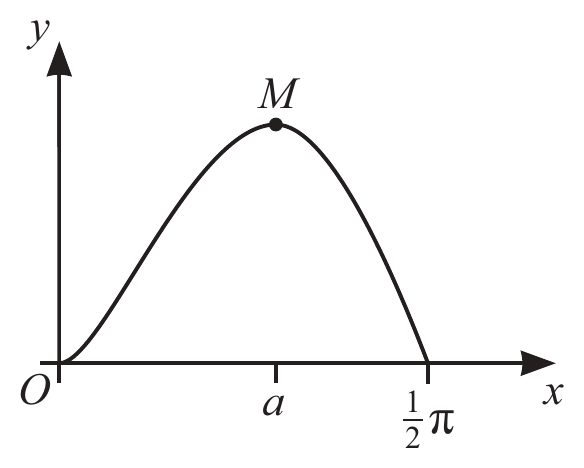
The diagram shows the curve for . The curve has a maximum point at , where .
(a) Show that
(b) Show by calculation that .
(c) Show that if a sequence of values given by the iterative formula
converges, then it converges to .
(d) Use the iterative formula in part (c) to calculate correct to decimal places. Give the result of each iteration to decimal places.
题目中文翻译
图中显示了曲线 ,其中 。曲线在点 处达到最大值,该点的 坐标为 。
(a) 证明 。
(b) 通过计算证明 。
(c) 证明:如果由迭代公式
给出的数值序列收敛,则它收敛于 。
(d) 使用 (c) 问中的迭代公式计算 ,答案精确到小数点后 位。每次迭代的结果保留小数点后 位。
原卷通用作答要求
Answer all questions. You should use a calculator where appropriate.
You must show all necessary working clearly; no marks will be given for unsupported answers from a calculator.
Give non-exact numerical answers correct to 3 significant figures, or 1 decimal place for angles in degrees, unless a different level of accuracy is specified in the question.
请回答所有题目。适当时应使用计算器。必须清楚展示所有必要的计算过程;仅给出计算器答案而没有过程,不予评分。除非题目另有精度要求,非精确数值答案保留 3 位有效数字,以度为单位的角度保留 1 位小数。
解答
(a)
解法一
思路
展开
用乘积法则求导,乘去根号分母后得到三角方程。除以余弦前说明它不可能在驻点为零。
答题过程
展开
For ,
At the maximum , the derivative is zero. Multiplying by gives
Here : otherwise and the left side would equal . Dividing by ,
(b)
解法一
思路
展开
用两边之差检查变号,确认区间内没有正切渐近线。
答题过程
展开
Let . Using radians,
The interval is to the right of , and is continuous on . The sign change gives a root there.
Moreover, for , cannot equal . For ,
so the root is unique. Hence .
(c)
解法一
思路
展开
对收敛序列取极限,再取正切恢复驻点方程。反正切主值保证极限落在正确的驻点区间。
答题过程
展开
If the sequence converges to , continuity gives
Thus
Taking tangents,
Since , the fixed-point equation first gives
In particular, , so . Substituting this sharper range into the same equation gives . By the uniqueness established in (b), .
(d)
解法一
思路
展开
用(b)的区间端点作为初值,迭代时保留完整精度,输出六位小数,直到四位小数稳定。
答题过程
展开
Starting with , use
in radians. The iterations are
| to 6 decimal places | |
|---|---|
| 0 | 0.900000 |
| 1 | 0.920872 |
| 2 | 0.917944 |
| 3 | 0.918347 |
| 4 | 0.918292 |
| 5 | 0.918300 |
| 6 | 0.918298 |
Thus to 4 decimal places.