题目
Problem
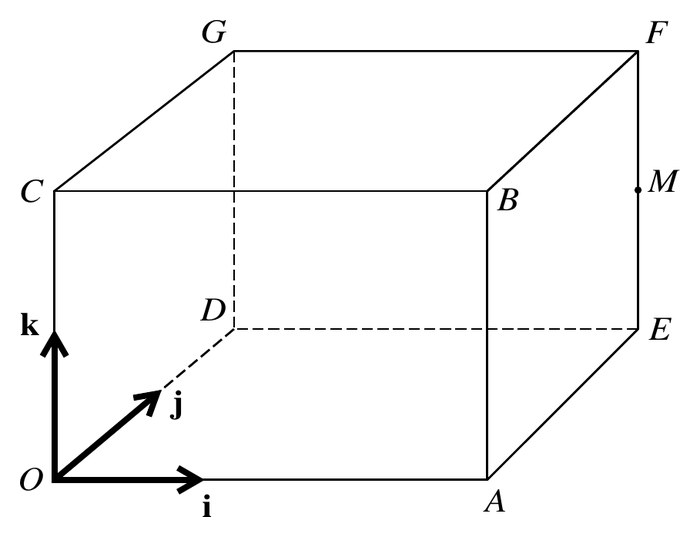
In the diagram, O A B C D E F G OABCDEFG O A B C D E F G O A = 3 OA=3 O A = 3 O C = 2 OC=2 O C = 2 O D = 2 OD=2 O D = 2 i \mathbf{i} i j \mathbf{j} j k \mathbf{k} k O A OA O A O D OD O D O C OC O C M M M E F EF E F
(a) Find the position vector of M M M
(1)
The position vector of P P P i + j + 2 k \mathbf{i}+\mathbf{j}+2\mathbf{k} i + j + 2 k
(b) Calculate angle P A M PAM P A M
(4)
(c) Find the exact length of the perpendicular from P P P O O O M M M
(5)
题目中文翻译
图中,O A B C D E F G OABCDEFG O A B C D E F G O A = 3 OA=3 O A = 3 O C = 2 OC=2 O C = 2 O D = 2 OD=2 O D = 2 i \mathbf{i} i j \mathbf{j} j k \mathbf{k} k O A OA O A O D OD O D O C OC O C M M M E F EF E F
(a) 求 M M M
(1)
P P P i + j + 2 k \mathbf{i}+\mathbf{j}+2\mathbf{k} i + j + 2 k
(b) 计算角 P A M PAM P A M
(4)
(c) 求从 P P P O O O M M M
(5)
原卷通用作答要求
Answer all questions. You should use a calculator where appropriate.
You must show all necessary working clearly; no marks will be given for unsupported answers from a calculator.
Give non-exact numerical answers correct to 3 significant figures, or 1 decimal place for angles in degrees, unless a different level of accuracy is specified in the question.
请回答所有题目。适当时应使用计算器。必须清楚展示所有必要的计算过程;仅给出计算器答案而没有过程,不予评分。除非题目另有精度要求,非精确数值答案保留 3 位有效数字,以度为单位的角度保留 1 位小数。
解答
(a)
解法一
思路
展开
根据三个单位向量的方向,写出 E E E F F F
答题过程
展开
The endpoints of E F EF E F
O E → = 3 i + 2 j , O F → = 3 i + 2 j + 2 k . \begin{align*}
\overrightarrow{OE}=&\,3\mathbf i+2\mathbf j,\\[4mm]
\overrightarrow{OF}=&\,3\mathbf i+2\mathbf j+2\mathbf k.
\end{align*} O E = O F = 3 i + 2 j , 3 i + 2 j + 2 k . Since M M M
O M → = 3 i + 2 j + k . \boxed{\overrightarrow{OM}=3\mathbf i+2\mathbf j+\mathbf k}. O M = 3 i + 2 j + k .
(b)
解法一
思路
展开
角的顶点是 A A A A P → \overrightarrow{AP} A P A M → \overrightarrow{AM} A M O P → \overrightarrow{OP} O P O M → \overrightarrow{OM} O M
答题过程
展开
Since O A → = 3 i \overrightarrow{OA}=3\mathbf i O A = 3 i
A P → = ( − 2 , 1 , 2 ) , A M → = ( 0 , 2 , 1 ) . \begin{align*}
\overrightarrow{AP}=&\,(-2,1,2),\\[4mm]
\overrightarrow{AM}=&\,(0,2,1).
\end{align*} A P = A M = ( − 2 , 1 , 2 ) , ( 0 , 2 , 1 ) . Thus
A P → ⋅ A M → = ( − 2 ) ( 0 ) + 1 ( 2 ) + 2 ( 1 ) = 4. \overrightarrow{AP}\cdot\overrightarrow{AM}
=(-2)(0)+1(2)+2(1)=4. A P ⋅ A M = ( − 2 ) ( 0 ) + 1 ( 2 ) + 2 ( 1 ) = 4. Also ∣ A P → ∣ = 3 |\overrightarrow{AP}|=3 ∣ A P ∣ = 3 ∣ A M → ∣ = 5 |\overrightarrow{AM}|=\sqrt5 ∣ A M ∣ = 5
∠ P A M = cos − 1 ( 4 3 5 ) ≈ 53.4 ∘ . \angle PAM=\cos^{-1}\bigg(\frac4{3\sqrt5}\bigg)
\approx\boxed{53.4^\circ}. ∠ P A M = cos − 1 ( 3 5 4 ) ≈ 53. 4 ∘ .
(c)
解法一
思路
展开
设垂足 Q Q Q O M OM O M λ ( 3 , 2 , 1 ) \lambda(3,2,1) λ ( 3 , 2 , 1 )
答题过程
展开
Let the foot of the perpendicular be Q Q Q
O Q → = λ ( 3 , 2 , 1 ) . \overrightarrow{OQ}=\lambda(3,2,1). O Q = λ ( 3 , 2 , 1 ) . Then
P Q → = ( 3 λ − 1 , 2 λ − 1 , λ − 2 ) . \overrightarrow{PQ}=(3\lambda-1,\,2\lambda-1,\,\lambda-2). P Q = ( 3 λ − 1 , 2 λ − 1 , λ − 2 ) . Since P Q ⊥ O M PQ\perp OM P Q ⊥ O M
3 ( 3 λ − 1 ) + 2 ( 2 λ − 1 ) + ( λ − 2 ) = 0 , 14 λ − 7 = 0. \begin{align*}
3(3\lambda-1)+2(2\lambda-1)+(\lambda-2)=&\,0,\\[4mm]
14\lambda-7=&\,0.
\end{align*} 3 ( 3 λ − 1 ) + 2 ( 2 λ − 1 ) + ( λ − 2 ) = 14 λ − 7 = 0 , 0. Thus λ = 1 / 2 \lambda=1/2 λ = 1/2
P Q → = ( 1 2 , 0 , − 3 2 ) . \overrightarrow{PQ}=\bigg(\frac12,0,-\frac32\bigg). P Q = ( 2 1 , 0 , − 2 3 ) . Therefore
P Q = 1 4 + 9 4 = 10 2 . \boxed{PQ=\sqrt{\frac14+\frac94}=\frac{\sqrt{10}}2}. P Q = 4 1 + 4 9 = 2 10 .
解法二
思路
展开
也可把 P P P
答题过程
展开
A general point Q Q Q O M OM O M λ ( 3 , 2 , 1 ) \lambda(3,2,1) λ ( 3 , 2 , 1 )
P Q 2 = ( 3 λ − 1 ) 2 + ( 2 λ − 1 ) 2 + ( λ − 2 ) 2 = 14 λ 2 − 14 λ + 6 = 14 ( λ − 1 2 ) 2 + 5 2 . \begin{align*}
PQ^2
=&\,(3\lambda-1)^2+(2\lambda-1)^2\\[4mm]
&\,\hspace{2pt}+(\lambda-2)^2\\[4mm]
=&\,14\lambda^2-14\lambda+6\\[4mm]
=&\,14\bigg(\lambda-\frac12\bigg)^2+\frac52.
\end{align*} P Q 2 = = = ( 3 λ − 1 ) 2 + ( 2 λ − 1 ) 2 + ( λ − 2 ) 2 14 λ 2 − 14 λ + 6 14 ( λ − 2 1 ) 2 + 2 5 . The minimum is 5 / 2 5/2 5/2 λ = 1 / 2 \lambda=1/2 λ = 1/2
5 2 = 10 2 . \boxed{\sqrt{\frac52}=\frac{\sqrt{10}}2}. 2 5 = 2 10 .
解法三
思路
展开
先用点积求 O P → \overrightarrow{OP} O P O M OM O M
答题过程
展开
A direction vector for O M OM O M d = ( 3 , 2 , 1 ) \mathbf d=(3,2,1) d = ( 3 , 2 , 1 ) ∣ d ∣ = 14 |\mathbf d|=\sqrt{14} ∣ d ∣ = 14 O P → = ( 1 , 1 , 2 ) \overrightarrow{OP}=(1,1,2) O P = ( 1 , 1 , 2 )
The projection length of O P → \overrightarrow{OP} O P O M OM O M
O P → ⋅ d ∣ d ∣ = 3 + 2 + 2 14 = 7 14 . \frac{\overrightarrow{OP}\cdot\mathbf d}{|\mathbf d|}
=\frac{3+2+2}{\sqrt{14}}=\frac7{\sqrt{14}}. ∣ d ∣ O P ⋅ d = 14 3 + 2 + 2 = 14 7 . Since O P 2 = 1 2 + 1 2 + 2 2 = 6 OP^2=1^2+1^2+2^2=6 O P 2 = 1 2 + 1 2 + 2 2 = 6
d 2 = 6 − ( 7 14 ) 2 = 6 − 7 2 = 5 2 . d^2=6-\bigg(\frac7{\sqrt{14}}\bigg)^2
=6-\frac72=\frac52. d 2 = 6 − ( 14 7 ) 2 = 6 − 2 7 = 2 5 . Therefore d = 10 / 2 \boxed{d=\sqrt{10}/2} d = 10 /2