
题目
(a) By sketching a suitable pair of graphs, show that the equation
has only one root.
(b) Show by calculation that this root lies between and .
(c) Show that, if a sequence of values given by the iterative formula
converges, then it converges to the root of the equation in (a).
(d) Use the iterative formula to calculate the root correct to decimal places. Give the result of each iteration to decimal places.
题目中文翻译
(a) 通过画出一组合适的两个函数图像的草图,证明方程
只有一个根。
(b) 通过计算证明此根位于 与 之间。
(c) 证明:如果由迭代公式
给出的数列收敛,那么它收敛于 (a) 问中方程的根。
(d) 使用此迭代公式计算此根,结果保留 位小数。每次迭代的结果保留 位小数。
原卷通用作答要求
Answer all questions. You should use a calculator where appropriate.
You must show all necessary working clearly; no marks will be given for unsupported answers from a calculator.
Give non-exact numerical answers correct to 3 significant figures, or 1 decimal place for angles in degrees, unless a different level of accuracy is specified in the question.
请回答所有题目。适当时应使用计算器。必须清楚展示所有必要的计算过程;仅给出计算器答案而没有过程,不予评分。除非题目另有精度要求,非精确数值答案保留 3 位有效数字,以度为单位的角度保留 1 位小数。
解答
(a)
解法一
思路
展开
画 与 ,注意前者定义域为 。指数曲线从较低处出发并最终超过根式曲线;交点右侧指数曲线的斜率始终更大,因此不会再相交。
答题过程
展开
Sketch for , starting at and increasing with decreasing gradient.
On the same axes sketch , passing through and , and increasing with increasing gradient. Mark their single intersection.
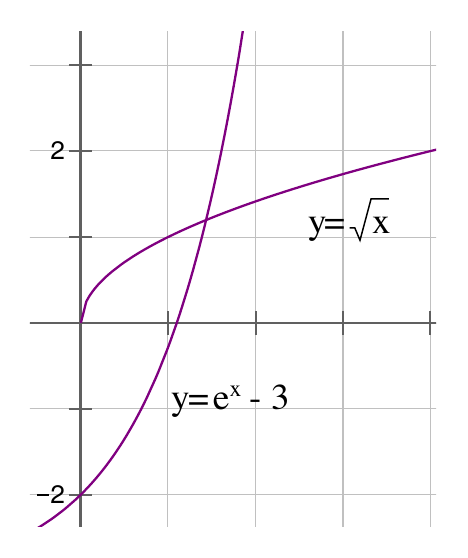
For , , so no intersection occurs there. For ,
Thus after the exponential curve rises faster throughout and eventually lies above . The two graphs therefore cross exactly once, so the equation has .
(b)
解法一
思路
展开
把方程移项成连续函数为零,在 、 处计算函数值并比较符号。
答题过程
展开
Let . Then
Since is continuous on , there is a root between and . By part (a), it is the only root.
(c)
解法一
思路
展开
若迭代收敛,连续函数作用后可取极限,极限在相邻两项中相同。把极限方程指数化,就得到(a)中的原方程。
答题过程
展开
Suppose . The real iterates have , so . By continuity of on ,
Exponentiating,
Thus the limit satisfies the equation in part (a), and so it is its unique root.
(d)
解法一
思路
展开
从区间内的值开始迭代,计算时保留精度,显示到四位小数,直到相邻结果稳定。
答题过程
展开
Starting with , use
Keeping unrounded values internally:
| to 4 decimal places | |
|---|---|
| 0 | 1.0000 |
| 1 | 1.3863 |
| 2 | 1.4297 |
| 3 | 1.4341 |
| 4 | 1.4345 |
| 5 | 1.4345 |
Hence the root is to 2 decimal places.