
题目
(a) By sketching a suitable pair of graphs, show that the equation has only one root.
(b) Show by calculation that this root lies between and .
(c) Use the iterative formula
to determine the root correct to decimal places. Give the result of each iteration to decimal places.
[ is an alternative notation for .]
题目中文翻译
(a) 通过画出一对合适的图像的草图,证明方程 只有一个根。
(b) 通过计算证明此根位于 与 之间。
(c) 使用迭代公式
求此根,结果保留 位小数。每次迭代的结果保留 位小数。
[ 是 的另一种记法。]
原卷通用作答要求
Answer all questions. You should use a calculator where appropriate.
You must show all necessary working clearly; no marks will be given for unsupported answers from a calculator.
Give non-exact numerical answers correct to 3 significant figures, or 1 decimal place for angles in degrees, unless a different level of accuracy is specified in the question.
请回答所有题目。适当时应使用计算器。必须清楚展示所有必要的计算过程;仅给出计算器答案而没有过程,不予评分。除非题目另有精度要求,非精确数值答案保留 3 位有效数字,以度为单位的角度保留 1 位小数。
解答
(a)
解法一
思路
展开
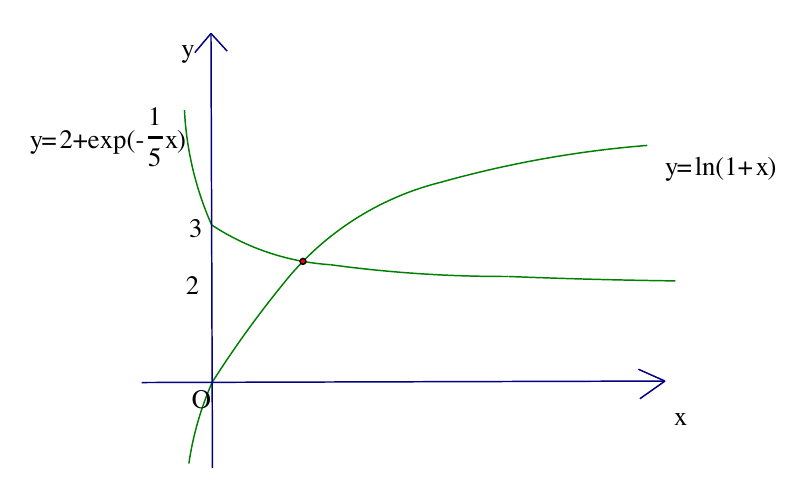
对数的定义域为 。在这整个定义域,一条曲线递增,另一条递减,且两端的上下关系交换。
答题过程
展开
Sketch and for .
The exponential curve decreases, passes through and has horizontal asymptote . The logarithmic curve increases, passes through and has vertical asymptote .
As , the logarithmic curve is below the exponential curve. As , it grows without bound while the exponential curve approaches .
Continuity gives an intersection, and the opposite strict monotonicity ensures that there is exactly one. Therefore the equation has .
(b)
解法一
思路
展开
构造两边之差并检查变号。
答题过程
展开
Let . Then
Since is continuous on , the sign change proves that the root lies in .
(c)
解法一
思路
展开
用区间内初值迭代,输出四位小数,内部保留完整精度。
答题过程
展开
Starting with , use
This gives
| to 4 decimal places | |
|---|---|
| 0 | 8.0000 |
| 1 | 8.0421 |
| 2 | 8.0268 |
| 3 | 8.0324 |
| 4 | 8.0304 |
| 5 | 8.0311 |
| 6 | 8.0308 |
| 7 | 8.0309 |
Hence the root is to 2 decimal places.