题目
Problem
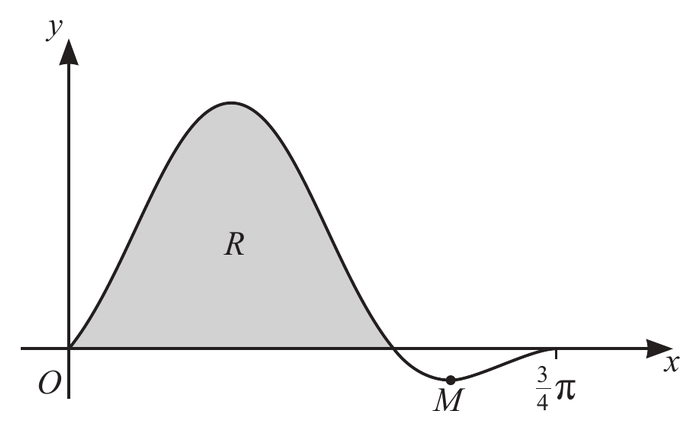
The diagram shows the curve y=sin2x(1+sin2x), for 0≤x≤43π, and its minimum point M. The shaded region bounded by the curve that lies above the x-axis and the x-axis itself is denoted by R.
(a) Given that the x-coordinate of M lies in the interval 21π<x<43π, find the exact coordinates of M.
(4)
(b) Find the exact area of the region R.
(4)
题目中文翻译
图中显示了曲线 y=sin2x(1+sin2x) 及其极小值点 M,其中 0≤x≤43π。由位于 x 轴上方的曲线部分与 x 轴围成的阴影区域记为 R。
(a) 已知 M 的 x 坐标位于区间 21π<x<43π 内,求 M 的精确坐标。
(4)
(b) 求区域 R 的精确面积。
(4)
原卷通用作答要求
Answer all questions. You should use a calculator where appropriate.
You must show all necessary working clearly; no marks will be given for unsupported answers from a calculator.
Give non-exact numerical answers correct to 3 significant figures, or 1 decimal place for angles in degrees, unless a different level of accuracy is specified in the question.
请回答所有题目。适当时应使用计算器。必须清楚展示所有必要的计算过程;仅给出计算器答案而没有过程,不予评分。除非题目另有精度要求,非精确数值答案保留 3 位有效数字,以度为单位的角度保留 1 位小数。
解答
(a)
解法一
思路
展开
乘积求导后因式分解,在指定开区间选驻点。再代回函数求纵坐标,并检查是最小值。
答题过程
展开
Differentiating,
dxdy==2cos2x(1+sin2x)+2sin2xcos2x2cos2x(1+2sin2x).
For π/2<x<3π/4, we have π<2x<3π/2, so cos2x is nonzero. Thus the stationary point satisfies
sin2x=−21.
In this interval, 2x=7π/6, giving x=7π/12. Then
y=−21(1−21)=−41.
Also y=s+s2=(s+1/2)2−1/4, with s=sin2x, so −1/4 is the minimum value. Therefore
M=(127π,−41).
(b)
解法一
思路
展开
阴影在横轴上方,对应 0 到 π/2。平方正弦用降幂公式积分。
答题过程
展开
The curve is above the horizontal axis for 0<x<π/2. For π/2<x<3π/4, it is below it, so only the first interval contributes to R.
Thus
A=====∫0π/2(sin2x+sin22x)dx∫0π/2(sin2x+21−21cos4x)dx[−21cos2x+2x−81sin4x]0π/221+4π+211+4π.
解法二
思路
展开
也可把原来的两个因式直接用于分部积分,再把剩下的平方余弦降幂。
答题过程
展开
As in the first method, the area is the integral over 0⩽x⩽π/2. Take u=1+sin2x and dv=sin2xdx. Then du=2cos2xdx and v=−21cos2x. Thus
A====[−21cos2x(1+sin2x)]0π/2+∫0π/2cos22xdx1+∫0π/221+cos4xdx1+[2x+81sin4x]0π/21+4π.
