
题目
(a) By sketching a suitable pair of graphs, show that the equation
has only one root in the interval .
(b) Show by calculation that this root lies between and .
(c) Show that if a sequence of values given by the iterative formula
converges, then it converges to the root of the equation in part (a).
(d) Use the iterative formula given in part (c) to calculate correct to decimal places. Give the result of each iteration to decimal places.
题目中文翻译
(a) 通过画出合适的两个函数图像的草图,证明方程
在区间 内只有一个根。
(b) 通过计算证明这个根位于 与 之间。
(c) 证明:若由迭代公式
给出的数列收敛,则它收敛于第 (a) 问中方程的根。
(d) 使用第 (c) 问中给出的迭代公式计算 ,答案精确到小数点后 位。每次迭代的结果保留小数点后 位。
原卷通用作答要求
Answer all questions. You should use a calculator where appropriate.
You must show all necessary working clearly; no marks will be given for unsupported answers from a calculator.
Give non-exact numerical answers correct to 3 significant figures, or 1 decimal place for angles in degrees, unless a different level of accuracy is specified in the question.
请回答所有题目。适当时应使用计算器。必须清楚展示所有必要的计算过程;仅给出计算器答案而没有过程,不予评分。除非题目另有精度要求,非精确数值答案保留 3 位有效数字,以度为单位的角度保留 1 位小数。
解答
(a)
解法一
思路
展开
正割在区间内有渐近线,必须分两段讨论。左段为正,不可能等于负指数;右段递增而负指数递减,只相交一次。
答题过程
展开
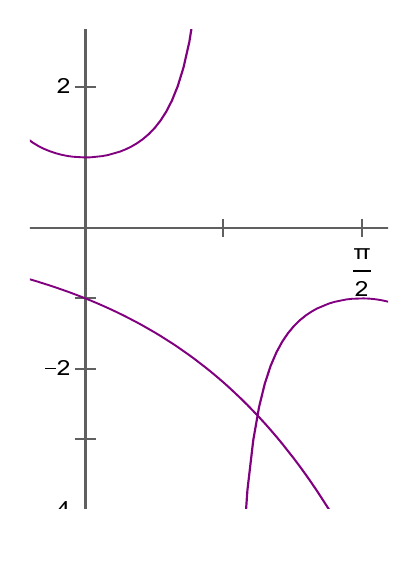
Sketch and on , marking the asymptote and their single intersection.
For , whereas , so there is no intersection.
For , increases from towards , whereas decreases. Just to the right of , the secant curve is below the exponential curve. Near , it is above it since .
By continuity and strict opposite monotonicity, there is exactly one intersection on this second interval. Hence there is .
解法二
思路
展开
把方程等价地变成余弦与负指数的交点问题,可避开正割的渐近线。两个函数在整个区间单调方向相反。
答题过程
展开
The equation is equivalent to
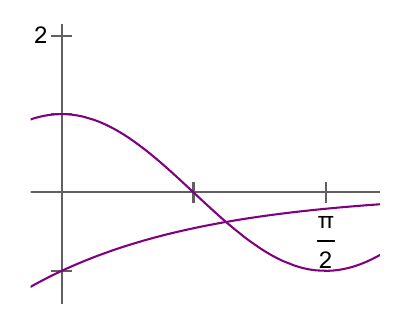
Sketch and for .
The cosine curve strictly decreases from towards , crossing the horizontal axis at . The other curve strictly increases from towards .
Near , ; near , . Thus the continuous curves intersect, and their strict opposite monotonicity gives exactly one intersection.
Therefore the original equation has in the stated interval.
(b)
解法一
思路
展开
计算两边之差并检查变号。这里只在不跨渐近线的闭区间上使用连续性。
答题过程
展开
Let . Using radians,
Since lies entirely to the right of , is continuous on this interval. The sign change therefore proves that the root lies in .
(c)
解法一
思路
展开
若迭代收敛,连续的迭代函数在极限处满足不动点方程。依次取余弦和倒数可恢复原方程。
答题过程
展开
If the sequence converges to , continuity of the iteration function gives
Hence
Taking reciprocals,
The fixed-point equation gives . The value would require , and would require ; both are impossible. Thus , so by (a) it is the unique required root.
(d)
解法一
思路
展开
取初值一,使用弧度制迭代。每步计算保留完整精度,表格输出五位小数。
答题过程
展开
Using and
the iterations are
| to 5 decimal places | |
|---|---|
| 0 | 1.00000 |
| 1 | 0.97376 |
| 2 | 0.97903 |
| 3 | 0.97796 |
| 4 | 0.97818 |
| 5 | 0.97813 |
| 6 | 0.97814 |
| 7 | 0.97814 |
Thus the root is to 3 decimal places.