
题目
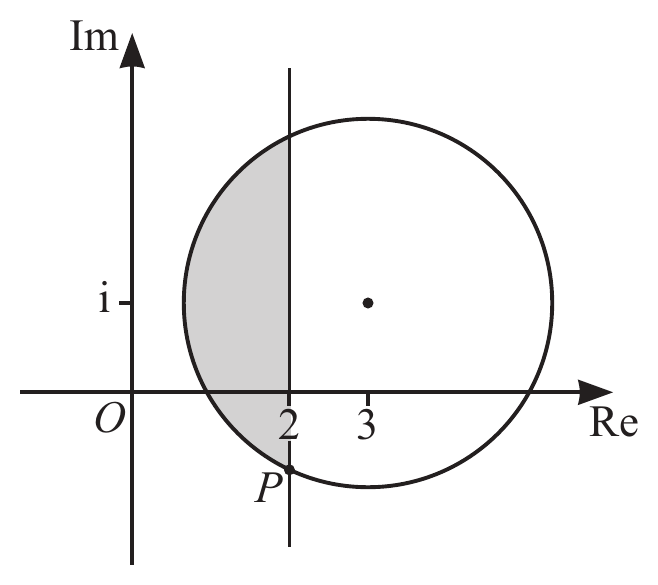
The shaded region in the Argand diagram, bounded by a line and a circle, represents the complex numbers satisfying
The point shown on the diagram is one of the points of intersection of the line and the circle.
(a) Find the complex number represented by the point . Give your answer in the form , where and are real and exact.
(b) Find the greatest value of for points in the shaded region.
题目中文翻译
Argand 图中以一条直线和一个圆为边界的阴影区域表示满足以下条件的复数 :
图中所示的点 是直线与圆的交点之一。
(a) 求点 所表示的复数。答案写成 的形式,其中 和 均为精确的实数。
(b) 求阴影区域内各点所对应的 的最大值。
原卷通用作答要求
Answer all questions. You should use a calculator where appropriate.
You must show all necessary working clearly; no marks will be given for unsupported answers from a calculator.
Give non-exact numerical answers correct to 3 significant figures, or 1 decimal place for angles in degrees, unless a different level of accuracy is specified in the question.
请回答所有题目。适当时应使用计算器。必须清楚展示所有必要的计算过程;仅给出计算器答案而没有过程,不予评分。除非题目另有精度要求,非精确数值答案保留 3 位有效数字,以度为单位的角度保留 1 位小数。
解答
(a)
解法一
思路
展开
圆与竖直线相交时实部为二,代入圆方程后选图中较低的交点。
答题过程
展开
Write . At the intersection with the line, , and
Thus , giving .
Since is the lower intersection, . Therefore
(b)
解法一
思路
展开
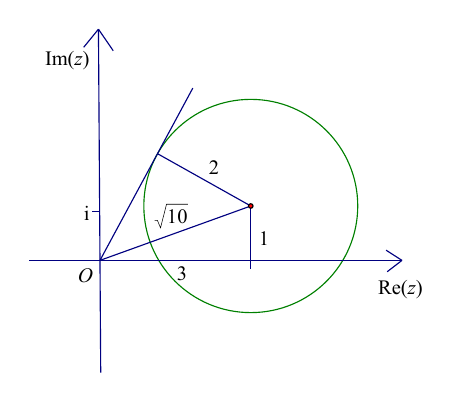
最大辐角对应从原点向圆作的上方切线。圆心连线与切线的夹角可由半径和圆心到原点的距离求出,并确认切点符合实部限制。
答题过程
展开
Let be the centre of the circle, and let be the upper point of tangency from .
Since and , the right triangle gives
Also . Thus the greatest angle subtended by the disk is
The upper tangency point has
so it belongs to the shaded region and the angle is attained there.
解法二
思路
展开
设过原点的切线斜率为 。与圆联立后只有一个交点,故二次方程判别式为零,选择上方切线。
答题过程
展开
Let the upper tangent from the origin be . Substituting into the circle,
so
For tangency, the discriminant is zero:
The upper tangent has
At the point of contact, the quadratic has a repeated root. Thus its point of contact has
so it is within the shaded region. Therefore