题目
Problem
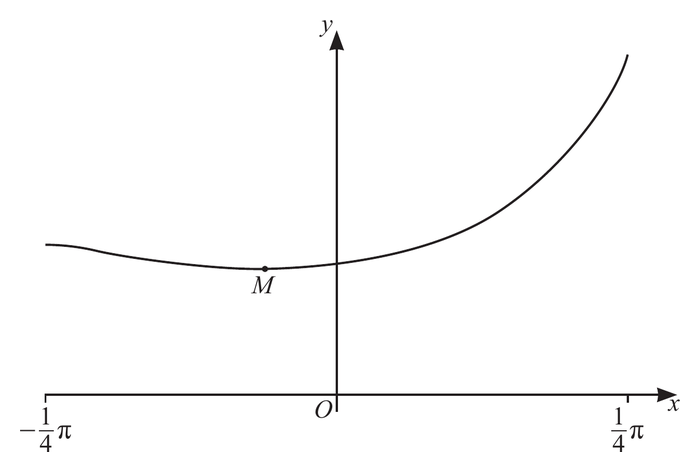
The diagram shows the graph of y = sec 2 x 3 + 2 tan x y=\sec^2x\sqrt{3+2\tan x} y = sec 2 x 3 + 2 tan x − 1 4 π ≤ x ≤ 1 4 π -\frac14\pi\le x\le\frac14\pi − 4 1 π ≤ x ≤ 4 1 π M M M
(a) Find the x x x M M M
(6)
(b) Using the substitution u = 3 + 2 tan x u=3+2\tan x u = 3 + 2 tan x x x x x = − 1 4 π x=-\frac14\pi x = − 4 1 π x = 1 4 π x=\frac14\pi x = 4 1 π
(6)
题目中文翻译
图中显示了 y = sec 2 x 3 + 2 tan x y=\sec^2x\sqrt{3+2\tan x} y = sec 2 x 3 + 2 tan x − 1 4 π ≤ x ≤ 1 4 π -\frac14\pi\le x\le\frac14\pi − 4 1 π ≤ x ≤ 4 1 π M M M
(a) 求 M M M x x x
(6)
(b) 使用换元 u = 3 + 2 tan x u=3+2\tan x u = 3 + 2 tan x x x x x = − 1 4 π x=-\frac14\pi x = − 4 1 π x = 1 4 π x=\frac14\pi x = 4 1 π
(6)
原卷通用作答要求
Answer all questions. You should use a calculator where appropriate.
You must show all necessary working clearly; no marks will be given for unsupported answers from a calculator.
Give non-exact numerical answers correct to 3 significant figures, or 1 decimal place for angles in degrees, unless a different level of accuracy is specified in the question.
请回答所有题目。适当时应使用计算器。必须清楚展示所有必要的计算过程;仅给出计算器答案而没有过程,不予评分。除非题目另有精度要求,非精确数值答案保留 3 位有效数字,以度为单位的角度保留 1 位小数。
解答
(a)
解法一
思路
展开
乘积求导后约去恒正因子,得到关于 tan x \tan x tan x
答题过程
展开
The factor derivatives are
d d x ( sec 2 x ) = 2 sec 2 x tan x , d d x 3 + 2 tan x = sec 2 x 3 + 2 tan x . \begin{align*}
\frac{\mathrm{d}}{\mathrm{d}x}(\sec^2x)
=&\,2\sec^2x\tan x,\\[4mm]
\frac{\mathrm{d}}{\mathrm{d}x}\sqrt{3+2\tan x}
=&\,\frac{\sec^2x}{\sqrt{3+2\tan x}}.
\end{align*} d x d ( sec 2 x ) = d x d 3 + 2 tan x = 2 sec 2 x tan x , 3 + 2 tan x sec 2 x . Using the product rule,
d y d x = 2 sec 2 x tan x 3 + 2 tan x + sec 4 x 3 + 2 tan x = sec 2 x 3 + 2 tan x × [ 2 tan x ( 3 + 2 tan x ) + sec 2 x ] . \begin{align*}
\frac{\mathrm{d}y}{\mathrm{d}x}
=&\,2\sec^2x\tan x\sqrt{3+2\tan x}\\
&\,\hspace{2pt}+\frac{\sec^4x}{\sqrt{3+2\tan x}}\\
=&\,\frac{\sec^2x}{\sqrt{3+2\tan x}}\\[4mm]
&\,\hspace{2pt}\times\big[2\tan x(3+2\tan x)+\sec^2x\big].
\end{align*} d x d y = = 2 sec 2 x tan x 3 + 2 tan x + 3 + 2 tan x sec 4 x 3 + 2 tan x sec 2 x × [ 2 tan x ( 3 + 2 tan x ) + sec 2 x ] . Throughout the interval, 3 + 2 tan x ⩾ 1 3+2\tan x\geqslant1 3 + 2 tan x ⩾ 1 sec 2 x = 1 + tan 2 x \sec^2x=1+\tan^2x sec 2 x = 1 + tan 2 x
5 tan 2 x + 6 tan x + 1 = 0 , 5\tan^2x+6\tan x+1=0, 5 tan 2 x + 6 tan x + 1 = 0 , or
( 5 tan x + 1 ) ( tan x + 1 ) = 0. (5\tan x+1)(\tan x+1)=0. ( 5 tan x + 1 ) ( tan x + 1 ) = 0. The value tan x = − 1 \tan x=-1 tan x = − 1 x = − π / 4 x=-\pi/4 x = − π /4
x = − tan − 1 1 5 = − 0.197395 … . x=-\tan^{-1}\frac15=-0.197395\ldots. x = − tan − 1 5 1 = − 0.197395 … . For − 1 < tan x < − 1 / 5 -1<\tan x<-1/5 − 1 < tan x < − 1/5 − 1 / 5 < tan x < 1 -1/5<\tan x<1 − 1/5 < tan x < 1 M M M
x M = − 0.197 radians . \boxed{x_M=-0.197\text{ radians}}. x M = − 0.197 radians .
(b)
解法一
思路
展开
指定换元的导数正好包含 sec 2 x \sec^2x sec 2 x u u u
答题过程
展开
Let u = 3 + 2 tan x u=3+2\tan x u = 3 + 2 tan x
d u = 2 sec 2 x d x . \mathrm{d}u=2\sec^2x\,\mathrm{d}x. d u = 2 sec 2 x d x . The limits become
x = − π 4 ⟹ u = 1 , x = π 4 ⟹ u = 5. x=-\frac\pi4\ \Longrightarrow\ u=1,
\qquad
x=\frac\pi4\ \Longrightarrow\ u=5. x = − 4 π ⟹ u = 1 , x = 4 π ⟹ u = 5. The curve is positive throughout the interval, so the required area is
A = ∫ − π / 4 π / 4 sec 2 x 3 + 2 tan x d x = 1 2 ∫ 1 5 u 1 / 2 d u = [ 1 3 u 3 / 2 ] 1 5 = 5 5 − 1 3 . \begin{align*}
A=&\,\int_{-\pi/4}^{\pi/4}
\sec^2x\sqrt{3+2\tan x}\,\mathrm{d}x\\
=&\,\frac12\int_1^5u^{1/2}\,\mathrm{d}u\\
=&\,\bigg[\frac13u^{3/2}\bigg]_1^5\\
=&\,\boxed{\frac{5\sqrt5-1}{3}}.
\end{align*} A = = = = ∫ − π /4 π /4 sec 2 x 3 + 2 tan x d x 2 1 ∫ 1 5 u 1/2 d u [ 3 1 u 3/2 ] 1 5 3 5 5 − 1 .