
题目
The populations of 150 villages in the UK, to the nearest hundred, are summarised in the table.
| Population | 100–800 | 900–1200 | 1300–2000 | 2100–3200 | 3300–4800 |
|---|---|---|---|---|---|
| Number of villages | 8 | 12 | 50 | 48 | 32 |
(a) Draw a histogram to represent this information.
(b) Write down the class interval which contains the median for this information.
(c) Find the greatest possible value of the interquartile range for the populations of the 150 villages.
题目中文翻译
英国 150 个村庄的人口数(四舍五入到最接近的百位)汇总于下表。
| 人口数 | 100–800 | 900–1200 | 1300–2000 | 2100–3200 | 3300–4800 |
|---|---|---|---|---|---|
| 村庄数 | 8 | 12 | 50 | 48 | 32 |
(a) 画一幅直方图表示这些数据。
(b) 写出这些数据的中位数所在的组区间。
(c) 求这 150 个村庄人口数的四分位距可能的最大值。
原卷通用作答要求
Answer all questions. You should use a calculator where appropriate.
You must show all necessary working clearly; no marks will be given for unsupported answers from a calculator.
Give non-exact numerical answers correct to 3 significant figures, or 1 decimal place for angles in degrees, unless a different level of accuracy is specified in the question.
请回答所有题目。适当时应使用计算器。必须清楚展示所有必要的计算过程;仅给出计算器答案而没有过程,不予评分。除非题目另有精度要求,非精确数值答案保留 3 位有效数字,以度为单位的角度保留 1 位小数。
解答
(a)
解法一
思路
展开
人口记录到最近百位,连续组界应减加50;组距不等,柱高用频数密度。
答题过程
展开
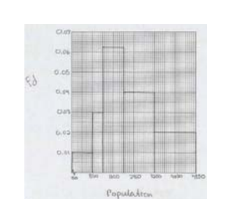
The continuous class boundaries and frequency densities are
| Population interval | Class width | Frequency density |
|---|---|---|
Draw adjoining bars over these intervals with the stated densities as heights. Label the axes “Population” and “Frequency density”, using linear scales.
(b)
解法一
思路
展开
累计人数依次8、20、70、118、150,中位数第75、76项均落在第四组。
答题过程
展开
The cumulative frequencies are . The 75th and 76th villages lie in the fourth class, so the median class is 2100–3200.
(c)
解法一
思路
展开
先找下、上四分位数组,为使差最大,应取上四分位数最大、下四分位数最小的整数人口。
答题过程
展开
The lower quartile lies in the third class and the upper quartile in the fourth class.
The smallest actual population in the third class is 1250, while the largest integer population in the fourth class is 3249. Thus the greatest possible interquartile range is