
题目
Chen has three boxes. Box contains 5 counters, of which 3 are white and 2 are yellow. Box contains 4 red marbles and 3 blue marbles. Box contains 5 red marbles and 3 blue marbles.
Chen chooses one counter at random from box . If the counter is white, he chooses two marbles from box , at random and without replacement. If the counter is yellow, he chooses two marbles from box , at random and without replacement.
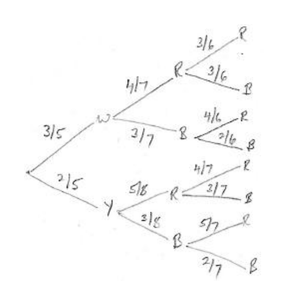
(a) Draw a fully labelled tree diagram to illustrate this information, including all the probabilities.
(b) Find the probability that one red marble and one blue marble are obtained.
(c) Find the probability that a white counter is chosen from box , given that one red marble and one blue marble are obtained.
题目中文翻译
Chen 有三个盒子。盒 内有 5 个筹码,其中 3 个为白色,2 个为黄色。盒 内有 4 颗红色弹珠和 3 颗蓝色弹珠。盒 内有 5 颗红色弹珠和 3 颗蓝色弹珠。
Chen 从盒 中随机取出一个筹码。若筹码为白色,他便从盒 中随机取出两颗弹珠且不放回;若筹码为黄色,他便从盒 中随机取出两颗弹珠且不放回。
(a) 画出标注完整的树状图表示这些信息,并标明所有概率。
(b) 求取到一颗红色弹珠和一颗蓝色弹珠的概率。
(c) 已知取到一颗红色弹珠和一颗蓝色弹珠,求从盒 中取出白色筹码的概率。
原卷通用作答要求
Answer all questions. You should use a calculator where appropriate.
You must show all necessary working clearly; no marks will be given for unsupported answers from a calculator.
Give non-exact numerical answers correct to 3 significant figures, or 1 decimal place for angles in degrees, unless a different level of accuracy is specified in the question.
请回答所有题目。适当时应使用计算器。必须清楚展示所有必要的计算过程;仅给出计算器答案而没有过程,不予评分。除非题目另有精度要求,非精确数值答案保留 3 位有效数字,以度为单位的角度保留 1 位小数。
解答
(a)
解法一
思路
展开
第一层表示所取的白或黄筹码,决定后两次使用的盒子。两颗弹珠不放回,第二次的数量需要按第一颗颜色更新。
答题过程
展开
Start with white counter, W, of probability , or yellow counter, Y, of probability .
- After W, use box W: first marble R with probability , or B with probability . After R, the second probabilities are R and B ; after B, they are R and B .
- After Y, use box Y: first marble R with probability , or B with probability . After R, the second probabilities are R and B ; after B, they are R and B .
The fully labelled tree is:
(b)
解法一
思路
展开
一红一蓝可能按红蓝或蓝红的次序出现,且可以来自白筹码或黄筹码分支,共四条互斥路径。
答题过程
展开
(c)
解法一
思路
展开
分子只包括白筹码下的一红一蓝两条路径,分母则是(b)中全部一红一蓝的概率。
答题过程
展开
Let denote obtaining one red marble and one blue marble. From (b),
Therefore,