
题目
A project is modelled by the activity network shown in Figure 5. The activities are represented by the arcs. The number in brackets on each arc gives the time required, in hours, to complete the corresponding activity. The numbers in circles are the event numbers.
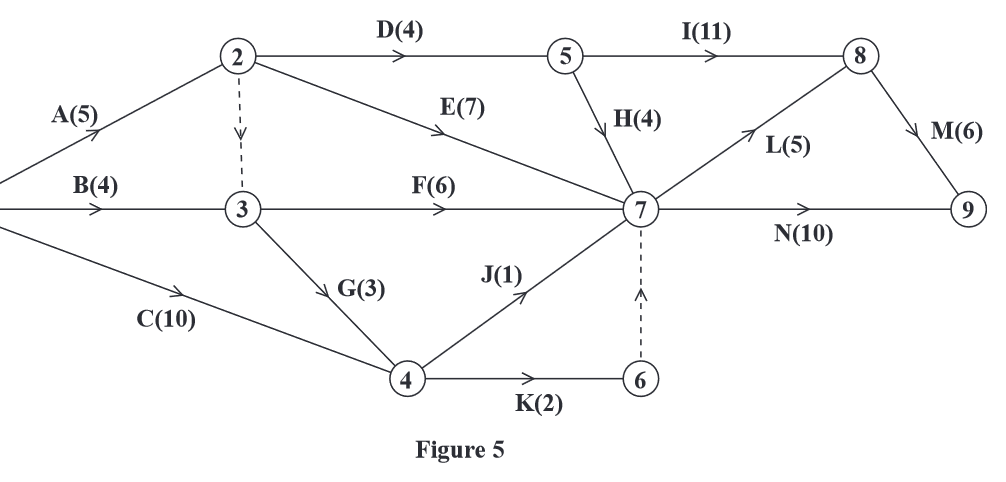
(a) Explain the significance of the dummy activity
(i) from event 2 to event 3
(ii) from event 6 to event 7
(b) Complete Diagram 1 in the answer book to show the early event times and the late event times.
(c) State the minimum project completion time and list the critical activities.
The duration of activity H changes to x hours.
(d) Find, in terms of x where necessary,
(i) the possible new early event time for event 7
(ii) the possible new late event time for event 7
Given that the duration of activity H is such that the minimum project completion time is four hours greater than the time found in (c),
(e) determine the value of x.
(Total 12 marks)
题目中文翻译
一个项目由图 5 所示的活动网络建模。活动用弧表示。每条弧上括号中的数字表示完成相应活动所需的时间(单位:小时)。圆圈中的数字是事件编号。
(a) 解释虚活动的意义
(i) 从事件 2 到事件 3
(ii) 从事件 6 到事件 7
(b) 完成答案册中的 Diagram 1,显示最早事件时间和最晚事件时间。
(c) 说明最短项目完成时间并列出关键活动。
活动 H 的持续时间变为 x 小时。
(d) 用 x 表示(必要时),求
(i) 事件 7 可能的新最早事件时间
(ii) 事件 7 可能的新最晚事件时间
已知活动 H 的持续时间使得最短项目完成时间比 (c) 中找到的时间长四小时,
(e) 求 x 的值。
解答
(a)(i)
解法一
思路
展开
F、G 都从事件 3 开始,因此它们必须等待 A、B 完成;但 D、E 从事件 2 开始,只依赖 A。虚活动把 A 的完成状态传至事件 3,而不会错误地使 D、E 依赖 B。
答题过程
展开
The dummy from event 2 to event 3 ensures that activities and depend on both and , while activities and depend on only.
(a)(ii)
解法一
思路
展开
J、K 都从事件 4 开始。如果 K 也直接结束于事件 7,J 与 K 就会具有相同的开始和结束事件,无法由事件编号唯一识别。让 K 先结束于事件 6,再以虚活动连至事件 7,可保持两项活动不同。
答题过程
展开
The dummy from event 6 to event 7 distinguishes activities and . Without it, both activities would have the same start and finish events.
(b)
解法一
思路
展开
正向扫描时,每个事件取所有进入活动的“前一事件最早时间加活动工期”之最大值;反向扫描时,从项目结束事件开始,每个事件取所有离开活动的“后一事件最晚时间减活动工期”之最小值。虚活动工期取 0。
答题过程
展开
The completed event times are:
| Event | Early event time | Late event time |
|---|---|---|
| 1 | 0 | 0 |
| 2 | 5 | 5 |
| 3 | 5 | 9 |
| 4 | 10 | 13 |
| 5 | 9 | 9 |
| 6 | 12 | 15 |
| 7 | 13 | 15 |
| 8 | 20 | 20 |
| 9 | 26 | 26 |
For example, the early event time at event 7 is
and its late event time is
(c)
解法一
思路
展开
结束事件 9 的最早时间就是最短项目完成时间。关键路线经过最早时间与最晚时间相等的事件 ,对应活动 A、D、I、M。
答题过程
展开
The minimum project completion time is
The critical activities are
(d)(i)
解法一
思路
展开
只有从事件 5 经 H 到事件 7 的进入时间会改变,为 。其他进入路线中最大的时间仍为 12,因此事件 7 的新最早时间取 与 中较大者。
答题过程
展开
The two possible controlling values are and . Hence the new early event time at event 7 is
(d)(ii)
解法一
思路
展开
若原来的项目完成时间仍由 A-D-I-M 控制,事件 7 的最晚时间仍为 15;若含 H 的路线成为控制路线,项目完成时间随 增加,反向计算会使事件 7 的最晚时间变为 。
答题过程
展开
The possible new late event times at event 7 are
(e)
解法一
思路
展开
新的完成时间为 。受 H 影响并延伸至终点的最长路线在 H 前用时 9 小时,在 H 后经 L、M 还需 小时,所以总时间为 。
答题过程
展开
The new minimum completion time is
The route controlled by has duration
Therefore
giving