
题目
The table above shows the activities required for the completion of a building project. For each activity the table shows the duration, in days, and the immediately preceding activities. Each activity requires one worker. The project is to be completed in the shortest possible time.
| Activity | Duration (days) | Immediately preceding activities |
|---|---|---|
| A | 4 | – |
| B | 7 | – |
| C | 6 | – |
| D | 10 | A |
| E | 5 | A |
| F | 7 | C |
| G | 6 | B, C, E |
| H | 6 | B, C, E |
| I | 7 | B, C, E |
| J | 9 | D, H |
| K | 8 | B, C, E |
| L | 4 | F, G, K |
| M | 6 | F, G, K |
| N | 7 | F, G |
| P | 5 | M, N |
Figure 2 shows a partially completed activity network used to model the project. The activities are represented by the arcs and the numbers in brackets on the arcs are the times taken, in days, to complete each activity.
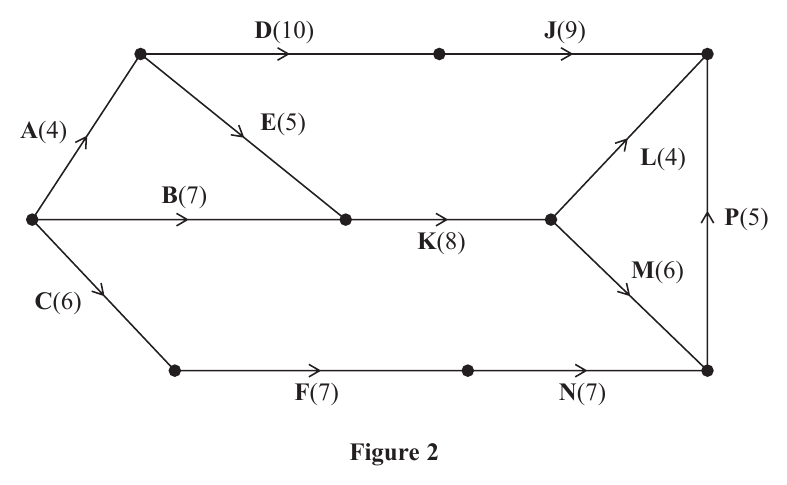
(a) Complete the network in Diagram 1 in the answer book by adding activities G, H and I and the minimum number of dummies.
(b) Add the early event times and the late event times to Diagram 1 in the answer book.
(c) State the critical activities.
(d) Calculate a lower bound for the number of workers needed to complete the project in the shortest possible time. You must show your working.
(e) Schedule the activities on Grid 1 in the answer book, using the minimum number of workers, so that the project is completed in the minimum time.
题目中文翻译
上表显示了完成建筑项目所需的活动。对于每项活动,表显示了持续时间(单位:天)和紧前活动。每项活动需要一名工人。项目应在最短时间内完成。
| 活动 | 持续时间(天) | 紧前活动 |
|---|---|---|
| A | 4 | – |
| B | 7 | – |
| C | 6 | – |
| D | 10 | A |
| E | 5 | A |
| F | 7 | C |
| G | 6 | B, C, E |
| H | 6 | B, C, E |
| I | 7 | B, C, E |
| J | 9 | D, H |
| K | 8 | B, C, E |
| L | 4 | F, G, K |
| M | 6 | F, G, K |
| N | 7 | F, G |
| P | 5 | M, N |
图 2 显示了用于模拟项目的部分完成的活动网络。活动由弧表示,弧上括号内的数字是完成每项活动所需的时间(单位:天)。
(a) 通过添加活动 G、H、I 和最少数量的虚活动,完成答案本中图 1 的网络。
(b) 将最早事件时间和最迟事件时间添加到答案本中图 1。
(c) 写出关键活动。
(d) 计算在最短时间内完成项目所需的工人数量的下界。必须展示计算过程。
(e) 在答案本的网格 1 上安排活动,使用最少数量的工人,使项目在最短时间内完成。
解答
(a)
解法一
思路
展开
都要等待 ,因此需要先让这三项紧前活动汇合。已有图中 在同一事件结束,所以用一个虚活动把 的完成也接入该事件,再从此事件画出 。此外, 同时以 为紧前活动,因此还需第二个虚活动把 的完成事件接到 的完成事件。
答题过程
展开
Add a dummy activity from the end of to the event at which and finish. Activities , and then begin from this common event, each with its stated duration.
Add a second dummy activity from the event at which and finish to the event at which finishes. This ensures that both and have , and as their immediate predecessors.
The completed network, together with the event times used in part (b), is:
(b)
解法一
思路
展开
先从起点 0 做 forward pass,在汇合事件取最大值;项目最早完成时间为 28。再从终点 28 做 backward pass,在分支事件取最小值。虚活动工期为 0,但其先后约束必须参与计算。
答题过程
展开
Using a forward pass and then a backward pass gives:
| Event position | Early event time | Late event time |
|---|---|---|
| Start | ||
| End of | ||
| End of | ||
| End of and first dummy | ||
| End of | ||
| End of | ||
| End of and second dummy | ||
| End of | ||
| Finish |
Therefore the minimum project completion time is
(c)
解法一
思路
展开
关键活动的总浮时为 0。根据 (b) 的最早、最迟事件时间,沿零浮时路线从起点追踪到终点即可得到所有关键活动。
答题过程
展开
The zero-float route is
Hence the critical activities are
(d)
解法一
思路
展开
每项活动需要一名工人,所以先把所有活动工期相加,得到总工作量,再除以必须完成项目的 28 天。工人数必须是整数,因此最后向上取整。
答题过程
展开
The total amount of work is
Therefore a lower bound for the number of workers is
and hence the lower bound is
(e)
解法一
思路
展开
将关键活动 固定在第一名工人上,再把其余活动分配给另外三名工人。每项活动的开始时间既不能早于所有紧前活动完成的时间,也不能与同一工人的其他活动重叠。下面的排程使用恰好 4 名工人,并在第 28 天完成,因此达到 (d) 的下界。
答题过程
展开
One valid schedule is:
| Worker | Activity schedule |
|---|---|
| 1 | , , , , |
| 2 | , , , |
| 3 | , , , |
| 4 | , |
Every activity starts after all its immediate predecessors have finished, and no worker is assigned overlapping activities. The project finishes at time using four workers.
The corresponding schedule is: