题目
Problem
Figure 5 shows the constraints of a linear programming problem in x and y, where R is the feasible region. The equations of two of the lines and the three intersection points, A, B and C, are shown. The coordinates of C are (435,415).
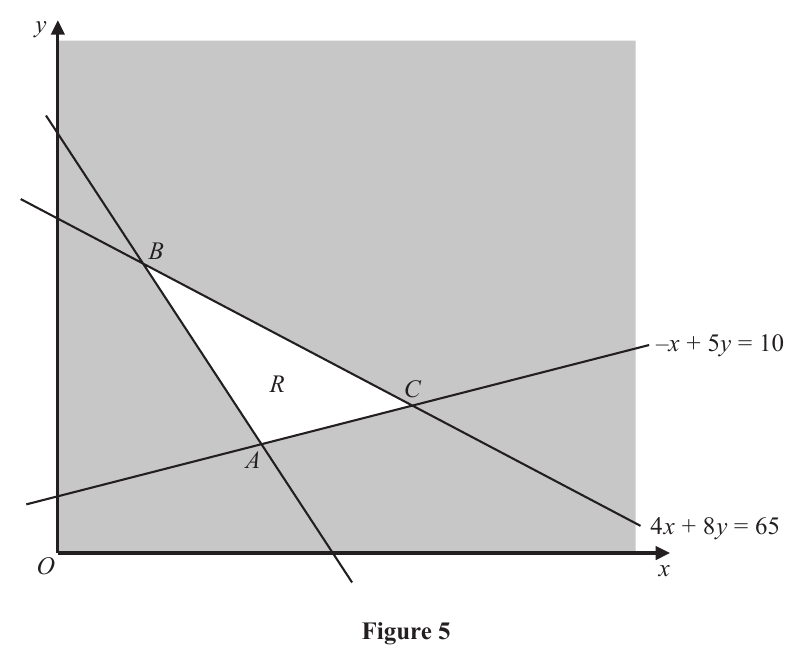
The objective function is P=x+3y.
When the objective is to maximise x+3y, the value of P is 24.
When the objective is to minimise x+3y, the value of P is 10.
(a) (i) Find the coordinates of A and B.
(ii) Determine the inequalities that define R.
(8)
An additional constraint, y≥kx, where k is a positive constant, is added to the linear programming problem.
(b) Determine the greatest value of k for which this additional constraint does not affect the feasible region.
(2)
题目中文翻译
图 5 显示了 x 和 y 的线性规划问题的约束条件,其中 R 是可行域。图中显示了两条直线的方程和三个交点 A、B 和 C。C 的坐标为 (435,415)。
目标函数为 P=x+3y。
当目标是最大化 x+3y 时,P 的值为 24。
当目标是最小化 x+3y 时,P 的值为 10。
(a) (i) 找到 A 和 B 的坐标。
(ii) 确定定义 R 的不等式。
一个附加约束 y≥kx(其中 k 是正常数)被添加到线性规划问题中。
(b) 确定 k 的最大值,使得此附加约束不影响可行域。
解答
(a)(i)
解法一
思路
展开
目标函数在可行域顶点取得极值。图中 A 位于直线 −x+5y=10 上,且在 A 取得最小值 10;B 位于直线 4x+8y=65 上,且在 B 取得最大值 24。因此分别把两点代入 x+3y=10 与 x+3y=24,解两组联立方程。
答题过程
展开
Let A=(a1,a2). Since the minimum value of x+3y is 10 at A,
a1+3a2=−a1+5a2=10,10.
Adding the equations gives 8a2=20, so
a2=25,a1=25.
Let B=(b1,b2). Since the maximum value of x+3y is 24 at B,
b1+3b2=4b1+8b2=24,65.
Substituting b1=24−3b2 into the second equation,
4(24−3b2)+8b2=65,
so b2=431 and b1=43. Hence
A=B=(25,25),(43,431).
(a)(ii)
解法一
思路
展开
第三条边界线通过 A、B,先由两点求斜率与方程。然后在三条边界各取可行域内部一点判断不等号方向;从图形也可看出 R 位于上升直线的上方,并位于另外两条下降直线的相应一侧。
答题过程
展开
The gradient of the line through A and B is
43−25431−25=−47421=−3.
Therefore its equation is
y−25=−3(x−25),
or
3x+y=10.
Using the position of the feasible region relative to each boundary, the inequalities defining R are
3x+y⩾−x+5y⩾4x+8y⩽10,10,65.
(b)
解法一
思路
展开
约束 y≥kx 表示可行点必须位于过原点、斜率为 k 的直线上方。要使它不削去 R 的任何部分,最大斜率的边界线应刚好通过 R 中 y/x 最小的顶点 C。
答题过程
展开
At the greatest possible value of k, the line y=kx passes through
C=(435,415).
Thus
k=435415=73.