题目
Problem
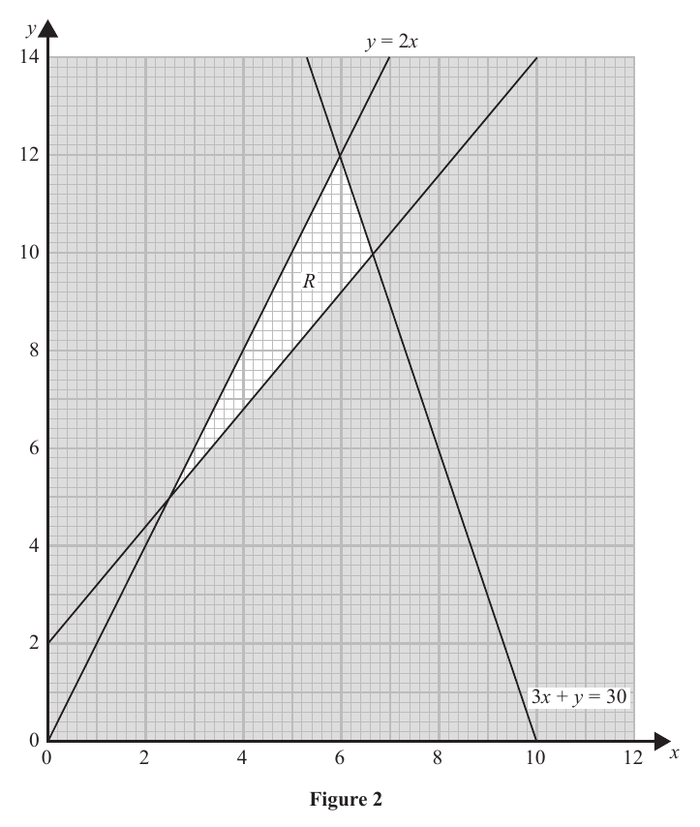
Figure 2 shows the constraints of a linear programming problem in x and y, where R is the feasible region. The equations of two of the lines are shown on the graph.
(a) Determine the inequalities that define the feasible region.
(3)
(b) Find the exact coordinates of the vertices of the feasible region.
(3)
The objective is to maximise P, where P=2x+ky.
(c) For the case k=3, use the point testing method to find the optimal vertex of the feasible region and state the corresponding value of P.
(3)
(d) Determine the range of values for k for which the optimal vertex found in (c) is still optimal.
(2)
题目中文翻译
图 2 显示了 x 和 y 的线性规划问题的约束条件,其中 R 是可行域。图上显示了两条直线的方程。
(a) 确定定义可行域的不等式。
(3)
(b) 找到可行域顶点的确切坐标。
(3)
目标是最大化 P,其中 P=2x+ky。
(c) 对于 k=3 的情况,使用点测试法找到可行域的最优顶点,并写出相应的 P 值。
(3)
(d) 确定 k 的取值范围,使得 (c) 中找到的最优顶点仍然是最优的。
(2)
解答
(a)
解法一
思路
展开
从阴影区域相对三条边界的位置判断不等号方向。第三条直线经过图上的 (0,2) 与 (10,14);先由两点式求其方程,再代入可行域内一点判断应取直线的哪一侧。
答题过程
展开
From the graph, the feasible region lies below y=2x and below 3x+y=30. Thus
y≤2x
and
3x+y≤30.
For the third boundary, using the points (0,2) and (10,14) gives
14−2y−2=10x.
Simplifying,
5y=6x+10.
The feasible region lies above this line, so the inequalities are
y≤2x,3x+y≤30,5y≥6x+10.
(b)
解法一
思路
展开
可行域的三个顶点分别是三对边界直线的交点。联立对应的两条直线,并保留精确分数形式。
答题过程
展开
First, y=2x and 3x+y=30 give
3x+2x=30,
so the first vertex is
(x,y)=(6,12).
Next, y=2x and 5y=6x+10 give
10x=6x+10,
so
(x,y)=(25,5).
Finally, 3x+y=30 and 5y=6x+10 give
5(30−3x)=6x+10,
so x=320 and y=10. Therefore the vertices are
(6,12),(25,5),(320,10).
(c)
解法一
思路
展开
当 k=3 时,目标函数为 P=2x+3y。点测试法要求把可行域的三个顶点逐一代入,再比较所得目标函数值。
答题过程
展开
For k=3, the objective is P=2x+3y. Testing the three vertices gives
======P(25,5)2(25)+3(5)20,P(320,10)2(320)+3(10)3130,P(6,12)2(6)+3(12)48.
Therefore the optimal vertex and maximum value are
(6,12) and P=48.
(d)
解法一
思路
展开
要使 (6,12) 继续最优,只需将它的目标函数值与相邻竞争顶点 (320,10) 比较。两者相等时是临界值;题目允许该顶点仍为并列最优,所以端点应包含。
答题过程
展开
For (6,12) to remain optimal,
≥2(6)+12k2(320)+10k.
Hence
12+12k≥340+10k,
so
2k≥34.
Therefore
k≥32.
解法二
思路
展开
比较目标线与顶点两侧边界的斜率。先排除 k≤0:从 (6,12) 沿 3x+y=30 向右下方移动时,x 增大、y 减小,目标值会增大。对于 k>0,目标线斜率为 −2/k;要使 (6,12) 最优,斜率应在两侧边界的斜率 −3 与 2 之间。目标线斜率为负,因此只需处理与 −3 的比较;平行于边界时该顶点仍为并列最优。
答题过程
展开
If k≤0, moving from (6,12) towards (320,10) increases x and decreases y, so 2x+ky increases. Thus (6,12) cannot be optimal in this case.
For k>0, the objective line is
y=−k2x+kP,
with gradient −2/k. The two boundaries meeting at (6,12) have gradients −3 and 2.
For this vertex to remain optimal, the objective gradient must satisfy
−3≤−k2≤2.
Since k>0, the second inequality is automatic. Multiplying the first inequality by the positive number k gives
−3k≤−2,
so
k≥32.
At k=32, the objective line is parallel to 3x+y=30, so (6,12) is still an optimal vertex.
