题目
Problem
Figure 4 shows the constraints of a linear programming problem in x and y, where R is the feasible region.
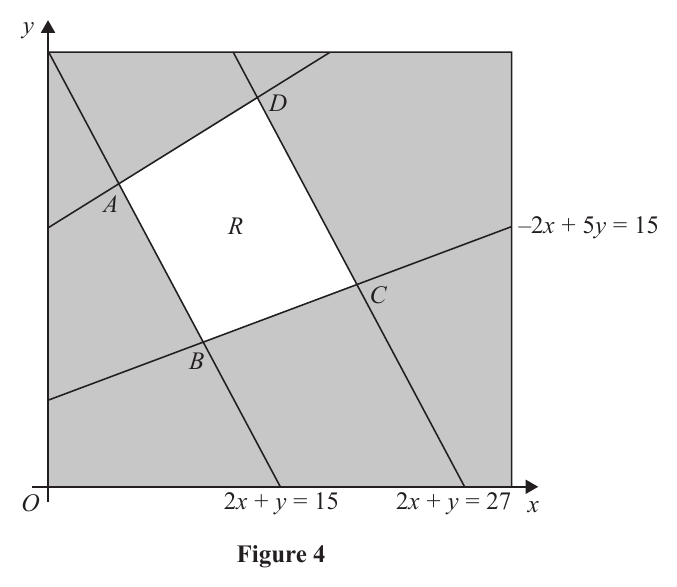
The equations of three of the lines, and the four intersection points, A, B, C and D, are shown.
The four vertices of R are A(49,221), B(5,5), C(10,7) and D(427,227).
(a) Determine the inequalities that define R.
(4)
The objective function, P, is given by
P=2x+ky
where k is a positive constant.
Given that the minimum value of P is at least half of the maximum value of P,
(b) determine the range of possible values of k.
(5)
题目中文翻译
图 4 显示了 x 和 y 的线性规划问题的约束条件,其中 R 是可行域。
三条直线的方程和四个交点 A、B、C、D 已标出。
R 的四个顶点为 A(49,221)、B(5,5)、C(10,7) 和 D(427,227)。
(a) 确定定义 R 的不等式。
目标函数 P 由下式给出
P=2x+ky
其中 k 是正的常数。
已知 P 的最小值至少是 P 最大值的一半,
(b) 确定 k 的可能取值范围。
解答
(a)
解法一
思路
展开
前三条边界直线的方程已在图中给出。第四条边界经过 A、D,先由两点求出方程。再选取可行域内部的测试点,判断每条边界应取哪一侧。
答题过程
展开
The gradient of the line through A and D is
427−49227−221=32.
Hence
y−221=32(x−49),
so the fourth boundary line is
−2x+3y=27.
Testing a point inside R gives the four constraints
2x+y≥−2x+5y≥−2x+3y≤2x+y≤15,15,27,27.
(b)
解法一
思路
展开
线性目标函数的最大值和最小值必在可行域顶点取得。先把四个顶点代入 P=2x+ky。当 k≤1 时,最小值在 A、最大值在 C;当 k≥1 时,最小值在 B、最大值在 D。分别使用“最小值至少为最大值的一半”建立不等式,最后合并两个范围。
答题过程
展开
The values of P at the four vertices are
PA=PB=PC=PD=29+221k,10+5k,20+7k,227+227k.
Also,
PB−PA=PC−PD=PD−PA=PC−PB=211(1−k),213(1−k),9+3k>0,10+2k>0.
For 0<k≤1, the minimum is at A and the maximum is at C. Therefore,
29+221k≥9+21k≥14k≥21(20+7k)20+7k11,
giving
k≥1411.
For k≥1, the minimum is at B and the maximum is at D. Therefore,
10+5k≥20+10k≥213≥21(227+227k)227+227k27k,
giving
k≤713.
Combining the two cases,
1411≤k≤713.