
题目
A project is modelled by the activity network shown in Figure 3. The activities are represented by the arcs. The number in brackets on each arc gives the time, in days, to complete the activity. Each activity requires exactly one worker. The project is to be completed in the shortest possible time.
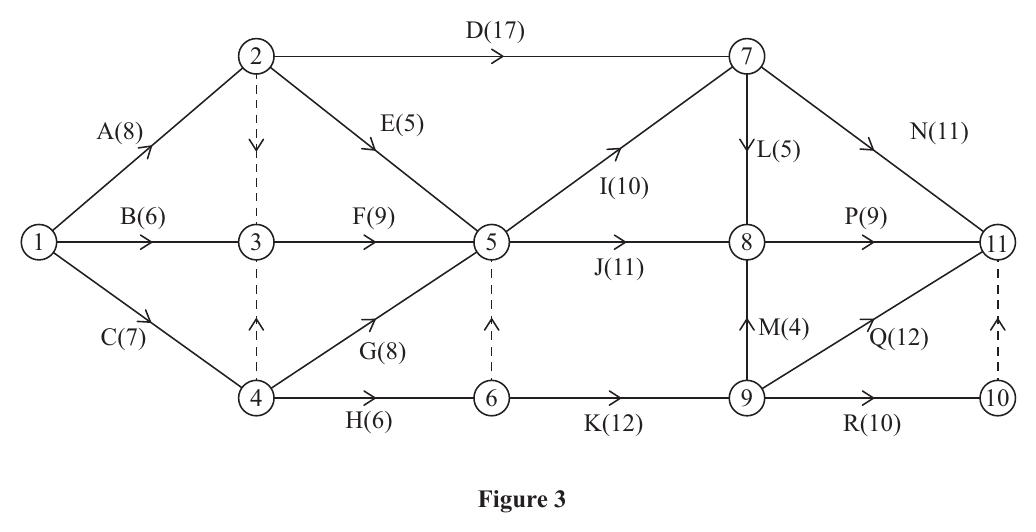
(a) Explain the purpose of the dummy between event 10 and event 11.
(b) Complete Diagram 1 in the answer book to show the early event times and the late event times.
(c) State the critical activities.
(d) Calculate the maximum number of days by which activity K could be delayed without lengthening the completion time of the project. You must make the numbers used in your calculation clear.
(e) Draw a Gantt (cascade) chart on the grid in the answer book.
(f) Use the Gantt chart to determine a lower bound for the minimum number of workers required to complete the project in the minimum time. You must make specific reference to the number of workers, activities and times.
题目中文翻译
一个项目由图 3 所示的活动网络建模。活动由弧表示。每条弧上括号内的数字是完成活动所需的时间(单位:天)。每个活动恰好需要一名工人。项目应在最短时间内完成。
(a) 解释事件 10 和事件 11 之间虚活动的目的。
(b) 在答案本中完成图 1,显示最早事件时间和最晚事件时间。
(c) 说明关键活动。
(d) 计算活动 K 在不延长项目完成时间的情况下可以延迟的最大天数。必须清楚说明计算中使用的数字。
(e) 在答案本中的网格上绘制甘特图(级联图)。
(f) 使用甘特图确定在最短时间内完成项目所需最少工人数量的下界。必须具体说明工人数量、活动和时间。
解答
(a)
解法一
思路
展开
活动箭线图中不能有两个活动拥有完全相同的起点和终点。若没有事件 10 到事件 11 的虚活动,Q 与 R 将无法被唯一识别,因此需要用虚活动区分它们。
答题过程
展开
The dummy is required to define activities Q and R uniquely, so that they do not have the same start and end events.
(b)
解法一
思路
展开
正向计算最早事件时间:每个事件取所有进入活动的“前一事件最早时间加活动时长”之最大值。再从项目完成时间 41 反向计算最晚事件时间:每个事件取所有离开活动的“后一事件最晚时间减活动时长”之最小值。
答题过程
展开
The early and late event times are
| Event | Early event time | Late event time |
|---|---|---|
| 1 | 0 | 0 |
| 2 | 8 | 8 |
| 3 | 8 | 8 |
| 4 | 7 | 8 |
| 5 | 17 | 17 |
| 6 | 13 | 16 |
| 7 | 27 | 27 |
| 8 | 32 | 32 |
| 9 | 25 | 28 |
| 10 | 35 | 41 |
| 11 | 41 | 41 |
(c)
解法一
思路
展开
关键活动的总浮时为 0。沿最早与最晚事件时间相同的事件追踪,并检查相邻活动恰好连接这些时间,可得从事件 1 到事件 11 的关键路径。
答题过程
展开
The critical activities are
(d)
解法一
思路
展开
活动 K 从事件 6 开始、在事件 9 结束。用“终点最晚事件时间减起点最早事件时间,再减活动时长”计算它的总浮时。
答题过程
展开
For activity K,
Therefore, activity K can be delayed by at most
解法二
思路
展开
官方评分资料也接受比较路径长度。包含 K 且决定其可延迟空间的路线为 C-H-K-M-P;用项目最短完成时间减去该路线总时长,即为 K 可以增加而不延误项目的时间。
答题过程
展开
The duration of the path containing C, H, K, M and P is
Since the minimum project completion time is 41 days, the maximum possible delay to K is
(e)
解法一
思路
展开
先把关键活动 A、F、I、L、P 首尾相接画在固定位置;其余活动从最早开始时间画到最早完成时间,并将末端到最晚完成时间之间的总浮时清楚标出。级联图必须包含全部 17 个活动,且每个活动只出现一次。
答题过程
展开
A correct cascade chart can be drawn from the following intervals. The float follows each non-critical activity.
| Activity | Activity interval | Float interval |
|---|---|---|
| A | 0-8 | - |
| B | 0-6 | 6-8 |
| C | 0-7 | 7-8 |
| D | 8-25 | 25-27 |
| E | 8-13 | 13-17 |
| F | 8-17 | - |
| G | 7-15 | 15-17 |
| H | 7-13 | 13-16 |
| I | 17-27 | - |
| J | 17-28 | 28-32 |
| K | 13-25 | 25-28 |
| L | 27-32 | - |
| M | 25-29 | 29-32 |
| N | 27-38 | 38-41 |
| P | 32-41 | - |
| Q | 25-37 | 37-41 |
| R | 25-35 | 35-41 |
(f)
解法一
思路
展开
在级联图中寻找无论怎样利用浮时都必定重叠的活动。严格在时间 12 与 13 之间,D、E、F、G、H 五项活动都正在进行,而每项活动各需一名工人,因此至少需要五名工人。
答题过程
展开
For any time such that
activities D, E, F, G and H must all be in progress. Since each activity requires one worker, a lower bound for the minimum number of workers is