
题目
Figure 4 shows the constraints of a linear programming problem in and .
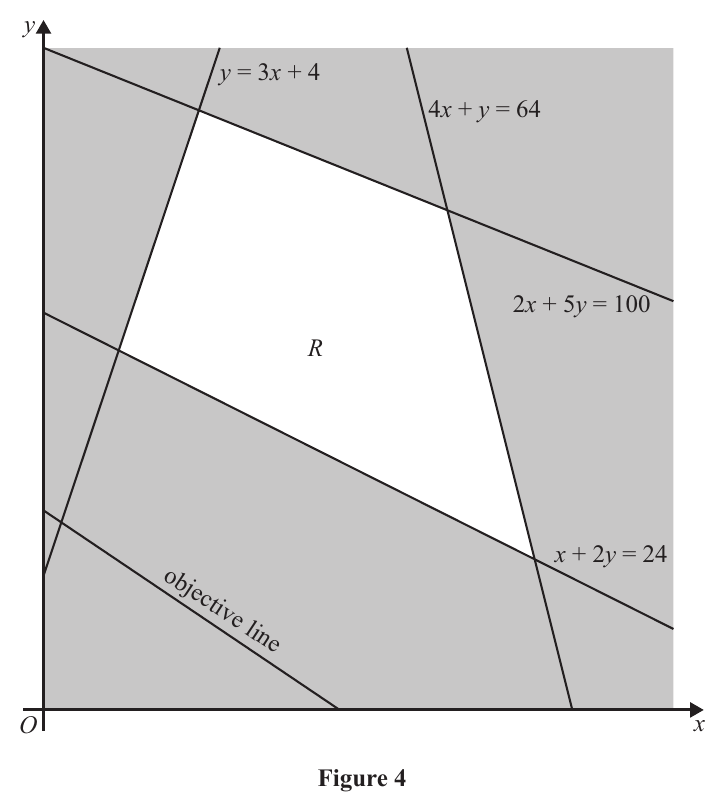
The unshaded area, including its boundaries, forms the feasible region .
An objective line has been drawn and labelled on the graph.
(a) State the four inequalities that define the feasible region.
The maximum value of the objective function is .
The minimum value of the objective function is .
(b) Determine the objective function, showing your working clearly.
The practical solution to the linear programming problem requires integer values.
(c) State the minimum integer solution for this problem.
题目中文翻译
图 4 显示了 和 的线性规划问题的约束条件。
未阴影区域(包括其边界)构成可行域 。
图上已画出并标注了一条目标线。
(a) 写出定义可行域的四个不等式。
目标函数的最大值为 。
目标函数的最小值为 。
(b) 确定目标函数,清楚展示运算过程。
该线性规划问题的实际解需要整数值。
(c) 说明此问题的最小整数解。
解答
(a)
解法一
思路
展开
对每条边界线在可行域内选一个测试点,判断可行域位于直线的哪一侧。图中 位于 的下方、 的上方,并位于另外两条直线的下方。
答题过程
展开
The four inequalities defining the feasible region are
(b)
解法一
思路
展开
先求目标线在连续可行域中取得最大值和最小值的两个顶点。设目标函数为 ,把两个顶点及题目给出的极值代入,联立求出 、。
答题过程
展开
The maximum occurs at the intersection of
and
Solving these simultaneously gives
The minimum occurs at the intersection of
and
Therefore,
so
Let the objective function be
Using the given maximum and minimum values,
Hence
Eliminating gives , so . Substitution then gives . Therefore, the objective function is
(c)
解法一
思路
展开
承接 (b) 求出的连续最小点,将 、 坐标分别向上、向下取整,得到附近的四个格点。逐一检验约束,剔除不在可行域内的点,再计算保留下来的点所对应的目标值。
答题过程
展开
From part (b), the continuous minimum occurs at
Rounding each coordinate up and down gives four nearby integer points. Check whether they lie in the feasible region:
| Point | Constraint check | In ? |
|---|---|---|
| No | ||
| No | ||
| No | ||
| Satisfies all four constraints | Yes |
Of these four points, only lies in . At this point,
The four-point check therefore gives the integer solution
若严格在整个可行域中寻找最优整数解,本题应为 ,对应目标值 ,比 对应的 更小。
常见教学中的“将交点坐标分别上下取整,再比较附近四个格点”,是方便的应试方法,却不保证找到整个可行域内真正的最优整数解;更好的点可能在稍远的位置,完整确认还需要额外检验。
不过,本题的官方评分标准与考官报告(Examiner Report)都以 为答案,考官报告也肯定了检查附近四个整数点的做法。因此,以本题备考为目的,可以放心按上述四点法作答,不必额外展开更远整数点的搜索。记住这里“考试采用的答案”与“数学上真正的最优解”的区别即可,不需要因此打乱常规解题步骤。