题目
Problem
The feasible region, R, of a linear programming problem is shown in Figure 4.
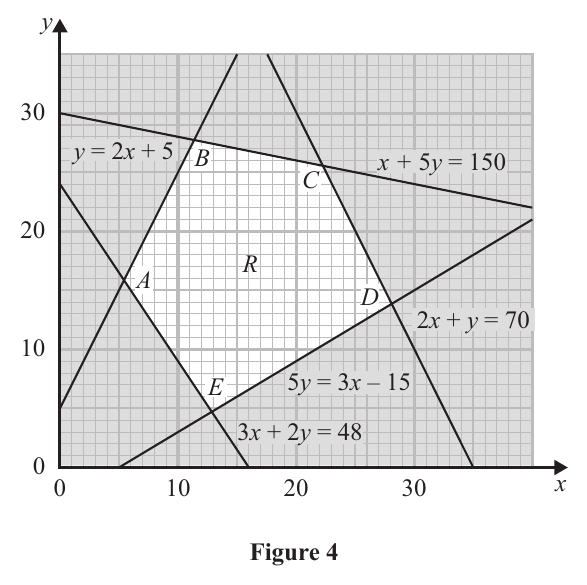
The boundaries form part of the feasible region.
The regions excluded from the feasible region have been shaded.
Given that one of the constraints is
3x+2y≥48
(a) state the remaining four constraints.
(2)
The five vertices of the feasible region are labelled A, B, C, D and E.
An objective function is of the form
P=ax+by
where a and b are integers.
This objective function has
- a minimum value of 20275 at vertex E
- a maximum value of 57632 at vertex C
(b) Determine the value of a and the value of b, making your working clear.
(4)
A different objective function is of the form
Q=x+ky
where k is a positive constant.
This objective function has a minimum value at vertex A and a maximum value at vertex C.
(c) Determine the range of values of k, making your working clear.
(4)
题目中文翻译
线性规划问题的可行域 R 如图 4 所示。
边界构成可行域的一部分。
从可行域中排除的区域已被阴影标记。
已知其中一个约束条件为
3x+2y≥48
(a) 写出其余四个约束条件。
可行域的五个顶点分别标记为 A、B、C、D 和 E。
目标函数的形式为
P=ax+by
其中 a 和 b 是整数。
该目标函数
- 在顶点 E 处取得最小值 20275
- 在顶点 C 处取得最大值 57632
(b) 确定 a 和 b 的值,清楚展示运算过程。
另一个目标函数的形式为
Q=x+ky
其中 k 是一个正常数。
该目标函数在顶点 A 处取得最小值,在顶点 C 处取得最大值。
(c) 确定 k 的取值范围,清楚展示运算过程。
解答
(a)
解法一
思路
展开
逐条观察图中可行域位于各直线的哪一侧。可以选取可行域内一个明显的点代入直线两边,判断不等号方向;题目说明边界属于可行域,所以均使用包含等号的不等号。
答题过程
展开
The remaining four constraints are
y≤2x+5,x+5y≤150,2x+y≤70,5y≥3x−15.
(b)
解法一
思路
展开
先联立顶点 E 与 C 所在的两条边界直线,求出它们的精确坐标。再把两个顶点坐标分别代入 P=ax+by,利用题目给出的最小值和最大值建立关于整数 a,b 的两个一次方程。
答题过程
展开
Vertex E is the intersection of
3x+2y=48
and
5y=3x−15.
Solving these equations gives
E=(790,733).
Vertex C is the intersection of
x+5y=150
and
2x+y=70,
so
C=(9200,9230).
At E, P=20275=71419, hence
790a+733b=30a+11b=71419473.
At C, P=57632=31730, hence
9200a+9230b=20a+23b=31730519.
Solving the simultaneous equations gives
a=11,b=13.
Therefore, P=11x+13y.
(c)
解法一
思路
展开
目标函数等值线 x+ky=Q 的斜率为 −1/k。要使等值线在 A 处取得最小值,其斜率必须越过 A 相邻边界 3x+2y=48 的斜率;要使其在 C 处取得最大值,则还必须受 C 相邻边界 2x+y=70 的斜率限制。分别比较即可得到 k 的上下界。
答题过程
展开
The objective line
x+ky=Q
has gradient −1/k.
The boundary 3x+2y=48 has gradient −3/2. For the minimum to occur at A,
−k1<−23,
so, since k>0,
k<32.
The boundary 2x+y=70 has gradient −2. For the maximum to occur at C,
−k1>−2,
so
k>21.
Combining the two conditions,
21<k<32.
解法二
思路
展开
官方评分资料也允许直接比较相邻顶点的目标函数值。A 要比相邻顶点 E 给出更小的 Q,而 C 要比相邻顶点 D 给出更大的 Q;这两个比较分别产生 k 的上界与下界。
答题过程
展开
The relevant vertices are
A=(738,7111),E=(790,733),C=(9200,9230),D=(13365,13180).
For A to give a smaller value than E,
Q(A)=Q(E)=738+111k,790+33k.
Hence
38+111k<78k<k<90+33k5232.
For C to give a larger value than D,
Q(C)=Q(D)=9200+230k,13365+180k.
Hence
2600+2990k>k>3285+1620k21.
Therefore,
21<k<32.
解法三
思路
展开
还可以把两条决定范围的边界直线改写成与目标函数 x+ky 相同的形式。改写后的 y 系数正好给出两个临界值,再由可行域中目标线移动的方向判断严格不等号。
答题过程
展开
Rearranging the boundary through A,
3x+2y=48⟹x+32y=16.
Therefore, for the minimum to occur at A,
k<32.
Similarly, the boundary through C can be written as
2x+y=70⟹x+21y=35.
Therefore, for the maximum to occur at C,
k>21.
Hence
21<k<32.