Skip to content
CalcGospel 國際數學圖譜
返回

FP1 2020 Oct Q3

A Level / Edexcel / FP1

IAL 2020 Oct Paper · Question 3

题目

Problem

3.

f(z)= z4+az3+ bz2+cz+d\begin{align*} f(z)=&\,z^4+az^3 \\ +&\,bz^2+cz+d \end{align*}

where aa, bb, cc and dd are integers.

The complex numbers 3+i3+\mathrm{i} and −1−2i-1-2\mathrm{i} are roots of the equation f(z)=0f(z) = 0

(a) Write down the other roots of this equation.

(2)

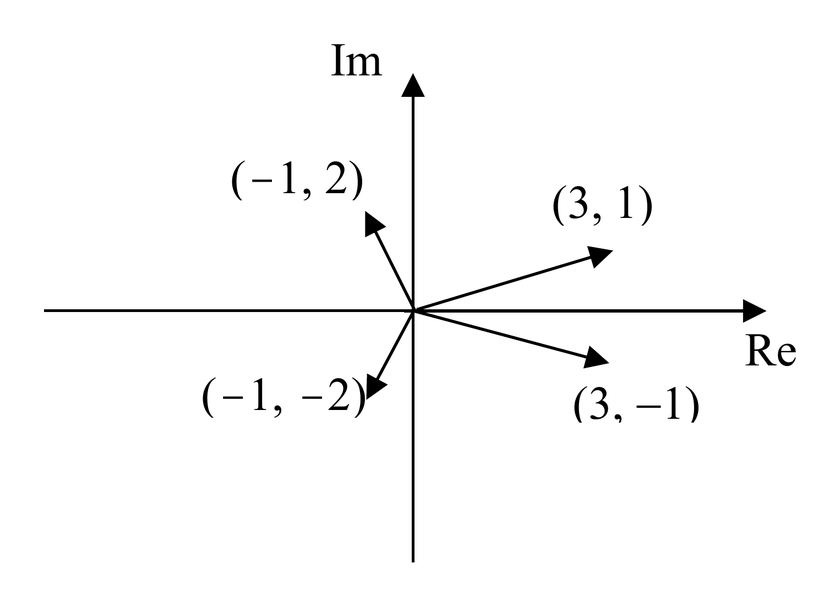
(b) Show all the roots of the equation f(z)=0f(z) = 0 on a single Argand diagram.

(2)

(c) Determine the values of aa, bb, cc and dd.

(5)
题目中文翻译

3.

f(z)= z4+az3+ bz2+cz+d\begin{align*} f(z)=&\,z^4+az^3 \\ +&\,bz^2+cz+d \end{align*}

其中 aa、bb、cc 和 dd 是整数。

复数 3+i3+\mathrm{i} 和 −1−2i-1-2\mathrm{i} 是方程 f(z)=0f(z) = 0 的根。

(a) 写出该方程的其他根。

(2)

(b) 在同一幅 Argand 图上画出方程 f(z)=0f(z) = 0 的所有根。

(2)

(c) 求 aa、bb、cc 和 dd 的值。

(5)

解答

(a)

解法一

思路

展开

多项式的系数都是实数,因此每个非实复根的共轭复数也必定是根。

答题过程

展开

Since f(z)f(z) has real coefficients, non-real roots occur in conjugate pairs. Therefore, the other roots are

3−iand−1+2i.\boxed{3-\mathrm{i}\quad\text{and}\quad-1+2\mathrm{i}}.

(b)

解法一

思路

展开

在 Argand 图上,复数 x+yix+y\mathrm{i} 对应点 (x,y)(x,y)。因此标出 (3,1)(3,1)、(3,−1)(3,-1)、(−1,2)(-1,2)、(−1,−2)(-1,-2);两对点均关于实轴对称。

答题过程

展开

The four roots are represented by the points

(3,1),(3,−1),(3,1),\qquad(3,-1),

and

(−1,2),(−1,−2)(-1,2),\qquad(-1,-2)

on the Argand diagram.

(c)

解法一

思路

展开

先把每对共轭复根组成一个实系数二次因式,再将两个二次因式相乘。展开所得四次多项式后,与题目给出的系数逐项比较。

答题过程

展开

The conjugate pair 3±i3\pm\mathrm{i} gives the factor

 [z−(3+i)] ×[z−(3−i)]= (z−3)2+1= z2−6z+10.\begin{align*} &\,\big[z-(3+\mathrm{i})\big] \\ &\,\hspace{2pt}\times\big[z-(3-\mathrm{i})\big] \\ =&\,(z-3)^2+1 \\ =&\,z^2-6z+10. \end{align*}

Similarly, the pair −1±2i-1\pm2\mathrm{i} gives

 [z−(−1+2i)] ×[z−(−1−2i)]= (z+1)2+4= z2+2z+5.\begin{align*} &\,\big[z-(-1+2\mathrm{i})\big] \\ &\,\hspace{2pt}\times\big[z-(-1-2\mathrm{i})\big] \\ =&\,(z+1)^2+4 \\ =&\,z^2+2z+5. \end{align*}

Therefore,

f(z)= (z2−6z+10) ×(z2+2z+5)= z4−4z3+3z2− 10z+50.\begin{align*} f(z) =&\,(z^2-6z+10) \\ &\,\hspace{2pt}\times(z^2+2z+5) \\ =&\,z^4-4z^3+3z^2 \\ -&\,10z+50. \end{align*}

Hence

 a=−4,b=3, c=−10,d=50.\begin{align*} &\,\boxed{a=-4,\quad b=3}, \\ &\,\boxed{c=-10,\quad d=50}. \end{align*}

解法二

思路

展开

使用韦达定理。将两对共轭根分别看成一组,先求每组的和与积;这样二阶、三阶对称和都可由两组的和与积快速得到,不必列出所有组合逐项计算。

答题过程

展开

Let the roots be r1,r2,r3,r4r_1,r_2,r_3,r_4, where

r1= 3+i,r2= 3−i,\begin{align*} r_1=&\,3+\mathrm{i}, \\ r_2=&\,3-\mathrm{i}, \end{align*}

and

r3= −1+2i,r4= −1−2i.\begin{align*} r_3=&\,-1+2\mathrm{i}, \\ r_4=&\,-1-2\mathrm{i}. \end{align*}

Then

r1+r2= 6,r1r2= 10,\begin{align*} r_1+r_2=&\,6, \\ r_1r_2=&\,10, \end{align*}

and

r3+r4= −2,r3r4= 5.\begin{align*} r_3+r_4=&\,-2, \\ r_3r_4=&\,5. \end{align*}

The sum of all four roots is

6+(−2)=4,6+(-2)=4,

so a=−4a=-4.

The sum of the six products of two distinct roots is

 r1r2+r3r4+ (r1+r2)(r3+r4)= 10+5+6(−2)= 3,\begin{align*} &\,r_1r_2+r_3r_4 \\ +&\,(r_1+r_2)(r_3+r_4) \\ =&\,10+5+6(-2) \\ =&\,3, \end{align*}

so b=3b=3.

The sum of the four products of three distinct roots is

 r1r2(r3+r4)+ r3r4(r1+r2)= 10(−2)+5(6)= 10,\begin{align*} &\,r_1r_2(r_3+r_4) \\ +&\,r_3r_4(r_1+r_2) \\ =&\,10(-2)+5(6) \\ =&\,10, \end{align*}

so c=−10c=-10.

Finally,

r1r2r3r4=10(5)=50,r_1r_2r_3r_4=10(5)=50,

so d=50d=50. Therefore,

 a=−4,b=3, c=−10,d=50.\begin{align*} &\,\boxed{a=-4,\quad b=3}, \\ &\,\boxed{c=-10,\quad d=50}. \end{align*}

解法三

思路

展开

不把共轭根先配成一组,而将来自两组的根交叉配对,得到两个复系数二次因式。把它们写成一个多项式加、减另一个多项式的虚数倍,乘积便可用平方差展开。另一种交叉配对也有同样结构。

答题过程

展开

Pair 3+i3+\mathrm{i} with −1−2i-1-2\mathrm{i}. Their sum and product are

 (3+i)+(−1−2i)= 2−i, (3+i)(−1−2i)= −1−7i.\begin{align*} &\,(3+\mathrm{i})+(-1-2\mathrm{i}) \\ =&\,2-\mathrm{i}, \\ &\,(3+\mathrm{i})(-1-2\mathrm{i}) \\ =&\,-1-7\mathrm{i}. \end{align*}

Thus this pair gives the quadratic factor

 z2−(2−i)z−1−7i= (z2−2z−1)+i(z−7).\begin{align*} &\,z^2-(2-\mathrm{i})z-1-7\mathrm{i} \\ =&\,(z^2-2z-1)+\mathrm{i}(z-7). \end{align*}

Let

U= z2−2z−1,V= z−7.\begin{align*} U=&\,z^2-2z-1, \\ V=&\,z-7. \end{align*}

The other pair, 3−i3-\mathrm{i} and −1+2i-1+2\mathrm{i}, gives U−iVU-\mathrm{i}V. Hence

f(z)= (U+iV)(U−iV)= U2+V2.\begin{align*} f(z)=&\,(U+\mathrm{i}V)(U-\mathrm{i}V) \\ =&\,U^2+V^2. \end{align*}

Expanding the two squares separately,

U2= z4−4z3+2z2+ 4z+1,V2= z2−14z+49.\begin{align*} U^2=&\,z^4-4z^3+2z^2 \\ +&\,4z+1, \\ V^2=&\,z^2-14z+49. \end{align*}

Therefore,

f(z)= z4−4z3+3z2− 10z+50.\begin{align*} f(z)=&\,z^4-4z^3+3z^2 \\ -&\,10z+50. \end{align*}

Alternatively, pair 3−i3-\mathrm{i} with −1−2i-1-2\mathrm{i} and pair the remaining two roots. The two quadratic factors are

 z2+(−2+3i)z−5−5i, z2+(−2−3i)z−5+5i.\begin{align*} &\,z^2+(-2+3\mathrm{i})z-5-5\mathrm{i}, \\ &\,z^2+(-2-3\mathrm{i})z-5+5\mathrm{i}. \end{align*}

Let

A= z2−2z−5,B= 3z−5.\begin{align*} A=&\,z^2-2z-5, \\ B=&\,3z-5. \end{align*}

These factors are A+iBA+\mathrm{i}B and A−iBA-\mathrm{i}B, so

f(z)=A2+B2.f(z)=A^2+B^2.

Now

A2= z4−4z3−6z2+ 20z+25,B2= 9z2−30z+25.\begin{align*} A^2=&\,z^4-4z^3-6z^2 \\ +&\,20z+25, \\ B^2=&\,9z^2-30z+25. \end{align*}

Adding again gives

f(z)= z4−4z3+3z2− 10z+50.\begin{align*} f(z)=&\,z^4-4z^3+3z^2 \\ -&\,10z+50. \end{align*}

Comparing coefficients in either case,

 a=−4,b=3, c=−10,d=50.\begin{align*} &\,\boxed{a=-4,\quad b=3}, \\ &\,\boxed{c=-10,\quad d=50}. \end{align*}

解法四

思路

展开

将题目给出的两个复根分别代入多项式。由于系数均为实数,每次代入所得等式的实部与虚部都应为零,因此得到四个一次方程。先用虚部方程表示一个未知数,再代入其余方程消元。

答题过程

展开

For the root 3+i3+\mathrm{i},

(3+i)2= 8+6i,(3+i)3= 18+26i,(3+i)4= 28+96i.\begin{align*} (3+\mathrm{i})^2=&\,8+6\mathrm{i}, \\ (3+\mathrm{i})^3=&\,18+26\mathrm{i}, \\ (3+\mathrm{i})^4=&\,28+96\mathrm{i}. \end{align*}

Substituting into f(3+i)=0f(3+\mathrm{i})=0 and equating real and imaginary parts gives

18a+8b+3c+d=−2818a+8b+3c+d=-28

and

26a+6b+c=−96.(1)26a+6b+c=-96. \tag{1}

For the root −1−2i-1-2\mathrm{i},

(−1−2i)2= −3+4i,(−1−2i)3= 11+2i,(−1−2i)4= −7−24i.\begin{align*} (-1-2\mathrm{i})^2=&\,-3+4\mathrm{i}, \\ (-1-2\mathrm{i})^3=&\,11+2\mathrm{i}, \\ (-1-2\mathrm{i})^4=&\,-7-24\mathrm{i}. \end{align*}

Similarly, f(−1−2i)=0f(-1-2\mathrm{i})=0 gives

11a−3b−c+d=711a-3b-c+d=7

and

2a+4b−2c=24.2a+4b-2c=24.

The last equation gives

c=a+2b−12.c=a+2b-12.

Substituting into (1),

 26a+6b+a+2b−12= −96.\begin{align*} &\,26a+6b+a+2b-12 \\ =&\,-96. \end{align*}

Thus

27a+8b=−84.(2)27a+8b=-84. \tag{2}

Subtracting the real-part equations gives

7a+11b+4c=−35.7a+11b+4c=-35.

Substituting for cc,

 7a+11b+ 4(a+2b−12)= −35.\begin{align*} &\,7a+11b \\ +&\,4(a+2b-12) \\ =&\,-35. \end{align*}

Therefore,

11a+19b=13.(3)11a+19b=13. \tag{3}

Multiplying (2) by 1919 and (3) by 88 gives

513a+152b=−1596513a+152b=-1596

and

88a+152b=104.88a+152b=104.

Subtracting gives

425a=−1700,425a=-1700,

so a=−4a=-4. Equation (2) then gives

−108+8b=−84,-108+8b=-84,

hence b=3b=3. Therefore,

c=−4+2(3)−12=−10.c=-4+2(3)-12=-10.

Finally, using the second real-part equation,

d= 7−11a+3b+c= 7+44+9−10= 50.\begin{align*} d=&\,7-11a+3b+c \\ =&\,7+44+9-10 \\ =&\,50. \end{align*}

Thus

 a=−4,b=3, c=−10,d=50.\begin{align*} &\,\boxed{a=-4,\quad b=3}, \\ &\,\boxed{c=-10,\quad d=50}. \end{align*}