Skip to content
CalcGospel 國際數學圖譜
返回

FP1 2021 June Q5

A Level / Edexcel / FP1

IAL 2021 June Paper · Question 5

题目

Problem

5.

 f(x)= (9x2+d) ×(x2−8x +(10d+1))\begin{align*} &\,f(x)\\ =&\,(9x^2+d)\\ &\,\hspace{2pt}\times\big(x^2-8x\\ &\,\hspace{4pt}+(10d+1)\big) \end{align*}

where dd is a positive constant.

(a) Find the four roots of f(x)f(x) giving your answers in terms of dd.

(3)

Given d=4d = 4

(b) Express these four roots in the form a+iba + \mathrm{i}b, where a,b∈Ra, b \in \mathbb{R}.

(2)

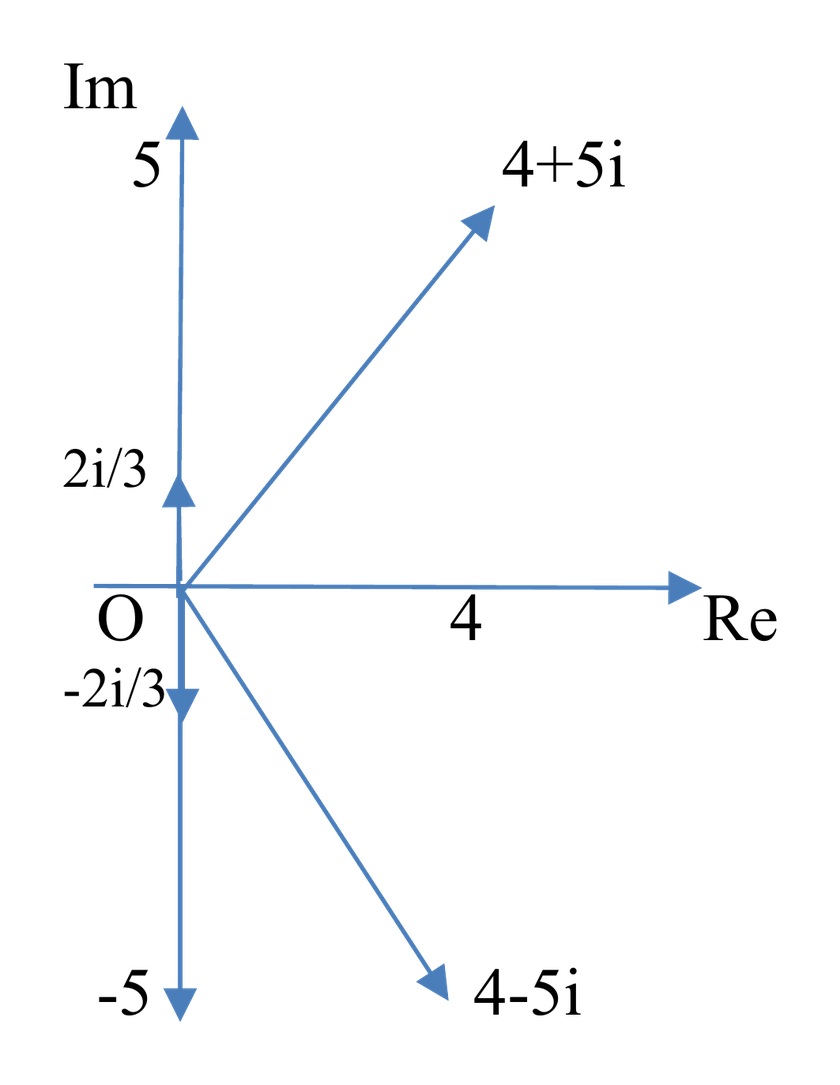
(c) Show these four roots on a single Argand diagram.

(2)
题目中文翻译
 f(x)= (9x2+d) ×(x2−8x +(10d+1))\begin{align*} &\,f(x)\\ =&\,(9x^2+d)\\ &\,\hspace{2pt}\times\big(x^2-8x\\ &\,\hspace{4pt}+(10d+1)\big) \end{align*}

其中 dd 是正常数。

(a) 求 f(x)f(x) 的四个根,答案用 dd 表示。

(3)

已知 d=4d = 4

(b) 将这四个根表示为 a+iba + \mathrm{i}b 的形式,其中 a,b∈Ra, b \in \mathbb{R}。

(2)

(c) 在同一幅 Argand 图上画出这四个根。

(2)

解答

(a)

解法一

思路

展开

令两个二次因式分别等于零。第一个因式直接给出一对纯虚根;第二个因式使用求根公式,并把判别式化简。最终需要把四个根全部明确列出。

答题过程

展开

From the first factor,

9x2+d= 0,x2= −d9.\begin{align*} 9x^2+d=&\,0,\\ x^2=&\,-\frac d9. \end{align*}

Since d>0d>0, this gives

x=id3orx=−id3.x=\frac{\mathrm{i}\sqrt d}{3} \quad\text{or}\quad x=-\frac{\mathrm{i}\sqrt d}{3}.

From the second factor,

x2−8x+(10d+1)=0.x^2-8x+(10d+1)=0.

Using the quadratic formula,

x= 8±64−4(10d+1)2= 8±60−40d2= 4±15−10d.\begin{align*} x =&\,\frac{8\pm\sqrt{64-4(10d+1)}}2\\ =&\,\frac{8\pm\sqrt{60-40d}}2\\ =&\,4\pm\sqrt{15-10d}. \end{align*}

Therefore, the four roots are

x1= id3,x2= −id3,x3= 4+15−10d,x4= 4−15−10d.\boxed{ \begin{aligned} x_1=&\,\frac{\mathrm{i}\sqrt d}{3},\\ x_2=&\,-\frac{\mathrm{i}\sqrt d}{3},\\ x_3=&\,4+\sqrt{15-10d},\\ x_4=&\,4-\sqrt{15-10d} \end{aligned} }.

解法二

思路

展开

第一个因式仍直接求出两个纯虚根;第二个因式可以配方,把 x2−8xx^2-8x 写成 (x−4)2−16(x-4)^2-16,再移项、开平方。最后把两组根合在一起,明确列出全部四个根。

答题过程

展开

From the first factor,

9x2+d= 0,x2= −d9.\begin{align*} 9x^2+d=&\,0,\\ x^2=&\,-\frac d9. \end{align*}

Since d>0d>0, the two roots are

x=id3orx=−id3.x=\frac{\mathrm{i}\sqrt d}{3} \quad\text{or}\quad x=-\frac{\mathrm{i}\sqrt d}{3}.

For the second factor, complete the square:

 x2−8x+(10d+1)=0, x2−8x+16 −16+10d+1=0, (x−4)2+10d−15=0.\begin{align*} &\,x^2-8x+(10d+1)=0,\\ &\,x^2-8x+16\\ &\,\hspace{2pt}-16+10d+1=0,\\ &\,(x-4)^2+10d-15=0. \end{align*}

Therefore,

(x−4)2= 15−10d,x−4= ±15−10d,x= 4±15−10d.\begin{align*} (x-4)^2=&\,15-10d,\\ x-4=&\,\pm\sqrt{15-10d},\\ x=&\,4\pm\sqrt{15-10d}. \end{align*}

Hence the four roots are

x1= id3,x2= −id3,x3= 4+15−10d,x4= 4−15−10d.\begin{align*} x_1=&\,\boxed{\frac{\mathrm{i}\sqrt d}{3}},\\ x_2=&\,\boxed{-\frac{\mathrm{i}\sqrt d}{3}},\\ x_3=&\,\boxed{4+\sqrt{15-10d}},\\ x_4=&\,\boxed{4-\sqrt{15-10d}}. \end{align*}

(b)

解法一

思路

展开

把 d=4d=4 代入 (a) 的四个根。前两个根立即化为纯虚数;后两个根中出现 −25\sqrt{-25},使用 −25=5i\sqrt{-25}=5\mathrm{i} 化为 a+iba+\mathrm{i}b 的形式。

答题过程

展开

When d=4d=4,

id3= 23i,−id3= −23i.\begin{align*} \frac{\mathrm{i}\sqrt d}{3} =&\,\frac23\mathrm{i},\\ -\frac{\mathrm{i}\sqrt d}{3} =&\,-\frac23\mathrm{i}. \end{align*}

Also,

 4±15−10d= 4±−25= 4±5i.\begin{align*} &\,4\pm\sqrt{15-10d}\\ =&\,4\pm\sqrt{-25}\\ =&\,4\pm5\mathrm{i}. \end{align*}

Hence the four roots are

x1= 23i,x2= −23i,x3= 4+5i,x4= 4−5i.\boxed{ \begin{aligned} x_1=&\,\frac23\mathrm{i},\\ x_2=&\,-\frac23\mathrm{i},\\ x_3=&\,4+5\mathrm{i},\\ x_4=&\,4-5\mathrm{i} \end{aligned} }.

(c)

解法一

思路

展开

在 Argand 图上,复数 a+bia+b\mathrm{i} 对应点 (a,b)(a,b)。两枚纯虚根位于虚轴上并关于原点对称;另外两根位于直线 Re⁡(z)=4\operatorname{Re}(z)=4 上并关于实轴对称,同时应保持合理的相对尺度。

答题过程

展开

Plot and label the four points

 (0,23), (0,−23), (4,5), (4,−5)\begin{aligned} &\,\bigg(0,\frac23\bigg),\\ &\,\bigg(0,-\frac23\bigg),\\ &\,(4,5),\\ &\,(4,-5) \end{aligned}

on a single Argand diagram. The first pair lies on the imaginary axis, and the second pair is symmetric about the real axis on the line Re⁡(z)=4\operatorname{Re}(z)=4.