题目
Problem
2. In this question you must show all stages of your working. Solutions relying on calculator technology are not acceptable.
Given that x=2+3i is a root of the equation
2x4−8x3+29x2−12x+39=0.
(a) write down another complex root of this equation.
(1)
(b) Use algebra to determine the other 2 roots of the equation.
(4)
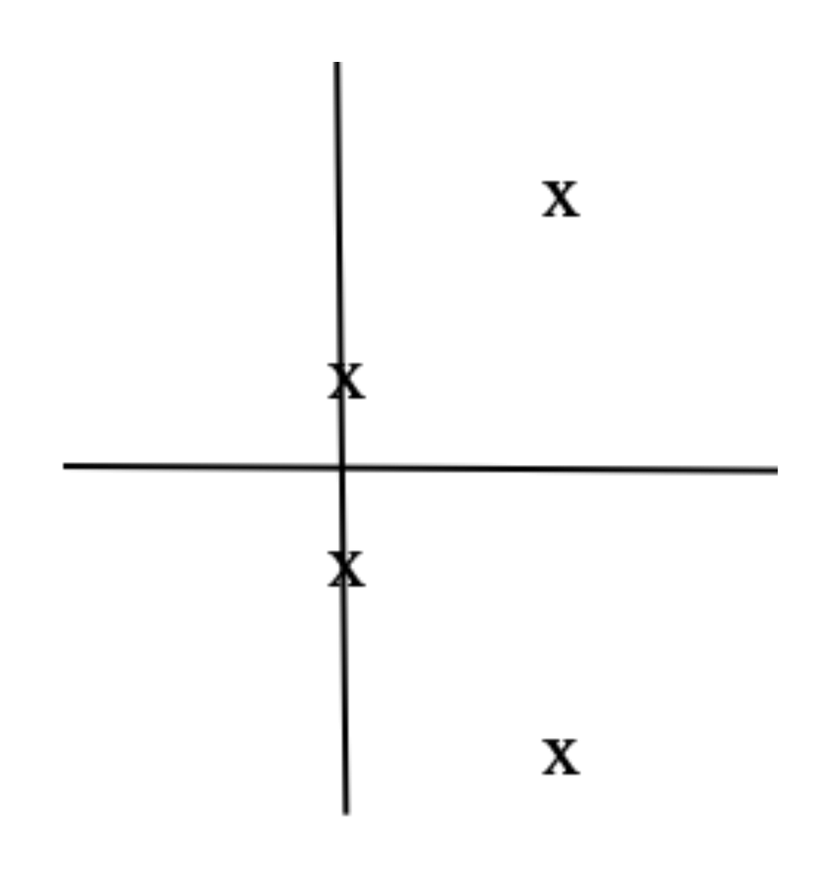
(c) Show all 4 roots on a single Argand diagram.
(2)
题目中文翻译
- 在本题中必须展示所有解题步骤。依赖计算器技术的解答不可接受。
已知 x=2+3i 是方程
2x4−8x3+29x2−12x+39=0.
的一个根,
(a) 写出该方程的另一个复根。
(1)
(b) 用代数方法确定方程的另外两个根。
(4)
(c) 在同一幅 Argand 图上画出所有 4 个根。
(2)
解答
(a)
解法一
思路
展开
多项式的系数全为实数,因此非实复根必成共轭对出现。把 2+3i 的虚部变号即可。
答题过程
展开
Since the polynomial has real coefficients, complex roots occur in conjugate pairs. Therefore another root is
2−3i.
(b)
解法一
思路
展开
先把共轭复根对应的两个一次因式相乘,得到实系数二次因式。再用多项式除法从原四次式中除去该因式,最后解余下的二次方程,并保持精确形式。
答题过程
展开
The two known roots give a quadratic factor F(x), where
=====F(x)(x−2−3i)×(x−2+3i)(x−2)2−(3i)2(x−2)2+9x2−4x+4+9x2−4x+13.
Let P(x) denote the polynomial in the question. To divide P(x) by F(x), the first term of the quotient is 2x2:
=2x2F(x)2x4−8x3+26x2.
Subtracting gives
====P(x)−2x2F(x)(29−26)x2−12x+393x2−12x+393(x2−4x+13)3F(x).
The next term of the quotient is therefore 3, and the remainder is zero. Thus
P(x)==2x2F(x)+3F(x)F(x)(2x2+3).
That is,
P(x)=(x2−4x+13)×(2x2+3).
Hence the other roots satisfy
2x2+3=0.
Thus
x2=−23,
so the other two roots are
x=26i,
x=−26i.
解法二
思路
展开
也可以先用两根的和与积构造二次因式,再设另一个二次因式的待定系数。展开并比较系数,可以不写多项式长除法而得到相同的剩余因式。
答题过程
展开
The sum and product of the two known roots are
(2+3i)+(2−3i)=4
and
===(2+3i)(2−3i)22−(3i)24+913.
Therefore their quadratic factor is
x2−4x+13.
Let P(x) denote the polynomial in the question, and write
P(x)=(x2−4x+13)×(2x2+px+q).
Expanding the product,
==P(x)2x4+px3+qx2−8x3−4px2−4qx+26x2+13px+13q2x4+(p−8)x3+(q−4p+26)x2+(−4q+13p)x+13q.
Comparing the coefficients of x3 and the constant terms gives
p−8=−8
and
13q=39.
Hence p=0 and q=3. The remaining coefficients also agree, since
q−4p+26=29
and
−4q+13p=−12.
Thus the remaining factor is 2x2+3. Therefore,
x=26i,
x=−26i.
(c)
解法一
思路
展开
在 Argand 图中,横坐标是实部,纵坐标是虚部。两根 2±3i 位于直线 Re(z)=2 上;另两根为纯虚数,位于虚轴上,并且关于实轴成对称分布。
答题过程
展开
The four roots are represented by the points
(2,3),
(2,−3),
(0,26),
(0,−26).