题目
Problem
In this question you must show all stages of your working.
Solutions relying entirely on calculator technology are not acceptable.
=f(z)z3−13z2+59z+p
p∈Z
Given that z=3 is a root of the equation f(z)=0
(a) show that p=−87
(2)
(b) Use algebra to determine the other roots of f(z)=0, giving your answers in simplest form.
(4)
On an Argand diagram
- the root z=3 is represented by the point P
- the other roots of f(z)=0 are represented by the points Q and R
- the number z=−9 is represented by the point S
(c) Show on a single Argand diagram the positions of P, Q, R and S
(1)
(d) Determine the perimeter of the quadrilateral PQSR, giving your answer as a simplified surd.
(2)
题目中文翻译
本题必须展示完整解题过程。
不允许完全依赖计算器技术。
已知
=f(z)z3−13z2+59z+p
p∈Z
已知 z=3 是方程 f(z)=0 的一个根。
(a) 证明 p=−87。
(2)
(b) 用代数方法确定方程 f(z)=0 的其余根,结果以最简形式给出。
(4)
在阿甘图(Argand diagram)上:
- 根 z=3 用点 P 表示
- 方程 f(z)=0 的其余根用点 Q 和 R 表示
- 数 z=−9 用点 S 表示
(c) 在同一个阿甘图上标出 P、Q、R、S 的位置。
(1)
(d) 确定四边形 PQSR 的周长,结果以最简根式给出。
(2)
解答
(a)
解法一
思路
展开
因为 z=3 是方程的根,所以 f(3)=0。代入并整理即可自然推出题目给定的 p 值。
答题过程
展开
Since z=3 is a root,
===f(3)33−13(3)2+59(3)+p27−117+177+p87+p.
Therefore,
87+p=p=0−87.
(b)
解法一
思路
展开
承接 (a),先把 p=−87 代回多项式。已知 z=3 是根,所以 z−3 是因式;用代数除法得到二次因式,再用二次方程公式求其两个复根。
答题过程
展开
Using p=−87 from part (a),
=f(z)z3−13z2+59z−87.
For division by z−3, the first quotient term is z2. Subtracting its product with z−3 gives
=(z3−13z2+59z−87)−(z3−3z2)−10z2+59z−87.
The next quotient term is −10z:
=(−10z2+59z−87)−(−10z2+30z)29z−87.
The final quotient term is 29, since
=(29z−87)−29(z−3)0.
Thus the quotient is z2−10z+29 and the remainder is zero, giving
=f(z)(z−3)(z2−10z+29).
Hence the other roots satisfy
z2−10z+29=0.
The discriminant is
Δ===(−10)2−4(1)(29)100−116−16.
Using the quadratic formula,
===z210±Δ210±−165±2i.
Therefore, the other roots are
z=5+2iandz=5−2i.
解法二
思路
展开
由上面的代数除法,另外两个根满足二次方程。也可以把二次式配方,得到复数的平方等于负数,再求出两个根。
答题过程
展开
Using the quadratic factor obtained above,
z2−10z+29=0.
Completing the square,
(z−5)2−25+29=(z−5)2+4=(z−5)2=00−4.
Hence
z−5=±2i.
The other roots are therefore
z=5+2iandz=5−2i.
(c)
解法一
思路
展开
在 Argand 图上,横坐标表示实部,纵坐标表示虚部。两个非实根关于实轴对称;P 与 S 都位于实轴上。
答题过程
展开
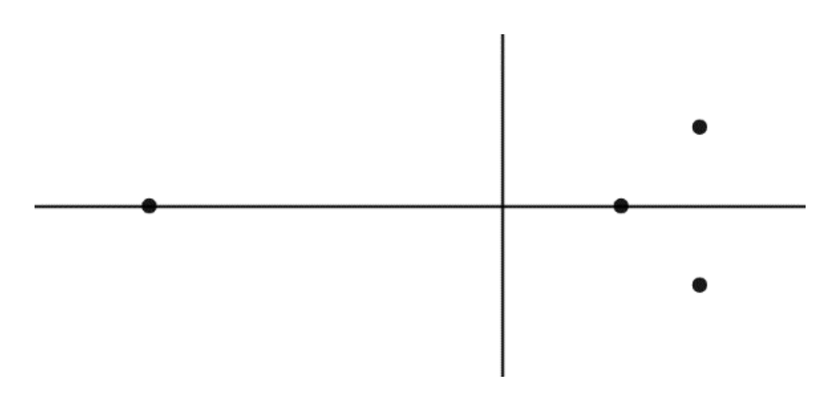
The four points are
P=Q=R=S=(3,0),(5,2),(5,−2),(−9,0).
The points Q and R are vertically aligned and symmetric about the real axis.
(d)
解法一
思路
展开
四边形关于实轴对称,因此 PQ=PR、QS=RS。分别用两点间距离公式求一条短边与一条长边,再把它们各取两倍。
答题过程
展开
By symmetry,
PQ=PR
and
QS=RS.
Now,
===PQ(5−3)2+(2−0)2822,
For QS, the coordinate differences are
Δx=Δy=5−(−9)=14,2−0=2.
Hence,
====QS(Δx)2+(Δy)2142+22200102.
Therefore, the perimeter of PQSR is
==2PQ+2QS2(22)+2(102)242.
