题目
Problem
=f(z)6z3+Az2+Bz+C
where A,B and C are integers.
Given that z=32+317i is a root of the equation f(z)=0
(a) write down the other complex root of the equation f(z)=0
(1)
Given that z=−23 is also a root of the equation f(z)=0
(b) determine the value of A, the value of B and the value of C.
(5)
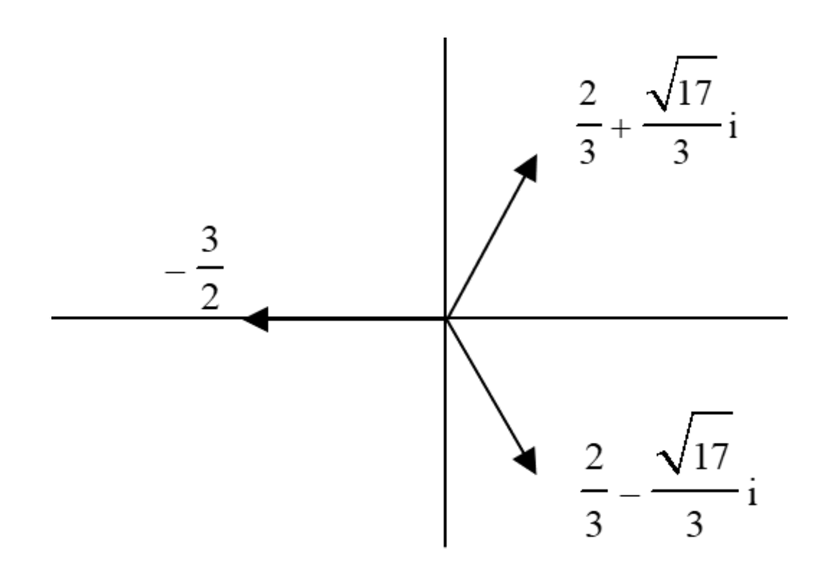
(c) Show all the roots of the equation f(z)=0 on a single Argand diagram.
(2)
题目中文翻译
已知多项式
=f(z)6z3+Az2+Bz+C
其中 A,B,C 均为整数。
已知 z=32+317i 是方程 f(z)=0 的一个根。
(a) 写出方程 f(z)=0 的另一个复数根。
(1)
已知 z=−23 也是方程 f(z)=0 的一个根。
(b) 确定 A 的值、B 的值以及 C 的值。
(5)
(c) 在同一个阿甘图(Argand diagram)上表示出方程 f(z)=0 的所有根。
(2)
解答
(a)
解法一
思路
展开
多项式的系数都是整数,因此是实系数多项式。非实复根必成共轭对,所以把已知根的虚部变号即可。
答题过程
展开
Since f has real coefficients, non-real roots occur in conjugate pairs. Therefore, the other complex root is
z=32−317i.
(b)
解法一
思路
展开
先把共轭根对应的两个一次因式相乘,得到实系数二次因式;再乘以实根对应的因式。由于原多项式首项系数为 6,最后将三个首一因式的乘积乘以 6,并比较系数。
答题过程
展开
The conjugate pair gives the quadratic factor
===(z−32−317i)×(z−32+317i)(z−32)2+917z2−34z+94+917z2−34z+37.
The third root is −23, so, using the leading coefficient 6,
====f(z)6(z+23)×(z2−34z+37)6[z3+(−34+23)z2+(37−2)z+27]6(z3+61z2+31z+27)6z3+z2+2z+21.
Comparing coefficients with
=f(z)6z3+Az2+Bz+C,
we obtain
A=1,B=2,C=21.
解法二
思路
展开
也可以使用三次方程的根与系数关系。分别计算三根之和、两两乘积之和与三根之积,再与 −6A、6B、−6C 比较。
答题过程
展开
Let the roots be
α=32+317i,β=32−317i,γ=−23.
Their sum is
α+β+γ=34−23=−61.
Since the sum of the roots is −6A,
−6A=−61⟹A=1.
Also,
αβ===(32)2+(317)294+91737.
Hence the pairwise product sum is
===αβ+αγ+βγαβ+γ(α+β)37−23(34)31.
Since this equals 6B,
6B=31⟹B=2.
Finally,
αβγ=37(−23)=−27.
Since the product of the roots is −6C,
−6C=C=−2721.
Therefore,
A=1,B=2,C=21.
解法三
思路
展开
把实根代入多项式,得到一个实系数方程。再计算已知复根的平方与立方,代入后分别令实部和虚部为零,得到另外两个方程。最后联立消元,求出三个系数。
答题过程
展开
Since −23 is a root,
==06(−23)3+A(−23)2−23B+C−481+49A−23B+C.
Multiplying by 4 gives
9A−6B+4C=81.(1)
Write the given non-real root as
w=32+317i.
Using i2=−1,
w2==94−17+9417i−913+9417i.
Multiplying this by w gives
w3==27−26−68+27(8−13)17i−2794−27517i.
Now f(w)=0. Its real part gives
−9188−913A+32B+C=0,
so
13A−6B−9C=−188.(2)
Its imaginary part gives
917(−10+4A+3B)=0,
so
4A+3B=10.(3)
From (3), 6B=20−8A. Substituting into (1) and (2), respectively, gives
9A−(20−8A)+4C=8117A+4C=101
and
13A−(20−8A)−9C=−18821A−9C=−1687A−3C=−56.
Multiplying these last two equations by 3 and 4 gives
51A+12C=303,28A−12C=−224.
Adding eliminates C:
79A=A=791.
Then
17+4C=4C=C=1018421.
Finally, substituting A=1 into (3),
4+3B=3B=B=1062.
Thus
A=1,B=2,C=21.
(c)
解法一
思路
展开
在同一 Argand 图上标出三个根:实根 −23 位于负实轴;共轭根的实部同为 32,虚部分别为正、负,因此它们在第一、第四象限并关于实轴对称。
答题过程
展开
The roots are represented by the points
(−23,0),(32,317),(32,−317).
The conjugate pair must be vertically aligned and symmetric about the real axis.