题目
Problem
7.
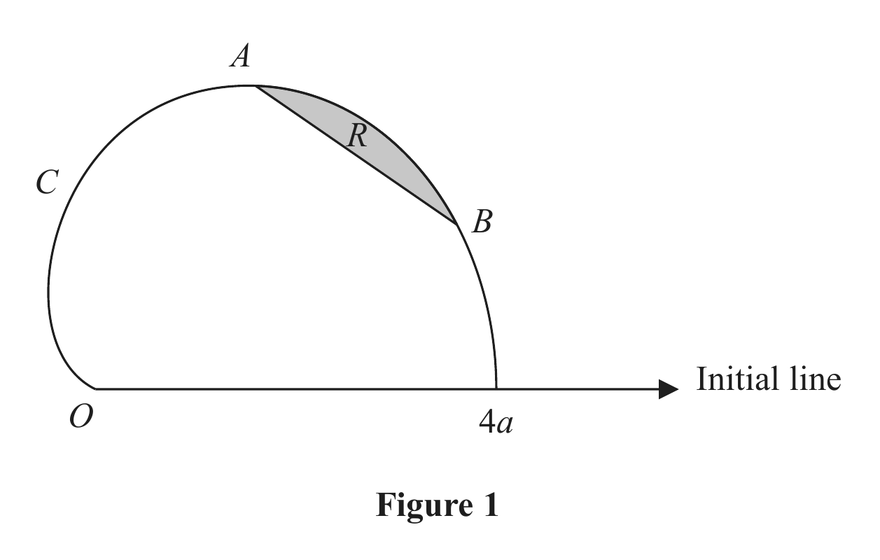
The curve C, shown in Figure 1, has polar equation
r=2a(1+cosθ)0⩽θ⩽π
where a is a positive constant.
The tangent to C at the point A is parallel to the initial line.
(a) Determine the polar coordinates of A.
(6)
The point B on the curve has polar coordinates (a(2+3),6π).
The finite region R, shown shaded in Figure 1, is bounded by the curve C and the line AB.
(b) Use calculus to determine the exact area of the shaded region R.
Give your answer in the form
4a2(dπ−e+f3)
where d, e and f are integers.
(7)
题目中文翻译
图 1 中的曲线 C 的极坐标方程为
r=2a(1+cosθ)0⩽θ⩽π,
其中 a 为正常数。
曲线 C 在点 A 处的切线平行于始线。
(a) 求 A 的极坐标。
(6)
曲线上点 B 的极坐标为 (a(2+3),6π)。
图 1 中的有限阴影区域 R 由曲线 C 与直线 AB 围成。
(b) 用微积分求阴影区域 R 的精确面积。
将答案写成
4a2(dπ−e+f3)
的形式,其中 d、e、f 为整数。
(7)
解答
(a)
解法一
思路
展开
切线平行于初始线,说明切线水平。极坐标中可以写 y=rsinθ,水平切线对应 dθdy=0。
答题过程
展开
Since
y====rsinθ2a(1+cosθ)sinθ2asinθ+2asinθcosθ2asinθ+asin2θ
Differentiate:
dθdy=2acosθ+2acos2θ
For a horizontal tangent,
2acosθ+2acos2θ=cosθ+cos2θ=cosθ+(2cos2θ−1)=2cos2θ+cosθ−1=(2cosθ−1)(cosθ+1)=00000
In the required part of the curve,
cosθ=21⇒θ=3π
Then
r===2a(1+cos3π)2a(1+21)3a
Therefore
A=(3a,3π)
(b)
解法一
思路
展开
阴影面积等于曲线从 θ=6π 到 θ=3π 扫过的极坐标面积,减去三角形 OAB 的面积。先用倍角公式处理 cos2θ,再代入上下限。
答题过程
展开
Let I be the polar area swept out between π/6 and π/3, and let f(θ)=(1+cosθ)2. Then
I==21∫π/6π/3r2dθ2a2∫π/6π/3f(θ)dθ.
Expand the integrand and use the double-angle formula:
==(1+cosθ)21+2cosθ+cos2θ23+2cosθ+21cos2θ.
An antiderivative is
J(θ)=23θ+2sinθ+41sin2θ.
At the limits,
J(3π)=J(6π)=2π+3+83,4π+1+83.
Therefore
I==2a2[J(3π)−J(6π)]2a2(4π+3−1).
Let T be the area of △OAB. Since OA=3a, OB=a(2+3) and ∠AOB=π/6,
T===21OAOBsin6π21(3a)a(2+3)2143a2(2+3).
The shaded area is
R====I−T2a2(4π+3−1)−43a2(2+3)2a2π+2a23−2a2−23a2−43a234a2(2π−14+53).
Thus d=2, e=14 and f=5.
解法二
思路
展开
也可以不先把 cos2θ 换成倍角形式,而是用分部积分求它的原函数。将产生的 sin2θ 写成 1−cos2θ,便能把同一个积分移到左边求出。最后仍减去三角形 OAB。
答题过程
展开
Let
J=∫cos2θdθ.
Integrating by parts with u=cosθ and dv=cosθdθ gives
J===sinθcosθ+∫sin2θdθsinθcosθ+∫(1−cos2θ)dθsinθcosθ+θ−J.
Hence, up to an additive constant,
2J=J=θ+sinθcosθ,2θ+21sinθcosθ.
At both θ=π/6 and θ=π/3, sinθcosθ=3/4. Therefore
K===∫π/6π/3cos2θdθ21(3π−6π)12π.
Also,
L===∫π/6π/3(1+2cosθ)dθ[θ+2sinθ]π/6π/36π+3−1.
Expanding (1+cosθ)2, the polar area is
I==2a2(L+K)2a2(4π+3−1).
The triangle has area
T===21OAOBsin6π21(3a)a(2+3)2143a2(2+3).
Thus the shaded area is
R===I−T2a2(4π+3−1)−43a2(2+3)4a2(2π−14+53).
Thus d=2, e=14 and f=5.
