Skip to content
CalcGospel 國際數學圖譜
返回

IAL 2021 Jan Q7

A Level / Edexcel / FP2

IAL 2021 Jan Paper · Question 7

题目

Problem

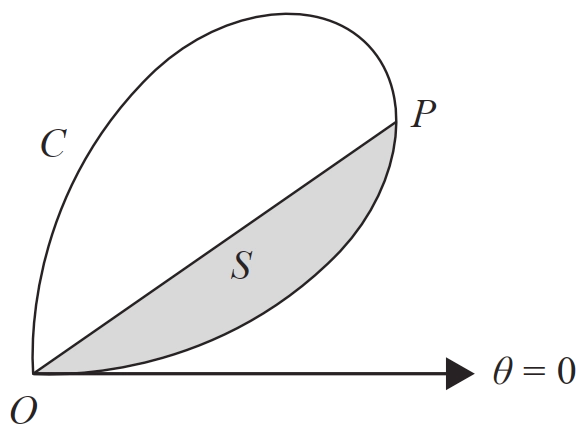
Figure 1

Figure 1 shows a sketch of curve CC with polar equation

r=3sin2θ0θπ2\begin{align*} r = 3\sin 2\theta \qquad 0 \leqslant \theta \leqslant \frac{\pi}{2} \end{align*}

The point PP on CC has polar coordinates (R,ϕ)(R,\phi). The tangent to CC at PP is perpendicular to the initial line.

(a) Show that tanϕ=12\tan\phi = \frac{1}{\sqrt{2}}

(4)

(b) Determine the exact value of RR.

(2)

The region SS, shown shaded in Figure 1, is bounded by CC and the line OPOP, where OO is the pole.

(c) Use calculus to show that the exact area of SS is

parctan12+q2\begin{align*} p\arctan\frac{1}{\sqrt{2}} + q\sqrt{2} \end{align*}

where pp and qq are constants to be determined.

Solutions relying entirely on calculator technology are not acceptable.
(7)

解答

(a)

解法一

思路

展开

切线垂直于 initial line,表示切线是竖直方向。用 x=rcosθx=r\cos\theta,竖直切线对应 dxdθ=0\dfrac{\mathrm{d}x}{\mathrm{d}\theta}=0。这一解法先把 sin2θ\sin2\theta 展开,微分会比较直接。

答题过程

展开

Since

x=rcosθ,\begin{align*} x=r\cos\theta, \end{align*}

we have

x=3sin2θcosθ=6sinθcos2θ.\begin{align*} x=&\,3\sin2\theta\cos\theta\\[4mm] =&\,6\sin\theta\cos^2\theta. \end{align*}

For a tangent perpendicular to the initial line,

dxdθ=0.\begin{align*} \frac{\mathrm{d}x}{\mathrm{d}\theta}=0. \end{align*}

Now

dxdθ=6cosθcos2θ12sin2θcosθ=6cosθ(cos2θ2sin2θ).\begin{align*} \frac{\mathrm{d}x}{\mathrm{d}\theta} =&\,6\cos\theta\cos^2\theta-12\sin^2\theta\cos\theta\\[4mm] =&\,6\cos\theta(\cos^2\theta-2\sin^2\theta). \end{align*}

At PP, θ=ϕ\theta=\phi and 0<ϕ<π20<\phi<\dfrac{\pi}{2}, so cosϕ0\cos\phi\neq0. Therefore,

cos2ϕ2sin2ϕ=0cos2ϕ=2sin2ϕtan2ϕ=12.\begin{align*} \cos^2\phi-2\sin^2\phi=&\,0\\[4mm] \cos^2\phi=&\,2\sin^2\phi\\[4mm] \tan^2\phi=&\,\frac12. \end{align*}

Since ϕ\phi is in the first quadrant,

tanϕ=12.\begin{align*} \tan\phi=\frac1{\sqrt2}. \end{align*}

解法二

思路

展开

也可以不先展开成 6sinθcos2θ6\sin\theta\cos^2\theta,而是直接对

x=3sin2θcosθ\begin{align*} x=3\sin2\theta\cos\theta \end{align*}

使用 product rule。最后仍然会得到同一个条件。

答题过程

展开

Since

x=rcosθ=3sin2θcosθ,\begin{align*} x=r\cos\theta=3\sin2\theta\cos\theta, \end{align*}

a tangent perpendicular to the initial line requires

dxdθ=0.\begin{align*} \frac{\mathrm{d}x}{\mathrm{d}\theta}=0. \end{align*}

Differentiate using the product rule:

dxdθ=6cos2θcosθ3sin2θsinθ.\begin{align*} \frac{\mathrm{d}x}{\mathrm{d}\theta} =&\,6\cos2\theta\cos\theta -3\sin2\theta\sin\theta. \end{align*}

At θ=ϕ\theta=\phi,

6cos2ϕcosϕ3sin2ϕsinϕ=02cos2ϕcosϕsin2ϕsinϕ=0.\begin{align*} 6\cos2\phi\cos\phi -3\sin2\phi\sin\phi =&\,0\\[4mm] 2\cos2\phi\cos\phi -\sin2\phi\sin\phi =&\,0. \end{align*}

Using sin2ϕ=2sinϕcosϕ\sin2\phi=2\sin\phi\cos\phi and cos2ϕ=cos2ϕsin2ϕ\cos2\phi=\cos^2\phi-\sin^2\phi,

2(cos2ϕsin2ϕ)cosϕ2sin2ϕcosϕ=02cosϕ(cos2ϕ2sin2ϕ)=0.\begin{align*} 2(\cos^2\phi-\sin^2\phi)\cos\phi -2\sin^2\phi\cos\phi =&\,0\\[4mm] 2\cos\phi(\cos^2\phi-2\sin^2\phi) =&\,0. \end{align*}

Since 0<ϕ<π20<\phi<\dfrac{\pi}{2}, cosϕ0\cos\phi\neq0. Therefore,

cos2ϕ=2sin2ϕtan2ϕ=12.\begin{align*} \cos^2\phi=&\,2\sin^2\phi\\[4mm] \tan^2\phi=&\,\frac12. \end{align*}

Since ϕ\phi is in the first quadrant,

tanϕ=12.\begin{align*} \tan\phi=\frac1{\sqrt2}. \end{align*}

(b)

解法一

思路

展开

tanϕ=12\tan\phi=\dfrac1{\sqrt2} 可取一个直角三角形:opposite =1=1,adjacent =2=\sqrt2,hypotenuse =3=\sqrt3。然后代入 R=3sin2ϕR=3\sin2\phi

答题过程

展开

From

tanϕ=12,\begin{align*} \tan\phi=\frac1{\sqrt2}, \end{align*}

we have

sinϕ=13,cosϕ=23.\begin{align*} \sin\phi=\frac1{\sqrt3},\qquad \cos\phi=\frac{\sqrt2}{\sqrt3}. \end{align*}

Therefore,

R=3sin2ϕ=6sinϕcosϕ=6(13)(23)=22.\begin{align*} R =&\,3\sin2\phi\\[4mm] =&\,6\sin\phi\cos\phi\\[4mm] =&\,6\left(\frac1{\sqrt3}\right)\left(\frac{\sqrt2}{\sqrt3}\right)\\[4mm] =&\,2\sqrt2. \end{align*}

(c)

解法一

思路

展开

阴影区域从 θ=0\theta=0θ=ϕ\theta=\phi,所以面积用

120ϕr2dθ.\begin{align*} \frac12\int_0^\phi r^2\,\mathrm{d}\theta. \end{align*}

最后要把 ϕ=arctan12\phi=\arctan\dfrac1{\sqrt2}sin4ϕ\sin4\phi 的精确值代入。

答题过程

展开

The area of SS is

120ϕr2dθ=120ϕ9sin22θdθ=920ϕ1cos4θ2dθ=94[θ14sin4θ]0ϕ=94ϕ916sin4ϕ.\begin{align*} \frac12\int_0^\phi r^2\,\mathrm{d}\theta =&\,\frac12\int_0^\phi 9\sin^2 2\theta\,\mathrm{d}\theta\\[4mm] =&\,\frac92\int_0^\phi \frac{1-\cos4\theta}{2}\,\mathrm{d}\theta\\[4mm] =&\,\frac94\left[\theta-\frac14\sin4\theta\right]_0^\phi\\[4mm] =&\,\frac94\phi-\frac9{16}\sin4\phi. \end{align*}

Now

ϕ=arctan12.\begin{align*} \phi=\arctan\frac1{\sqrt2}. \end{align*}

Also,

sin4ϕ=2sin2ϕcos2ϕ=4sinϕcosϕ(cos2ϕsin2ϕ)=4(13)(23)(2313)=429.\begin{align*} \sin4\phi =&\,2\sin2\phi\cos2\phi\\[4mm] =&\,4\sin\phi\cos\phi(\cos^2\phi-\sin^2\phi)\\[4mm] =&\,4\left(\frac1{\sqrt3}\right)\left(\frac{\sqrt2}{\sqrt3}\right) \left(\frac23-\frac13\right)\\[4mm] =&\,\frac{4\sqrt2}{9}. \end{align*}

Therefore,

Area of S=94arctan12916429=94arctan1224.\begin{align*} \text{Area of }S =&\,\frac94\arctan\frac1{\sqrt2} -\frac9{16}\cdot\frac{4\sqrt2}{9}\\[4mm] =&\,\frac94\arctan\frac1{\sqrt2}-\frac{\sqrt2}{4}. \end{align*}

Thus

p=94,q=14.\begin{align*} p=\frac94,\qquad q=-\frac14. \end{align*}