题目
Problem
8.
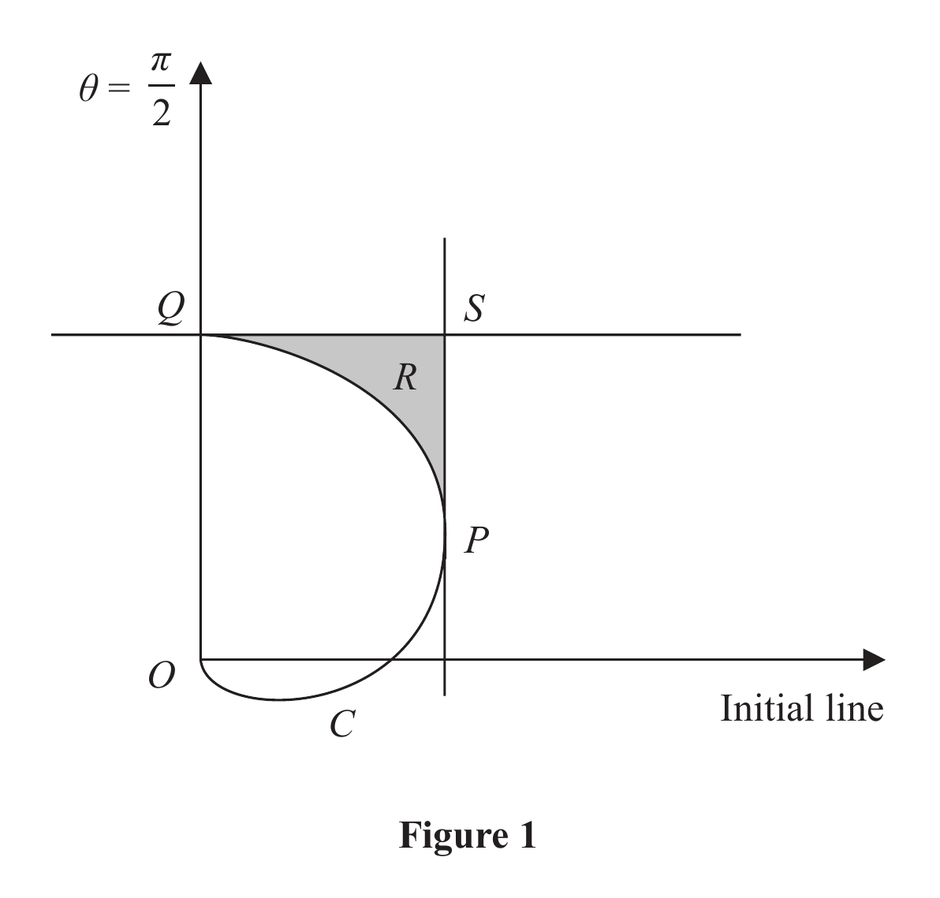
The curve C shown in Figure 1 has polar equation
r=1+sinθ,−2π<θ⩽2π.
The point P lies on C such that the tangent to C at P is perpendicular to the initial line.
(a) Use calculus to determine the polar coordinates of P.
(5)
The tangent to C at the point Q where θ=2π is parallel to the initial line.
The tangent to C at Q meets the tangent to C at P at the point S, as shown in Figure 1.
The finite region R, shown shaded in Figure 1, is bounded by the line segments QS, SP and the curve C.
(b) Use algebraic integration to show that the area of R is
321(a3+bπ)
where a and b are integers to be determined.
(6)
题目中文翻译
8. 图 1 所示曲线 C 的极坐标方程为
r=1+sinθ,−2π<θ⩽2π.
点 P 在 C 上,且 C 在 P 处的切线垂直于始边。
(a) 用微积分求 P 的极坐标。
(5)
曲线 C 在 θ=2π 对应的点 Q 处的切线平行于始边。
如图 1 所示,C 在 Q 处的切线与 C 在 P 处的切线交于点 S。
图 1 中阴影所示的有限区域 R 由线段 QS、SP 及曲线 C 围成。
(b) 用代数积分证明,R 的面积为
321(a3+bπ),
其中 a 和 b 是待求的整数。
(6)
解答
(a)
解法一
思路
展开
切线 perpendicular to the initial line,就是切线竖直。极坐标中
x=rcosθ.
竖直切线对应 dθdx=0。这里 r=1+sinθ,所以先对 x=(1+sinθ)cosθ 求导。
答题过程
展开
For the curve
r=1+sinθ,
we have
x==rcosθ(1+sinθ)cosθ.
Differentiate:
===dθdxcosθcosθ−(1+sinθ)sinθcos2θ−sinθ−sin2θcos2θ−sinθ.
For a tangent perpendicular to the initial line,
dθdx=0.
So
cos2θ−sinθ−sin2θ=0.
Use cos2θ=1−sin2θ:
==1−sin2θ−sinθ−sin2θ0,1−sinθ−2sin2θ0.
Therefore
2sin2θ+sinθ−1=0.
Factorise:
=(2sinθ−1)×(sinθ+1)0.
Hence
sinθ=or sinθ=21−1.
Since
−2π<θ⩽2π,
the value sinθ=−1 would give θ=−2π, which is not in the domain. Therefore
θ=6π.
Then
r=1+sin6π=23.
So the polar coordinates of P are
(23,6π).
(b)
解法一
思路
展开
先把 P 和 Q 的 Cartesian coordinates 找出来。Q 在 θ=2π,所以 Q=(0,2)。P 的竖直切线与 Q 的水平切线相交于 S。
记梯形 OQSP 的面积为 AT,极坐标扇形 OQP 的面积为 AS,所求区域 R 的面积为 AR,则
AR=AT−AS.
其中极坐标扇形面积用
21∫r2dθ.
答题过程
展开
From part (a),
P=(23,6π)
in polar coordinates. In Cartesian coordinates,
xP=23cos6π=433,
and
yP=23sin6π=43.
So
P=(433,43).
At Q, θ=2π, so
r=1+sin2π=2.
Hence
Q=(0,2).
The tangent at Q is horizontal and the tangent at P is vertical, so
S=(433,2).
Let AT be the area of trapezium OQSP. Then
AT===21[2+(2−43)]×43321(413)×43332393.
Let AS be the area of polar sector OQP. Then
AS==21∫6π2πr2dθ21∫6π2π(1+sinθ)2dθ.
Expand the integrand:
=(1+sinθ)21+2sinθ+sin2θ.
Use
sin2θ=21−21cos2θ.
Then
==(1+sinθ)21+2sinθ+21−21cos2θ23+2sinθ−21cos2θ.
So
==∫(1+sinθ)2dθ∫23dθ+2∫sinθdθ−21∫cos2θdθ23θ−2cosθ−41sin2θ+C.
Define
F(θ)=23θ−2cosθ−41sin2θ.
Applying the limits,
AS=21[F(θ)]6π2π.
At θ=2π,
F(2π)==23(2π)−2cos2π−41sinπ43π.
At θ=6π,
F(6π)===4π−2(23)−41(23)4π−3−834π−893.
Therefore
AS===21[43π−(4π−893)]21(2π+893)4π+1693.
Hence the area AR of R is
AR====AT−AS32393−(4π+1693)32393−328π−3218332213−8π.
Thus
a=21,b=−8.
