Skip to content
CalcGospel 國際數學圖譜
返回

FP2 2022 Jan Q8

A Level / Edexcel / FP2

IAL 2022 Jan Paper · Question 8

题目

Problem

8.

(a) Show that the transformation v=y−2xv = y - 2x transforms the differential equation

 dydx+2yx(y−4x)= 2−8x3(I)\begin{align*} &\,\frac{\mathrm{d}y}{\mathrm{d}x}+2yx(y-4x)\\[4mm] =&\,2-8x^3\qquad\text{(I)} \end{align*}

into the differential equation

dvdx=−2xv2(II)\begin{align*} \frac{\mathrm{d}v}{\mathrm{d}x} = -2xv^2 \qquad \text{(II)} \end{align*}
(4)

(b) Solve the differential equation (II) to determine vv as a function of xx

(4)

(c) Hence obtain the general solution of the differential equation (I).

(1)

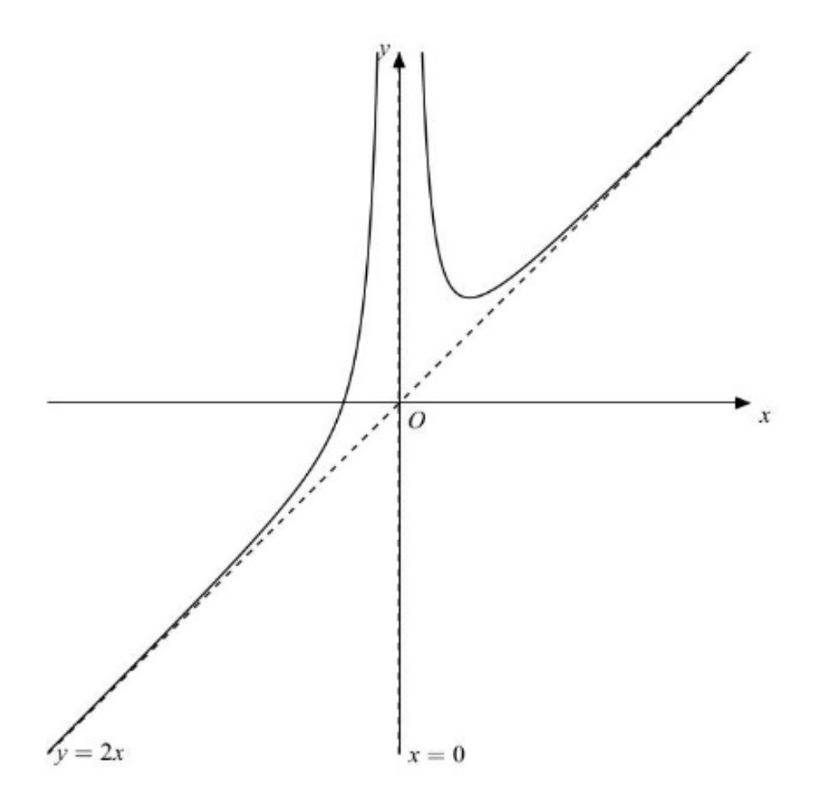
(d) Sketch the solution curve that passes through the point (−1,−1)(-1, -1).

On your sketch show clearly the equation of any horizontal or vertical asymptotes.

You do not need to find the coordinates of any intercepts with the coordinate axes or the coordinates of any stationary points.

(5)
题目中文翻译

8. (a) 证明变换 v=y−2xv=y-2x 将微分方程

 dydx+2yx(y−4x)= 2−8x3(I)\begin{align*} &\,\frac{\mathrm{d}y}{\mathrm{d}x}+2yx(y-4x)\\[4mm] =&\,2-8x^3\qquad\text{(I)} \end{align*}

化为微分方程

dvdx=−2xv2(II).\begin{align*} \frac{\mathrm{d}v}{\mathrm{d}x}=-2xv^2\qquad\text{(II)}. \end{align*}
(4)

(b) 解微分方程 (II),将 vv 表示为 xx 的函数。

(4)

(c) 由此求微分方程 (I) 的通解。

(1)

(d) 画出经过点 (−1,−1)(-1,-1) 的解曲线的示意图。

在图上清楚标出所有水平或竖直渐近线的方程。

不需要求曲线与坐标轴交点的坐标,也不需要求任何驻点的坐标。

(5)

解答

(a)

解法一

思路

展开

由

v=y−2x\begin{align*} v=y-2x \end{align*}

得 y=v+2xy=v+2x,且

dydx=dvdx+2.\begin{align*} \frac{\mathrm{d}y}{\mathrm{d}x} =\frac{\mathrm{d}v}{\mathrm{d}x}+2. \end{align*}

把这些代入原方程后,利用

y−4x=v−2x\begin{align*} y-4x=v-2x \end{align*}

化简。

答题过程

展开

Given

v=y−2x,\begin{align*} v=y-2x, \end{align*}

we have

y=v+2x.\begin{align*} y=v+2x. \end{align*}

Differentiate:

dvdx= dydx−2.\begin{align*} \frac{\mathrm{d}v}{\mathrm{d}x} =&\,\frac{\mathrm{d}y}{\mathrm{d}x}-2. \end{align*}

So

dydx= dvdx+2.\begin{align*} \frac{\mathrm{d}y}{\mathrm{d}x} =&\,\frac{\mathrm{d}v}{\mathrm{d}x}+2. \end{align*}

Substitute into (I):

 dvdx+2 +2x(v+2x)(v+2x−4x)= 2−8x3.\begin{align*} &\,\frac{\mathrm{d}v}{\mathrm{d}x}+2\\[4mm] &\,\hspace{2pt}+2x(v+2x)\Big(v+2x-4x\Big)\\[4mm] =&\,2-8x^3. \end{align*}

Since

v+2x−4x=v−2x,\begin{align*} v+2x-4x=v-2x, \end{align*}

we get

 dvdx+2 +2x(v+2x)(v−2x)= 2−8x3.\begin{align*} &\,\frac{\mathrm{d}v}{\mathrm{d}x}+2\\[4mm] &\,\hspace{2pt}+2x(v+2x)(v-2x)\\[4mm] =&\,2-8x^3. \end{align*}

Use difference of squares:

(v+2x)(v−2x)=v2−4x2.\begin{align*} (v+2x)(v-2x)=v^2-4x^2. \end{align*}

Therefore

 dvdx+2 +2x(v2−4x2)= 2−8x3.\begin{align*} &\,\frac{\mathrm{d}v}{\mathrm{d}x}+2\\[4mm] &\,\hspace{2pt}+2x(v^2-4x^2)\\[4mm] =&\,2-8x^3. \end{align*}

Expand:

 dvdx+2 +2xv2−8x3= 2−8x3.\begin{align*} &\,\frac{\mathrm{d}v}{\mathrm{d}x}+2\\[4mm] &\,\hspace{2pt}+2xv^2-8x^3\\[4mm] =&\,2-8x^3. \end{align*}

Cancel 2−8x32-8x^3 from both sides:

dvdx+2xv2=0.\begin{align*} \frac{\mathrm{d}v}{\mathrm{d}x}+2xv^2=0. \end{align*}

Hence

dvdx=−2xv2.\begin{align*} \frac{\mathrm{d}v}{\mathrm{d}x}=-2xv^2. \end{align*}

(b)

解法一

思路

展开

(II) 是 separable differential equation:

dvdx=−2xv2.\begin{align*} \frac{\mathrm{d}v}{\mathrm{d}x}=-2xv^2. \end{align*}

把 vv 放一边、xx 放一边,然后积分。

答题过程

展开

From (II),

dvdx=−2xv2.\begin{align*} \frac{\mathrm{d}v}{\mathrm{d}x}=-2xv^2. \end{align*}

Separate the variables:

1v2dvdx=−2x.\begin{align*} \frac{1}{v^2}\frac{\mathrm{d}v}{\mathrm{d}x}=-2x. \end{align*}

So

∫v−2 dv= ∫−2x dx.\begin{align*} \int v^{-2}\,\mathrm{d}v =&\,\int -2x\,\mathrm{d}x. \end{align*}

Integrate:

−v−1= −x2+C.\begin{align*} -v^{-1} =&\,-x^2+C. \end{align*}

Multiply by −1-1:

1v=x2+C.\begin{align*} \frac1v=x^2+C. \end{align*}

Therefore

v=1x2+C.\begin{align*} v=\frac{1}{x^2+C}. \end{align*}

(c)

解法一

思路

展开

由 v=y−2xv=y-2x 得 y=v+2xy=v+2x。把 (b) 的 vv 代入即可。

答题过程

展开

Since

v=y−2x,\begin{align*} v=y-2x, \end{align*}

we have

y=v+2x.\begin{align*} y=v+2x. \end{align*}

Using

v=1x2+C,\begin{align*} v=\frac{1}{x^2+C}, \end{align*}

the general solution of (I) is

y=2x+1x2+C.\begin{align*} y=2x+\frac{1}{x^2+C}. \end{align*}

(d)

解法一

思路

展开

先用点 (−1,−1)(-1,-1) 求出常数 CC。得到具体曲线后,再判断渐近线。若

y=2x+1x2,\begin{align*} y=2x+\frac1{x^2}, \end{align*}

则 x=0x=0 是 vertical asymptote;当 ∣x∣|x| 很大时,1x2→0\dfrac1{x^2}\to0,所以曲线接近斜线 y=2xy=2x。题目只要求 horizontal 或 vertical asymptotes,因此需要标出 x=0x=0。

答题过程

展开

From part (c),

y=2x+1x2+C.\begin{align*} y=2x+\frac{1}{x^2+C}. \end{align*}

The curve passes through (−1,−1)(-1,-1), so

−1= 2(−1)+1(−1)2+C= −2+11+C.\begin{align*} -1 =&\,2(-1)+\frac{1}{(-1)^2+C}\\[2mm] =&\,-2+\frac{1}{1+C}. \end{align*}

Thus

1=11+C.\begin{align*} 1=\frac{1}{1+C}. \end{align*}

So

C=0.\begin{align*} C=0. \end{align*}

Hence the required solution curve is

y=2x+1x2.\begin{align*} y=2x+\frac1{x^2}. \end{align*}

The vertical asymptote is

x=0.\begin{align*} x=0. \end{align*}

There is no horizontal asymptote. As x→±∞x\to\pm\infty,

y−2x=1x2→0,\begin{align*} y-2x=\frac1{x^2}\to0, \end{align*}

so the curve approaches the oblique asymptote y=2xy=2x.

For the sketch:

  • one branch lies for x<0x<0, passes through (−1,−1)(-1,-1), and tends to +∞+\infty as x→0−x\to0^-;
  • the other branch lies for x>0x>0, tends to +∞+\infty as x→0+x\to0^+, then has a minimum in the first quadrant before rising again;
  • mark the vertical asymptote x=0x=0.