Skip to content
CalcGospel 國際數學圖譜
返回

IAL 2022 June Q6

A Level / Edexcel / FP2

IAL 2022 June Paper · Question 6

题目

Problem

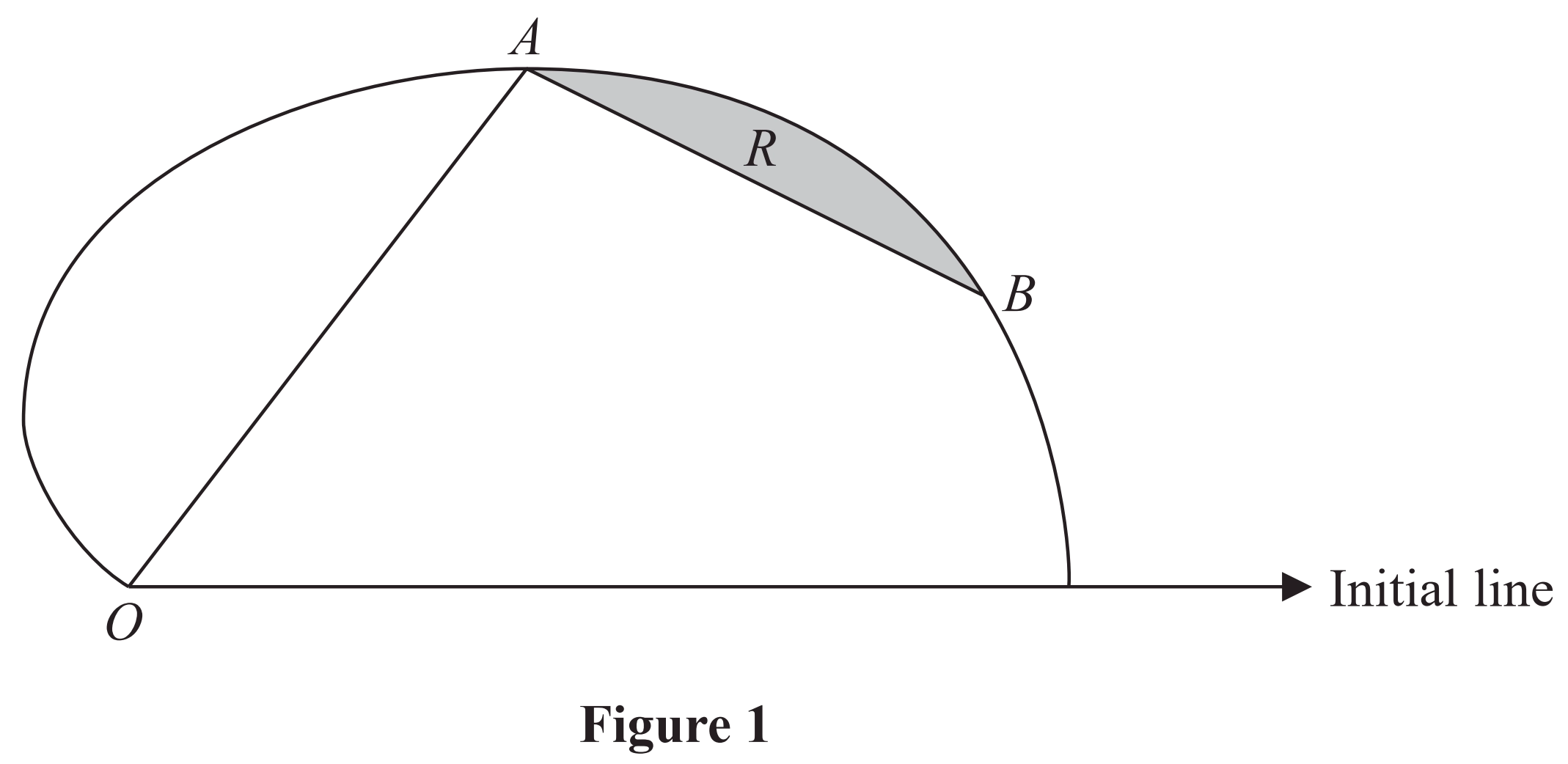
Figure 1

The curve shown in Figure 1 has polar equation

r=4a(1+cosθ),0θ<π\begin{align*} r =\,& 4a(1 + \cos \theta), \qquad 0 \leqslant \theta < \pi\\[2mm] \end{align*}

where aa is a positive constant.

The tangent to the curve at the point AA is parallel to the initial line.

(a) Show that the polar coordinates of AA are (6a,π3)\left( 6a, \frac{\pi}{3} \right)

(6)

The point BB lies on the curve such that angle AOB=π6AOB = \frac{\pi}{6}

The finite region RR , shown shaded in Figure 1, is bounded by the line ABAB and the curve.

(b) Use calculus to determine the area of the shaded region RR , giving your answer in the form a2(nπ+p3+q)a^2 (n\pi + p\sqrt{3} + q) , where n,pn, p and qq are integers.

(7)

解答

(a)

解法一

思路

展开

极坐标曲线要判断切线是否平行于 initial line,可以转成

y=rsinθ.\begin{align*} y=r\sin\theta. \end{align*}

切线平行于 initial line 表示水平切线,所以令 dydθ=0\dfrac{\mathrm{d}y}{\mathrm{d}\theta}=0。求出对应的 θ\theta 后,再代回 r=4a(1+cosθ)r=4a(1+\cos\theta)

答题过程

展开

For the polar curve,

r=4a(1+cosθ).\begin{align*} r=4a(1+\cos\theta). \end{align*}

Using y=rsinθy=r\sin\theta,

y=4a(1+cosθ)sinθ.\begin{align*} y=&\,4a(1+\cos\theta)\sin\theta. \end{align*}

Differentiate with respect to θ\theta:

dydθ=4a{sin2θ+(1+cosθ)cosθ}=4a(cosθ+cos2θsin2θ)=4a(cosθ+cos2θ).\begin{align*} \frac{\mathrm{d}y}{\mathrm{d}\theta} =&\,4a\left\{-\sin^2\theta+(1+\cos\theta)\cos\theta\right\}\\[2mm] =&\,4a(\cos\theta+\cos^2\theta-\sin^2\theta)\\[2mm] =&\,4a(\cos\theta+\cos 2\theta). \end{align*}

At AA, the tangent is parallel to the initial line, so

dydθ=0.\begin{align*} \frac{\mathrm{d}y}{\mathrm{d}\theta}=0. \end{align*}

Hence

cosθ+cos2θ=0cosθ+2cos2θ1=02cos2θ+cosθ1=0(2cosθ1)(cosθ+1)=0.\begin{align*} \cos\theta+\cos2\theta=&\,0\\[2mm] \cos\theta+2\cos^2\theta-1=&\,0\\[2mm] 2\cos^2\theta+\cos\theta-1=&\,0\\[2mm] (2\cos\theta-1)(\cos\theta+1)=&\,0. \end{align*}

Since 0θ<π0\leqslant\theta<\pi,

cosθ=12θ=π3.\begin{align*} \cos\theta=\frac{1}{2} \quad\Longrightarrow\quad \theta=\frac{\pi}{3}. \end{align*}

Then

r=4a(1+cosπ3)=4a(1+12)=6a.\begin{align*} r=&\,4a\left(1+\cos\frac{\pi}{3}\right)\\[2mm] =&\,4a\left(1+\frac{1}{2}\right)\\[2mm] =&\,6a. \end{align*}

Therefore the polar coordinates of AA are

(6a,π3).\begin{align*} \boxed{\left(6a,\frac{\pi}{3}\right)}. \end{align*}

(b)

解法一

思路

展开

阴影区域是「曲线从 BBAA 扫出的极坐标面积」减去三角形 OABOAB

由 (a) 知 AA 的角是 π3\frac{\pi}{3},又 AOB=π6\angle AOB=\frac{\pi}{6},所以 BB 的角是 π6\frac{\pi}{6}。先用

12αβr2dθ\begin{align*} \frac{1}{2}\int_{\alpha}^{\beta}r^2\,\mathrm{d}\theta \end{align*}

求曲线扇形面积,再减去

12(OA)(OB)sinAOB.\begin{align*} \frac{1}{2}(OA)(OB)\sin\angle AOB. \end{align*}

答题过程

展开

From part (a),

A=(6a,π3).\begin{align*} A=\left(6a,\frac{\pi}{3}\right). \end{align*}

Since AOB=π6\angle AOB=\dfrac{\pi}{6}, the polar angle of BB is

π3π6=π6.\begin{align*} \frac{\pi}{3}-\frac{\pi}{6} =\frac{\pi}{6}. \end{align*}

The area swept out by the curve from BB to AA is

12π6π3{4a(1+cosθ)}2dθ=8a2π6π3(1+cosθ)2dθ.\begin{align*} \frac{1}{2}\int_{\frac{\pi}{6}}^{\frac{\pi}{3}} \{4a(1+\cos\theta)\}^2\,\mathrm{d}\theta =&\,8a^2\int_{\frac{\pi}{6}}^{\frac{\pi}{3}} (1+\cos\theta)^2\,\mathrm{d}\theta. \end{align*}

Expanding the integrand,

8a2π6π3(1+cosθ)2dθ=8a2π6π3(1+2cosθ+cos2θ)dθ.\begin{align*} 8a^2\int_{\frac{\pi}{6}}^{\frac{\pi}{3}} (1+\cos\theta)^2\,\mathrm{d}\theta =&\,8a^2\int_{\frac{\pi}{6}}^{\frac{\pi}{3}} (1+2\cos\theta+\cos^2\theta)\,\mathrm{d}\theta. \end{align*}

Using

cos2θ=1+cos2θ2,\begin{align*} \cos^2\theta=\frac{1+\cos2\theta}{2}, \end{align*}

the area is

8a2[3θ2+2sinθ+14sin2θ]π6π3=8a2{π4+31}.\begin{align*} 8a^2 \left[ \frac{3\theta}{2}+2\sin\theta+\frac{1}{4}\sin2\theta \right]_{\frac{\pi}{6}}^{\frac{\pi}{3}} =&\,8a^2 \left\{ \frac{\pi}{4}+\sqrt{3}-1 \right\}. \end{align*}

Now find the area of triangle OABOAB.

At BB,

OB=4a(1+cosπ6)=4a(1+32)=4a+2a3.\begin{align*} OB=&\,4a\left(1+\cos\frac{\pi}{6}\right)\\[2mm] =&\,4a\left(1+\frac{\sqrt{3}}{2}\right)\\[2mm] =&\,4a+2a\sqrt{3}. \end{align*}

Also OA=6aOA=6a and AOB=π6\angle AOB=\dfrac{\pi}{6}. Therefore

area of triangle OAB=12(6a)(4a+2a3)sinπ6=12(6a)(4a+2a3)12=6a2+3a23.\begin{align*} \text{area of triangle }OAB =&\,\frac{1}{2}(6a)(4a+2a\sqrt{3}) \sin\frac{\pi}{6}\\[2mm] =&\,\frac{1}{2}(6a)(4a+2a\sqrt{3}) \cdot\frac{1}{2}\\[2mm] =&\,6a^2+3a^2\sqrt{3}. \end{align*}

So the shaded area is

8a2(π4+31)(6a2+3a23)=2πa2+8a238a26a23a23=a2(2π+5314).\begin{align*} 8a^2\left(\frac{\pi}{4}+\sqrt{3}-1\right) &-(6a^2+3a^2\sqrt{3})\\[2mm] =&\,2\pi a^2+8a^2\sqrt{3}-8a^2\\[2mm] &\,\hspace{2pt}-6a^2-3a^2\sqrt{3}\\[2mm] =&\,a^2(2\pi+5\sqrt{3}-14). \end{align*}

Therefore

n=2,p=5,q=14.\begin{align*} \boxed{n=2,\qquad p=5,\qquad q=-14}. \end{align*}