Skip to content
CalcGospel 國際數學圖譜
返回

IAL 2023 Jan Q8

A Level / Edexcel / FP2

IAL 2023 Jan Paper · Question 8

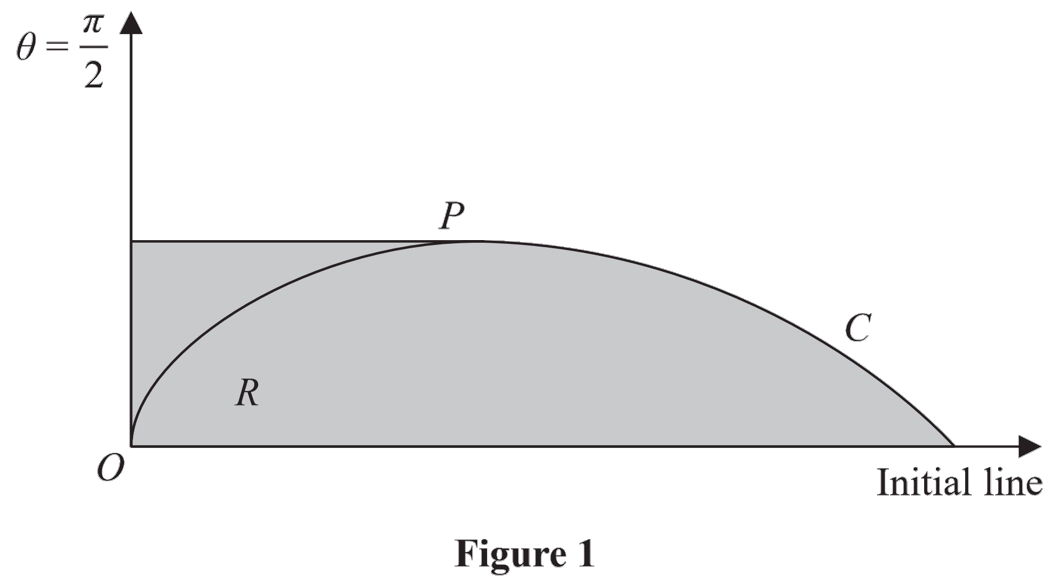
Figure 1

The curve CC shown in Figure 1 has polar equation

r=1sinθ0θ<π2\begin{align*} r =\,& 1 - \sin \theta \qquad 0 \leqslant \theta < \frac{\pi}{2}\\[2mm] \end{align*}

The point PP lies on CC , such that the tangent to CC at PP is parallel to the initial line.

(a) Use calculus to determine the polar coordinates of PP

(4)

The finite region RR , shown shaded in Figure 1, is bounded by

  • the line with equation θ=π2\theta = \frac{\pi}{2}
  • the tangent to CC at PP
  • part of the curve CC
  • the initial line

(b) Use algebraic integration to show that the area of RR is

132(aπ+b3+c)\begin{align*} \frac{1}{32}(a\pi + b\sqrt{3} + c)\\[2mm] \end{align*}

where aa , bb and cc are integers to be determined.

(6)

解答

(a)

The curve is r=1sinθr = 1 - \sin\theta. The tangent at PP is parallel to the initial line, which means the yy-coordinate is at a maximum or minimum, so dydθ=0\frac{\mathrm{d}y}{\mathrm{d}\theta} = 0.

y=rsinθ=(1sinθ)sinθ=sinθsin2θ\begin{align*} y = &\,r\sin\theta\\[4mm] = &\,(1 - \sin\theta)\sin\theta\\[4mm] = &\,\sin\theta - \sin^2\theta \end{align*}

Differentiate with respect to θ\theta:

dydθ=cosθ2sinθcosθ\begin{align*} \frac{\mathrm{d}y}{\mathrm{d}\theta} = &\,\cos\theta - 2\sin\theta\cos\theta \end{align*}

Set this to zero to find the turning point:

cosθ(12sinθ)=0\begin{align*} \cos\theta(1 - 2\sin\theta) = &\,0 \end{align*}

Since 0θ<π20 \le \theta < \frac{\pi}{2}, cosθ0\cos\theta \neq 0, so we must have:

12sinθ=0sinθ=12θ=π6\begin{align*} 1 - 2\sin\theta = &\,0\\[4mm] \sin\theta = &\,\frac{1}{2}\\[4mm] \theta = &\,\frac{\pi}{6} \end{align*}

Substitute θ=π6\theta = \frac{\pi}{6} into the equation for rr:

r=1sin(π6)=112=12\begin{align*} r = &\,1 - \sin\left(\frac{\pi}{6}\right)\\[4mm] = &\,1 - \frac{1}{2}\\[4mm] = &\,\frac{1}{2} \end{align*}

The polar coordinates of PP are (12,π6)\left( \frac{1}{2}, \frac{\pi}{6} \right).

(b)

The region RR lies below the horizontal tangent at PP, between the vertical line θ=π2\theta = \frac{\pi}{2} (the yy-axis), the curve CC, and the initial line (xx-axis). We can compute the area of RR by adding the area of the triangle formed by the origin, PP, and the yy-axis, to the polar area swept by the curve from θ=0\theta = 0 to θ=π6\theta = \frac{\pi}{6}.

First, find the Cartesian coordinates of PP:

xP=rcos(π6)=12(32)=34yP=rsin(π6)=12(12)=14\begin{align*} x_P = &\,r\cos\left(\frac{\pi}{6}\right) = \frac{1}{2}\left(\frac{\sqrt{3}}{2}\right) = \frac{\sqrt{3}}{4}\\[4mm] y_P = &\,r\sin\left(\frac{\pi}{6}\right) = \frac{1}{2}\left(\frac{1}{2}\right) = \frac{1}{4} \end{align*}

The area of the triangle formed by O(0,0)O(0,0), (0,yP)(0, y_P), and P(xP,yP)P(x_P, y_P) is:

Area of Triangle=12xPyP=12(34)(14)=332\begin{align*} \text{Area of Triangle} = &\,\frac{1}{2} \cdot x_P \cdot y_P\\[4mm] = &\,\frac{1}{2} \left(\frac{\sqrt{3}}{4}\right) \left(\frac{1}{4}\right)\\[4mm] = &\,\frac{\sqrt{3}}{32} \end{align*}

Next, find the polar area of the sector from θ=0\theta=0 to θ=π6\theta=\frac{\pi}{6}:

Area of Sector=120π6r2dθ=120π6(1sinθ)2dθ=120π6(12sinθ+sin2θ)dθ=120π6(12sinθ+1cos2θ2)dθ=120π6(322sinθ12cos2θ)dθ=12[32θ+2cosθ14sin2θ]0π6\begin{align*} \text{Area of Sector} = &\,\frac{1}{2}\int_{0}^{\frac{\pi}{6}} r^2 \,\mathrm{d}\theta\\[4mm] = &\,\frac{1}{2}\int_{0}^{\frac{\pi}{6}} (1 - \sin\theta)^2 \,\mathrm{d}\theta\\[4mm] = &\,\frac{1}{2}\int_{0}^{\frac{\pi}{6}} (1 - 2\sin\theta + \sin^2\theta) \,\mathrm{d}\theta\\[4mm] = &\,\frac{1}{2}\int_{0}^{\frac{\pi}{6}} \left(1 - 2\sin\theta + \frac{1 - \cos 2\theta}{2}\right) \,\mathrm{d}\theta\\[4mm] = &\,\frac{1}{2}\int_{0}^{\frac{\pi}{6}} \left(\frac{3}{2} - 2\sin\theta - \frac{1}{2}\cos 2\theta\right) \,\mathrm{d}\theta\\[4mm] = &\,\frac{1}{2}\left[ \frac{3}{2}\theta + 2\cos\theta - \frac{1}{4}\sin 2\theta \right]_{0}^{\frac{\pi}{6}} \end{align*}

Evaluate the limits:

Upper limit: 12(32(π6)+2cos(π6)14sin(π3))=12(π4+338)=12(π4+738)=π8+7316Lower limit: 12(0+2cos(0)0)=12(2)=1\begin{align*} \text{Upper limit: } & \frac{1}{2}\left( \frac{3}{2}\left(\frac{\pi}{6}\right) + 2\cos\left(\frac{\pi}{6}\right) - \frac{1}{4}\sin\left(\frac{\pi}{3}\right) \right)\\[4mm] = &\,\frac{1}{2}\left( \frac{\pi}{4} + \sqrt{3} - \frac{\sqrt{3}}{8} \right)\\[4mm] = &\,\frac{1}{2}\left( \frac{\pi}{4} + \frac{7\sqrt{3}}{8} \right) = \frac{\pi}{8} + \frac{7\sqrt{3}}{16}\\[4mm] \text{Lower limit: } & \frac{1}{2}\left( 0 + 2\cos(0) - 0 \right) = \frac{1}{2}(2) = 1 \end{align*}

The area of the sector is π8+73161\frac{\pi}{8} + \frac{7\sqrt{3}}{16} - 1.

Total area of RR is the sum of the triangle and the sector:

Total Area=332+(π8+73161)=332+4π32+143323232=132(4π+15332)\begin{align*} \text{Total Area} = &\,\frac{\sqrt{3}}{32} + \left( \frac{\pi}{8} + \frac{7\sqrt{3}}{16} - 1 \right)\\[4mm] = &\,\frac{\sqrt{3}}{32} + \frac{4\pi}{32} + \frac{14\sqrt{3}}{32} - \frac{32}{32}\\[4mm] = &\,\frac{1}{32}\left( 4\pi + 15\sqrt{3} - 32 \right) \end{align*}

This is in the required form 132(aπ+b3+c)\frac{1}{32}(a\pi + b\sqrt{3} + c), where a=4a=4, b=15b=15, and c=32c=-32.