题目
Problem
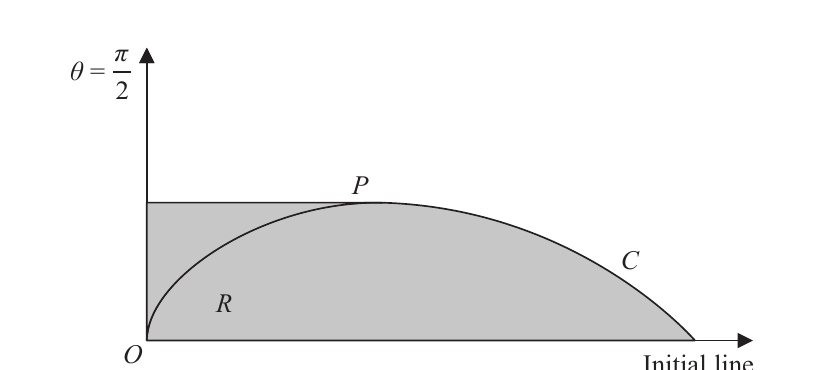
Figure 1
The curve C shown in Figure 1 has polar equation
r=1−sinθ,0⩽θ<2π
The point P lies on C, such that the tangent to C at P is parallel to the initial line.
(a) Use calculus to determine the polar coordinates of P
(4)
The finite region R, shown shaded in Figure 1, is bounded by
- the line with equation θ=2π
- the tangent to C at P
- part of the curve C
- the initial line
(b) Use algebraic integration to show that the area of R is
321(aπ+b3+c)
where a, b and c are integers to be determined.
(6)
解答
(a)
解法一
思路
展开
切线平行于 initial line 表示水平切线。极坐标中先写
y=rsinθ.
然后令 dθdy=0。
答题过程
展开
Since
r=1−sinθ,
we have
y===rsinθ(1−sinθ)sinθsinθ−sin2θ.
Differentiate:
dθdy==cosθ−2sinθcosθcosθ(1−2sinθ).
At P, the tangent is parallel to the initial line, so
dθdy=0.
Since 0⩽θ<2π, cosθ=0 at P. Hence
1−2sinθ=sinθ=θ=0216π.
Then
r===1−sin6π1−2121.
Therefore
P=(21,6π).
(b)
解法一
思路
展开
区域 R 可以看成两部分:
从 θ=0 到 θ=6π 的极坐标面积,加上点 P 到 y 轴形成的小三角形面积。
点 P 的直角坐标是
(43,41).
答题过程
展开
From part (a),
P=(21,6π).
The Cartesian coordinates of P are
xP=yP=21cos6π=43,21sin6π=41.
The triangular part has area
21xPyP==21⋅43⋅41323.
Now calculate the polar area from θ=0 to θ=6π:
21∫06π(1−sinθ)2dθ=21∫06π(1−2sinθ+sin2θ)dθ.
Using
sin2θ=21−cos2θ,
the polar area is
21∫06π(23−2sinθ−21cos2θ)dθ===21[23θ+2cosθ−41sin2θ]06π21(4π+3−83−2)8π+1673−1.
Therefore the area of R is
323+(8π+1673−1)==324π+323+32143−3232321(4π+153−32).
Hence
a=4,b=15,c=−32.