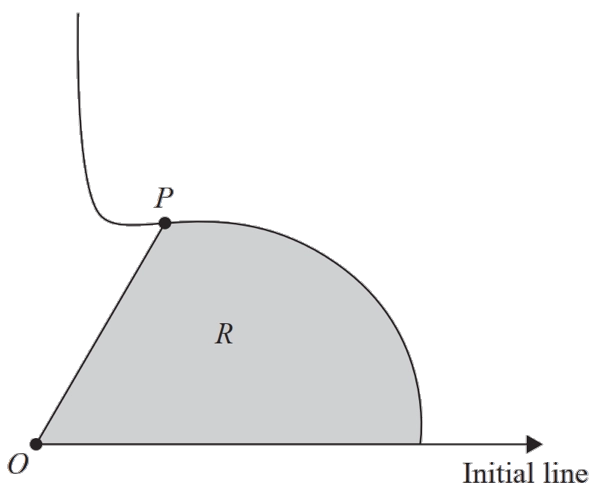
Figure 1 Figure 1 shows a sketch of the curve with polar equation
r = 10 cos θ + tan θ 0 ⩽ θ < π 2 \begin{align*}
r = 10\cos \theta + \tan \theta \qquad 0 \leqslant \theta < \frac{\pi}{2}
\end{align*} r = 10 cos θ + tan θ 0 ⩽ θ < 2 π The point P P P θ = π 3 \theta = \frac{\pi}{3} θ = 3 π
The region R R R O P OP O P O O O
Use algebraic integration to show that the exact area of R R R
1 12 ( a π + b 3 + c ) \begin{align*}
\frac{1}{12}(a\pi + b\sqrt{3} + c)
\end{align*} 12 1 ( aπ + b 3 + c ) where a a a b b b c c c
(9)
解答
The region R R R θ = 0 \theta=0 θ = 0 r = 10 cos θ + tan θ r = 10\cos\theta + \tan\theta r = 10 cos θ + tan θ O P OP O P θ = π 3 \theta = \frac{\pi}{3} θ = 3 π 1 2 ∫ 0 π 3 r 2 d θ \frac{1}{2} \int_{0}^{\frac{\pi}{3}} r^2 \,\mathrm{d}\theta 2 1 ∫ 0 3 π r 2 d θ
First, expand r 2 r^2 r 2
r 2 = ( 10 cos θ + tan θ ) 2 = 100 cos 2 θ + 20 cos θ tan θ + tan 2 θ = 100 cos 2 θ + 20 sin θ + tan 2 θ \begin{align*}
r^2
= &\,(10\cos\theta + \tan\theta)^2\\[4mm]
= &\,100\cos^2\theta + 20\cos\theta\tan\theta + \tan^2\theta\\[4mm]
= &\,100\cos^2\theta + 20\sin\theta + \tan^2\theta
\end{align*} r 2 = = = ( 10 cos θ + tan θ ) 2 100 cos 2 θ + 20 cos θ tan θ + tan 2 θ 100 cos 2 θ + 20 sin θ + tan 2 θ Use trigonometric identities to rewrite the terms for integration:
100 cos 2 θ = 50 ( 1 + cos 2 θ ) = 50 + 50 cos 2 θ 100\cos^2\theta = 50(1 + \cos 2\theta) = 50 + 50\cos 2\theta 100 cos 2 θ = 50 ( 1 + cos 2 θ ) = 50 + 50 cos 2 θ tan 2 θ = sec 2 θ − 1 \tan^2\theta = \sec^2\theta - 1 tan 2 θ = sec 2 θ − 1
So we rewrite the integral:
Area = 1 2 ∫ 0 π 3 ( 50 + 50 cos 2 θ + 20 sin θ + sec 2 θ − 1 ) d θ = 1 2 ∫ 0 π 3 ( 49 + 50 cos 2 θ + 20 sin θ + sec 2 θ ) d θ \begin{align*}
\text{Area}
= &\,\frac{1}{2} \int_{0}^{\frac{\pi}{3}} \left( 50 + 50\cos 2\theta + 20\sin\theta + \sec^2\theta - 1 \right) \,\mathrm{d}\theta\\[4mm]
= &\,\frac{1}{2} \int_{0}^{\frac{\pi}{3}} \left( 49 + 50\cos 2\theta + 20\sin\theta + \sec^2\theta \right) \,\mathrm{d}\theta
\end{align*} Area = = 2 1 ∫ 0 3 π ( 50 + 50 cos 2 θ + 20 sin θ + sec 2 θ − 1 ) d θ 2 1 ∫ 0 3 π ( 49 + 50 cos 2 θ + 20 sin θ + sec 2 θ ) d θ Integrate each term:
Area = 1 2 [ 49 θ + 25 sin 2 θ − 20 cos θ + tan θ ] 0 π 3 \begin{align*}
\text{Area}
= &\,\frac{1}{2} \left[ 49\theta + 25\sin 2\theta - 20\cos\theta + \tan\theta \right]_{0}^{\frac{\pi}{3}}
\end{align*} Area = 2 1 [ 49 θ + 25 sin 2 θ − 20 cos θ + tan θ ] 0 3 π Evaluate at the upper limit θ = π 3 \theta = \frac{\pi}{3} θ = 3 π
1 2 ( 49 ( π 3 ) + 25 sin ( 2 π 3 ) − 20 cos ( π 3 ) + tan ( π 3 ) ) = 1 2 ( 49 π 3 + 25 ( 3 2 ) − 20 ( 1 2 ) + 3 ) = 1 2 ( 49 π 3 + 25 3 2 − 10 + 3 ) = 1 2 ( 49 π 3 + 27 3 2 − 10 ) \begin{align*}
&\,\frac{1}{2} \left( 49\left(\frac{\pi}{3}\right) + 25\sin\left(\frac{2\pi}{3}\right) - 20\cos\left(\frac{\pi}{3}\right) + \tan\left(\frac{\pi}{3}\right) \right)\\[4mm]
= &\,\frac{1}{2} \left( \frac{49\pi}{3} + 25\left(\frac{\sqrt{3}}{2}\right) - 20\left(\frac{1}{2}\right) + \sqrt{3} \right)\\[4mm]
= &\,\frac{1}{2} \left( \frac{49\pi}{3} + \frac{25\sqrt{3}}{2} - 10 + \sqrt{3} \right)\\[4mm]
= &\,\frac{1}{2} \left( \frac{49\pi}{3} + \frac{27\sqrt{3}}{2} - 10 \right)
\end{align*} = = = 2 1 ( 49 ( 3 π ) + 25 sin ( 3 2 π ) − 20 cos ( 3 π ) + tan ( 3 π ) ) 2 1 ( 3 49 π + 25 ( 2 3 ) − 20 ( 2 1 ) + 3 ) 2 1 ( 3 49 π + 2 25 3 − 10 + 3 ) 2 1 ( 3 49 π + 2 27 3 − 10 ) Evaluate at the lower limit θ = 0 \theta = 0 θ = 0
1 2 ( 49 ( 0 ) + 25 sin ( 0 ) − 20 cos ( 0 ) + tan ( 0 ) ) = 1 2 ( − 20 ) = − 10 \begin{align*}
&\,\frac{1}{2} \left( 49(0) + 25\sin(0) - 20\cos(0) + \tan(0) \right)\\[4mm]
= &\,\frac{1}{2} \left( -20 \right)\\[4mm]
= &\,-10
\end{align*} = = 2 1 ( 49 ( 0 ) + 25 sin ( 0 ) − 20 cos ( 0 ) + tan ( 0 ) ) 2 1 ( − 20 ) − 10 Subtract the lower limit from the upper limit:
Total Area = 1 2 ( 49 π 3 + 27 3 2 − 10 ) − ( − 10 ) = 49 π 6 + 27 3 4 − 5 + 10 = 49 π 6 + 27 3 4 + 5 = 98 π + 81 3 + 60 12 = 1 12 ( 98 π + 81 3 + 60 ) \begin{align*}
\text{Total Area}
= &\,\frac{1}{2} \left( \frac{49\pi}{3} + \frac{27\sqrt{3}}{2} - 10 \right) - (-10)\\[4mm]
= &\,\frac{49\pi}{6} + \frac{27\sqrt{3}}{4} - 5 + 10\\[4mm]
= &\,\frac{49\pi}{6} + \frac{27\sqrt{3}}{4} + 5\\[4mm]
= &\,\frac{98\pi + 81\sqrt{3} + 60}{12}\\[4mm]
= &\,\frac{1}{12}(98\pi + 81\sqrt{3} + 60)
\end{align*} Total Area = = = = = 2 1 ( 3 49 π + 2 27 3 − 10 ) − ( − 10 ) 6 49 π + 4 27 3 − 5 + 10 6 49 π + 4 27 3 + 5 12 98 π + 81 3 + 60 12 1 ( 98 π + 81 3 + 60 ) This is in the required form 1 12 ( a π + b 3 + c ) \frac{1}{12}(a\pi+b\sqrt{3}+c) 12 1 ( aπ + b 3 + c ) a = 98 a=98 a = 98 b = 81 b=81 b = 81 c = 60 c=60 c = 60