Skip to content
CalcGospel 國際數學圖譜
返回

IAL 2024 Jan Q5

A Level / Edexcel / FP2

IAL 2024 Jan Paper · Question 5

题目

Problem

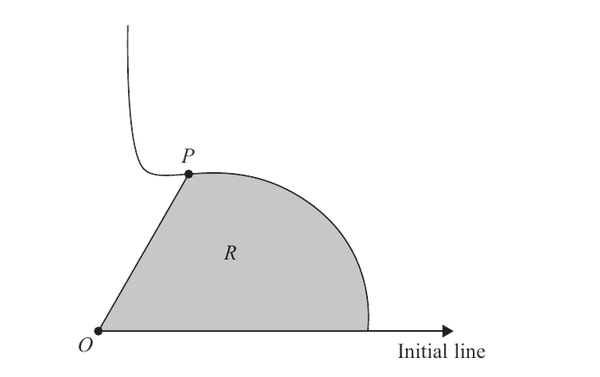
Figure 1

Figure 1 shows a sketch of the curve with polar equation

r=10cosθ+tanθ0θ<π2\begin{align*} r ={}& 10\cos \theta + \tan \theta \qquad 0 \leqslant \theta < \frac{\pi}{2} \end{align*}

The point PP lies on the curve where θ=π3\theta = \frac{\pi}{3}.

The region RR , shown shaded in Figure 1, is bounded by the initial line, the curve and the line OPOP , where OO is the pole.

Use algebraic integration to show that the exact area of RR is

112(aπ+b3+c)\begin{align*} \frac{1}{12}(a\pi + b\sqrt{3} + c) \end{align*}

where aa , bb and cc are integers to be determined.

(9)

解答

解法一

思路

展开

区域由 θ=0\theta=0θ=π3\theta=\frac{\pi}{3} 和曲线围成,所以直接用极坐标面积公式 12r2dθ\frac12\int r^2\,\mathrm{d}\theta。关键是把 r2r^2 展开后改写成容易积分的形式:cos2θ=12(1+cos2θ)\cos^2\theta=\frac12(1+\cos2\theta)tan2θ=sec2θ1\tan^2\theta=\sec^2\theta-1

答题过程

展开

The area is

Area=120π3r2dθ\begin{align*} \text{Area} ={}& \frac12\int_0^{\frac{\pi}{3}} r^2\,\mathrm{d}\theta \end{align*}

First expand r2r^2:

r2=(10cosθ+tanθ)2=100cos2θ+20cosθtanθ+tan2θ=100cos2θ+20sinθ+tan2θ\begin{align*} r^2 ={}& (10\cos\theta+\tan\theta)^2\\[4mm] ={}& 100\cos^2\theta +20\cos\theta\tan\theta +\tan^2\theta\\[4mm] ={}& 100\cos^2\theta +20\sin\theta +\tan^2\theta \end{align*}

Use

cos2θ=12(1+cos2θ)tan2θ=sec2θ1\begin{align*} \cos^2\theta={}&\frac12(1+\cos2\theta)\\[2mm] \tan^2\theta={}&\sec^2\theta-1 \end{align*}

Therefore

Area=120π3(100cos2θ+20sinθ+tan2θ)dθ=120π3(50(1+cos2θ)+20sinθ+sec2θ1)dθ=120π3(49+50cos2θ+20sinθ+sec2θ)dθ\begin{align*} \text{Area} ={}& \frac12\int_0^{\frac{\pi}{3}} \left( 100\cos^2\theta+20\sin\theta+\tan^2\theta \right)\,\mathrm{d}\theta\\[4mm] ={}& \frac12\int_0^{\frac{\pi}{3}} \left( 50(1+\cos2\theta)+20\sin\theta+\sec^2\theta-1 \right)\,\mathrm{d}\theta\\[4mm] ={}& \frac12\int_0^{\frac{\pi}{3}} \left( 49+50\cos2\theta+20\sin\theta+\sec^2\theta \right)\,\mathrm{d}\theta \end{align*}

Integrate:

Area=12[49θ+25sin2θ20cosθ+tanθ]0π3\begin{align*} \text{Area} ={}& \frac12 \left[ 49\theta+25\sin2\theta-20\cos\theta+\tan\theta \right]_0^{\frac{\pi}{3}} \end{align*}

Substitute the limits:

Area=12[(49π3+25sin2π320cosπ3+tanπ3)(0+25sin020cos0+tan0)]=12[(49π3+253210+3)(20)]=12(49π3+2732+10)=49π6+2734+5=98π+813+6012\begin{align*} \text{Area} ={}& \frac12\left[ \left( \frac{49\pi}{3} +25\sin\frac{2\pi}{3} -20\cos\frac{\pi}{3} +\tan\frac{\pi}{3} \right)\right.\\[4mm] &\,\hspace{2pt}\left. -\left( 0+25\sin0-20\cos0+\tan0 \right) \right]\\[4mm] ={}& \frac12\left[ \left( \frac{49\pi}{3} +\frac{25\sqrt3}{2} -10+\sqrt3 \right) -(-20) \right]\\[4mm] ={}& \frac12\left( \frac{49\pi}{3} +\frac{27\sqrt3}{2} +10 \right)\\[4mm] ={}& \frac{49\pi}{6} +\frac{27\sqrt3}{4} +5\\[4mm] ={}& \frac{98\pi+81\sqrt3+60}{12} \end{align*}

This is in the required form

112(aπ+b3+c)\begin{align*} \frac{1}{12}(a\pi+b\sqrt3+c) \end{align*}

where

a=98,b=81,c=60\begin{align*} \boxed{a=98,\qquad b=81,\qquad c=60} \end{align*}