题目
Problem
7.
A transformation T from the z-plane, where z=x+iy , to the w-plane, where w=u+iv is given by
w=2i−zz−3z=2i
The line in the z-plane with equation y=x+3 is mapped by T onto a circle C in the w-plane.
(a) Determine
(i) the coordinates of the centre of C
(ii) the exact radius of C
(8)
The region y>x+3 in the z-plane is mapped by T onto the region R in the w-plane.
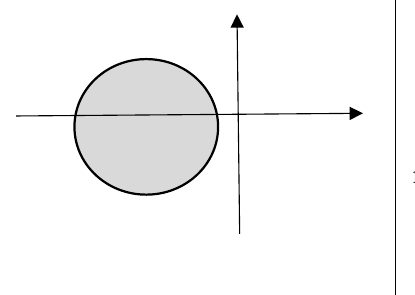
(b) On a single Argand diagram
(i) sketch the circle C
(ii) shade and label the region R
(2)
题目中文翻译
从 z 平面(其中 z=x+iy)到 w 平面(其中 w=u+iv)的变换 T 定义为
w=2i−zz−3,z=2i.
z 平面内方程为 y=x+3 的直线经 T 映射为 w 平面内的圆 C。
(a) 求
(i) 圆 C 的圆心坐标;
(ii) 圆 C 半径的精确值。
(8)
z 平面内的区域 y>x+3 经 T 映射为 w 平面内的区域 R。
(b) 在同一张 Argand 图上
(i) 画出圆 C 的示意图;
(ii) 用阴影表示区域 R,并标记 R。
(2)
解答
(a)(i)
解法一
思路
展开
要求 w-plane 里的圆,可以先把 z 用 w 表示,再令 w=u+iv。然后把得到的 x,y 代入直线 y=x+3,化成圆方程。
答题过程
展开
From
w=2i−zz−3,
make z the subject:
w(2i−z)=2iw−wz=z(w+1)=z=z−3z−33+2iww+13+2iw
Put w=u+iv:
z==u+iv+13+2i(u+iv)(u+1)+iv(3−2v)+2iu
Rationalise the denominator:
z=(u+1)2+v2((3−2v)+2iu)((u+1)−iv)
Expand the numerator:
((3−2v)+2iu)((u+1)−iv)=(3−2v)(u+1)+2uv+i(2u(u+1)−v(3−2v))
Since z=x+iy,
x=y=(u+1)2+v2(3−2v)(u+1)+2uv(u+1)2+v22u(u+1)−v(3−2v)
Use y=x+3:
(u+1)2+v22u(u+1)−v(3−2v)=(u+1)2+v2(3−2v)(u+1)+2uv+3
Multiplying by the denominator and expanding gives
2u2+2u−3v+2v2=2u2+2u−3v+2v2=3u−2v+3+3(u+1)2+3v23u−2v+3+3u2+6u+3+3v2
Therefore
u2+v2+7u+v+6=0
Complete the square:
(u+27)2−449+(v+21)2−41+6=(u+27)2+(v+21)2==0449+41−6213
Hence the centre is
(−27,−21)
解法二
思路
展开
另一种方法是直接把直线写成 z=x+i(x+3),代入变换式,得到 u,v 与参数 x 的关系,再消去 x。
答题过程
展开
On the line y=x+3,
z=x+i(x+3)
Substitute into the transformation:
w==2i−x−i(x+3)x+i(x+3)−3−x−i(x+1)x−3+i(x+3)
Let w=u+iv and cross-multiply:
(u+iv)(−x−i(x+1))=x−3+i(x+3)
Equating real and imaginary parts gives
−ux+v(x+1)=−u(x+1)−vx=x−3x+3
Make x the subject from each equation:
x=x=1+u−v3+v1+u+v−3−u
Equate these expressions:
1+u−v3+v=(3+v)(1+u+v)=1+u+v−3−u(−3−u)(1+u−v)
Expanding and simplifying:
3+3u+4v+uv+v2=u2+v2+7u+v+6=−3−4u−u2+3v+uv0
Completing the square gives
(u+27)2+(v+21)2=213
Therefore the centre is
(−27,−21)
解法三
思路
展开
题目已知像是圆,所以可在原直线上取三个点,分别求出它们的像。将三个像点代入一般圆方程,解联立方程便能求圆心。
答题过程
展开
Choose three points on y=x+3:
z1=3i,z2=1+4i,z3=2+5i.
Their images under T are
w1=w2==w3==−i−3+3i=1(−3+3i)i=−3−3i,−1−2i−2+4i=5(−2+4i)(−1+2i)5−6−8i,−2−3i−1+5i=13(−1+5i)(−2+3i)13−13−13i=−1−i.
Let the equation of C be
u2+v2+Du+Ev+F=0.
Substituting the three image points gives
18−3D−3E+F=4−56D−58E+F=2−D−E+F=0,(1)0,(2)0.(3)
Subtracting (3) from (1) and (2), respectively,
16−2D−2E=2−51D−53E=0,0.
Hence
D+E=D+3E=8,10.
Thus E=1, D=7, and equation (3) gives
F=D+E−2=6.
The circle therefore has equation
u2+v2+7u+v+6=0,
or
(u+27)2+(v+21)2=213.
Its centre is (−27,−21).
(a)(ii)
解法一
思路
展开
从 (i) 已得的圆方程中,半径的平方是 213,取正平方根即可。
答题过程
展开
From part (a)(i),
(u+27)2+(v+21)2=213.
Therefore the exact radius is
r=213=226.
(b)(i)
解法一
思路
展开
圆心的实部为 −27,半径约为 2.55,因此圆完全位于虚轴左侧。圆心在第三象限,圆与实轴相交。
答题过程
展开
Sketch the circle
(u+27)2+(v+21)2=213,
with centre (−27,−21) and radius 226.
The circle lies in quadrants II and III, with more than half of it below the real axis. Complete the shading on this same diagram as in part (b)(ii).
(b)(ii)
解法一
思路
展开
取原半平面内的点 z=4i,即 (x,y)=(0,4)。计算像点并判断它在圆内还是圆外,就能确定应涂的区域。
答题过程
展开
The point z=4i satisfies y>x+3, since 4>0+3. Its image is
w===2i−4i4i−3−2i−3+4i⋅ii−2−23i.
Its squared distance from the centre of C is
(−2+27)2+(−23+21)2=<49+1=413213.
So the image point lies inside C. Hence the region R is the interior of C.
Shade the inside of the circle and label the shaded region R on the same Argand diagram.