Skip to content
CalcGospel 國際數學圖譜
返回

IAL 2024 June Q10

A Level / Edexcel / FP2

IAL 2024 June Paper · Question 10

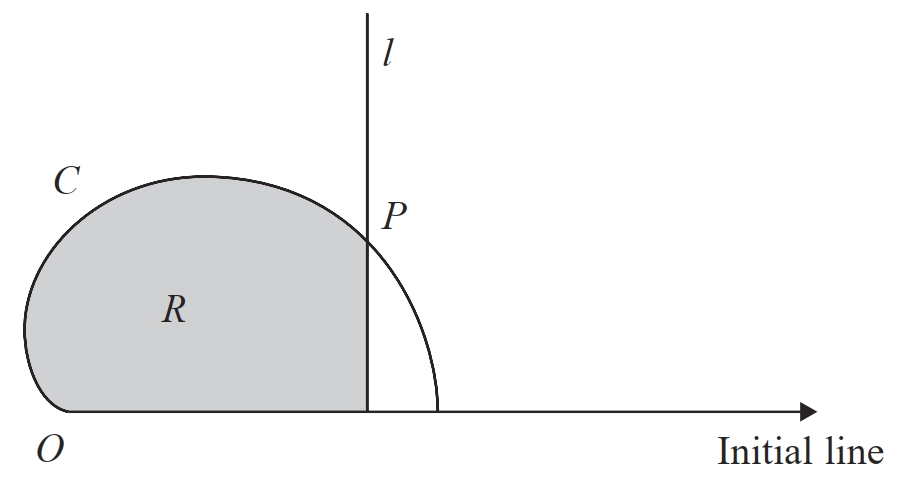
Figure 1

Figure 1 shows a sketch of the curve CC with polar equation

r=1+cosθ0θπ\begin{align*} r = 1 + \cos \theta \qquad 0 \leqslant \theta \leqslant \pi \end{align*}

and the line ll with polar equation

r=ksecθ0θ<π2\begin{align*} r = k\sec \theta \qquad 0 \leqslant \theta < \frac{\pi}{2} \end{align*}

where kk is a positive constant.

Given that

  • CC and ll intersect at the point PP
  • OP=1+32OP = 1 + \frac{\sqrt{3}}{2}

(a) determine the exact value of kk.

(2)

The finite region RR , shown shaded in Figure 1, is bounded by CC , the initial line and ll .

(b) Use algebraic integration to show that the area of RR is

pπ+q3+r\begin{align*} p\pi + q\sqrt{3} + r \end{align*}

where pp , qq and rr are simplified rational numbers to be determined.

(7)

解答

(a)

The curve CC is given by r=1+cosθr = 1 + \cos\theta and the line ll is r=ksecθr = k\sec\theta. They intersect at point PP where OP=r=1+32OP = r = 1 + \frac{\sqrt{3}}{2}.

First, find the angle θ\theta at PP using the equation for curve CC:

1+cosθ=1+32cosθ=32θ=π6\begin{align*} 1 + \cos\theta = &\,1 + \frac{\sqrt{3}}{2}\\[4mm] \cos\theta = &\,\frac{\sqrt{3}}{2}\\[4mm] \theta = &\,\frac{\pi}{6} \end{align*}

Since PP also lies on the line ll, substitute rr and θ\theta into the line’s polar equation:

r=ksecθrcosθ=k(1+32)(32)=kk=32+34\begin{align*} r = &\,k\sec\theta\\[4mm] r\cos\theta = &\,k\\[4mm] \left( 1 + \frac{\sqrt{3}}{2} \right) \left( \frac{\sqrt{3}}{2} \right) = &\,k\\[4mm] k = &\,\frac{\sqrt{3}}{2} + \frac{3}{4} \end{align*}

(b)

The region RR is bounded by CC from θ=π6\theta = \frac{\pi}{6} to θ=π\theta = \pi, and by a triangle formed by the pole, the line ll (which is a vertical line x=kx=k), and the line segment OPOP.

The area of region RR can be found by adding the area under CC between π6\frac{\pi}{6} and π\pi to the area of the right-angled triangle formed between θ=0\theta = 0 and θ=π6\theta = \frac{\pi}{6} up to the line x=kx=k.

Area under curve CC from π6\frac{\pi}{6} to π\pi:

12π6πr2dθ=12π6π(1+cosθ)2dθ=12π6π(1+2cosθ+cos2θ)dθ=12π6π(1+2cosθ+12+12cos2θ)dθ=12[32θ+2sinθ+14sin2θ]π6π\begin{align*} \frac{1}{2} \int_{\frac{\pi}{6}}^{\pi} r^2 \,\mathrm{d}\theta = &\,\frac{1}{2} \int_{\frac{\pi}{6}}^{\pi} (1 + \cos\theta)^2 \,\mathrm{d}\theta\\[4mm] = &\,\frac{1}{2} \int_{\frac{\pi}{6}}^{\pi} (1 + 2\cos\theta + \cos^2\theta) \,\mathrm{d}\theta\\[4mm] = &\,\frac{1}{2} \int_{\frac{\pi}{6}}^{\pi} \left( 1 + 2\cos\theta + \frac{1}{2} + \frac{1}{2}\cos 2\theta \right) \,\mathrm{d}\theta\\[4mm] = &\,\frac{1}{2} \left[ \frac{3}{2}\theta + 2\sin\theta + \frac{1}{4}\sin 2\theta \right]_{\frac{\pi}{6}}^{\pi} \end{align*}

Evaluate at the limits:

Upper limit (π):12(3π2+0+0)=3π4Lower limit (π6):12(3π12+2(12)+14(32))=π8+12+316\begin{align*} \text{Upper limit } (\pi): \quad &\,\frac{1}{2} \left( \frac{3\pi}{2} + 0 + 0 \right) = \frac{3\pi}{4}\\[4mm] \text{Lower limit } \left(\frac{\pi}{6}\right): \quad &\,\frac{1}{2} \left( \frac{3\pi}{12} + 2\left(\frac{1}{2}\right) + \frac{1}{4}\left(\frac{\sqrt{3}}{2}\right) \right) = \frac{\pi}{8} + \frac{1}{2} + \frac{\sqrt{3}}{16} \end{align*}

Area of this sector =3π4(π8+12+316)=5π812316= \frac{3\pi}{4} - \left( \frac{\pi}{8} + \frac{1}{2} + \frac{\sqrt{3}}{16} \right) = \frac{5\pi}{8} - \frac{1}{2} - \frac{\sqrt{3}}{16}.

Area of the Triangle: The triangle has a base along the initial line of length k=32+34k = \frac{\sqrt{3}}{2} + \frac{3}{4}, and a height yPy_P at point PP. We can use the formula Area =12absinC= \frac{1}{2}ab\sin C, where a=ksec(π/6)a = k\sec(\pi/6) (the distance OPOP), and b=kb = k, but it’s simpler to use the Cartesian area of a right triangle 12xy\frac{1}{2}xy:

xP=rcos(π6)=k=23+34yP=rsin(π6)=(1+32)(12)=2+34\begin{align*} x_P = &\,r\cos\left(\frac{\pi}{6}\right) = k = \frac{2\sqrt{3} + 3}{4}\\[4mm] y_P = &\,r\sin\left(\frac{\pi}{6}\right) = \left( 1 + \frac{\sqrt{3}}{2} \right)\left(\frac{1}{2}\right) = \frac{2 + \sqrt{3}}{4} \end{align*} Area of Triangle=12xPyP=12(23+34)(2+34)=132(43+6+6+33)=12+7332=38+7332\begin{align*} \text{Area of Triangle} = &\,\frac{1}{2}x_Py_P\\[4mm] = &\,\frac{1}{2} \left( \frac{2\sqrt{3} + 3}{4} \right) \left( \frac{2 + \sqrt{3}}{4} \right)\\[4mm] = &\,\frac{1}{32} \left( 4\sqrt{3} + 6 + 6 + 3\sqrt{3} \right)\\[4mm] = &\,\frac{12 + 7\sqrt{3}}{32}\\[4mm] = &\,\frac{3}{8} + \frac{7\sqrt{3}}{32} \end{align*}

Total Area of RR:

Total Area=(5π812316)+(38+7332)=5π848+382332+7332=5π8+533218\begin{align*} \text{Total Area} = &\,\left( \frac{5\pi}{8} - \frac{1}{2} - \frac{\sqrt{3}}{16} \right) + \left( \frac{3}{8} + \frac{7\sqrt{3}}{32} \right)\\[4mm] = &\,\frac{5\pi}{8} - \frac{4}{8} + \frac{3}{8} - \frac{2\sqrt{3}}{32} + \frac{7\sqrt{3}}{32}\\[4mm] = &\,\frac{5\pi}{8} + \frac{5\sqrt{3}}{32} - \frac{1}{8} \end{align*}

This is in the required form pπ+q3+rp\pi + q\sqrt{3} + r, with p=58p = \frac{5}{8}, q=532q = \frac{5}{32}, and r=18r = -\frac{1}{8}.