Skip to content
CalcGospel 國際數學圖譜
返回

IAL 2024 June Q10

A Level / Edexcel / FP2

IAL 2024 June Paper · Question 10

题目

Problem

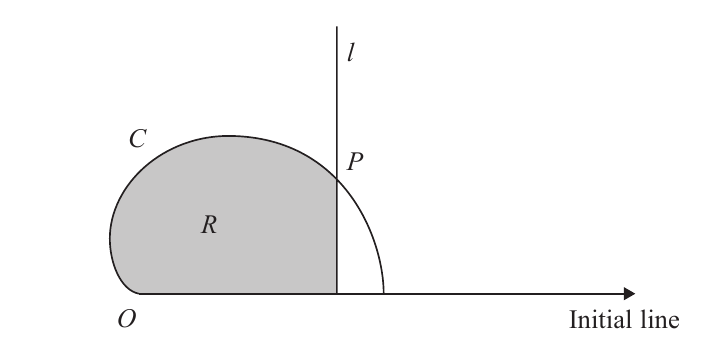
Figure 1

Figure 1 shows a sketch of the curve CC with polar equation

r=1+cosθ0θπ\begin{align*} r =&\, 1 + \cos \theta \qquad 0 \leqslant \theta \leqslant \pi \end{align*}

and the line ll with polar equation

r=ksecθ0θ<π2\begin{align*} r =&\, k\sec \theta \qquad 0 \leqslant \theta < \frac{\pi}{2} \end{align*}

where kk is a positive constant.

Given that

  • CC and ll intersect at the point PP
  • OP=1+32OP = 1 + \frac{\sqrt{3}}{2}

(a) determine the exact value of kk.

(2)

The finite region RR , shown shaded in Figure 1, is bounded by CC , the initial line and ll .

(b) Use algebraic integration to show that the area of RR is

pπ+q3+r\begin{align*} p\pi + q\sqrt{3} + r \end{align*}

where pp , qq and rr are simplified rational numbers to be determined.

(7)

解答

(a)

解法一

思路

展开

在交点 PP 上,曲线给出 r=1+cosθr=1+\cos\theta。题目给了 OP=r=1+32OP=r=1+\frac{\sqrt3}{2},所以可以先求 θ\theta。直线 r=ksecθr=k\sec\theta 等价于 rcosθ=kr\cos\theta=k

答题过程

展开

At PP,

r=1+32\begin{align*} r=1+\frac{\sqrt3}{2} \end{align*}

Using r=1+cosθr=1+\cos\theta,

1+cosθ=1+32cosθ=32\begin{align*} 1+\cos\theta =&\, 1+\frac{\sqrt3}{2}\\[2mm] \cos\theta =&\, \frac{\sqrt3}{2} \end{align*}

Hence

θ=π6\begin{align*} \theta=\frac{\pi}{6} \end{align*}

Since PP lies on r=ksecθr=k\sec\theta,

k=rcosθ=(1+32)32=32+34\begin{align*} k =&\, r\cos\theta\\[4mm] =&\, \left(1+\frac{\sqrt3}{2}\right)\frac{\sqrt3}{2}\\[4mm] =&\, \boxed{\frac{\sqrt3}{2}+\frac34} \end{align*}

(b)

解法一

思路

展开

区域可以拆成两部分:从 θ=π6\theta=\frac{\pi}{6}π\pi 的曲线面积,加上从 initial line 到 OPOP 之间由直线 ll 形成的小三角形。曲线面积用极坐标积分,小三角形用 12xy\frac12xy12absinC\frac12ab\sin C

答题过程

展开

First find the area under CC from θ=π6\theta=\frac{\pi}{6} to θ=π\theta=\pi:

AreaC=12π6π(1+cosθ)2dθ=12π6π(1+2cosθ+cos2θ)dθ=12π6π(32+2cosθ+12cos2θ)dθ\begin{align*} \text{Area}_C =&\, \frac12\int_{\frac{\pi}{6}}^{\pi}(1+\cos\theta)^2\,\mathrm{d}\theta\\[4mm] =&\, \frac12\int_{\frac{\pi}{6}}^{\pi} (1+2\cos\theta+\cos^2\theta)\,\mathrm{d}\theta\\[4mm] =&\, \frac12\int_{\frac{\pi}{6}}^{\pi} \left(\frac32+2\cos\theta+\frac12\cos2\theta\right) \,\mathrm{d}\theta \end{align*}

Therefore

AreaC=12[32θ+2sinθ+14sin2θ]π6π=12[3π2(π4+1+38)]=5π812316\begin{align*} \text{Area}_C =&\, \frac12\left[ \frac32\theta+2\sin\theta+\frac14\sin2\theta \right]_{\frac{\pi}{6}}^{\pi}\\[4mm] =&\, \frac12\left[ \frac{3\pi}{2} -\left( \frac{\pi}{4}+1+\frac{\sqrt3}{8} \right) \right]\\[4mm] =&\, \frac{5\pi}{8}-\frac12-\frac{\sqrt3}{16} \end{align*}

Now find the triangular area between the initial line and OPOP.

At PP,

xP=rcosπ6=k=32+34yP=rsinπ6=(1+32)12=12+34\begin{align*} x_P =&\, r\cos\frac{\pi}{6} =k =\frac{\sqrt3}{2}+\frac34\\[4mm] y_P =&\, r\sin\frac{\pi}{6} =\left(1+\frac{\sqrt3}{2}\right)\frac12\\[4mm] =&\, \frac12+\frac{\sqrt3}{4} \end{align*}

So

Area=12xPyP=12(32+34)(12+34)=7332+38\begin{align*} \text{Area}_{\triangle} =&\, \frac12 x_Py_P\\[4mm] =&\, \frac12 \left(\frac{\sqrt3}{2}+\frac34\right) \left(\frac12+\frac{\sqrt3}{4}\right)\\[4mm] =&\, \frac{7\sqrt3}{32}+\frac38 \end{align*}

Hence

AreaR=(5π812316)+(7332+38)=5π8+533218\begin{align*} \text{Area}_R =&\, \left(\frac{5\pi}{8}-\frac12-\frac{\sqrt3}{16}\right) +\left(\frac{7\sqrt3}{32}+\frac38\right)\\[4mm] =&\, \frac{5\pi}{8} +\frac{5\sqrt3}{32} -\frac18 \end{align*}

Thus

p=58,q=532,r=18\begin{align*} \boxed{ p=\frac58,\qquad q=\frac{5}{32},\qquad r=-\frac18 } \end{align*}