Skip to content
CalcGospel 國際數學圖譜
返回

IAL 2025 Jan Q5

A Level / Edexcel / FP2

IAL 2025 Jan Paper · Question 5

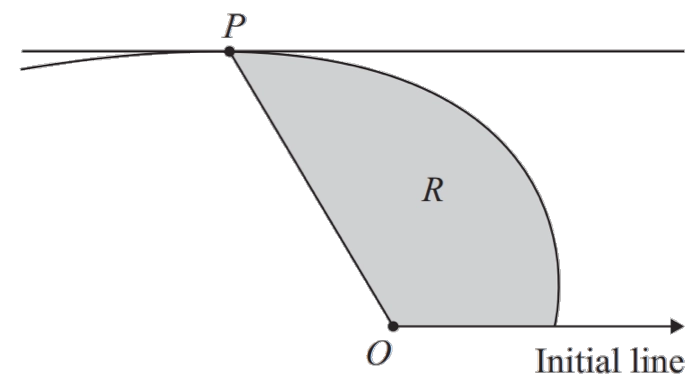
Figure 1
In this question you must show all stages of your working.
Solutions relying entirely on calculator technology are not acceptable.

Figure 1 shows a sketch of part of the curve with polar equation

r=3+tanθ20θ<π\begin{align*} r = \sqrt{3} + \tan \frac{\theta}{2} \qquad 0 \leqslant \theta < \pi \end{align*}

The tangent to the curve at the point PP is parallel to the initial line.

(a) Using the identity tanθ2=1cosθsinθ\tan \frac{\theta}{2} = \frac{1 - \cos \theta}{\sin \theta} or otherwise, determine the exact value of θ\theta at PP.

(4)

The region RR , shown shaded in Figure 1, is bounded by the initial line, the curve and the line OPOP , where OO is the pole.

(b) Use algebraic integration to determine the exact area of RR , giving your answer in the form pln2+qπ+rp\ln 2 + q\pi + r where pp , qq and rr are constants.

(6)

解答

(a)

Since the tangent is parallel to the initial line, dydθ=0\frac{\mathrm{d}y}{\mathrm{d}\theta} = 0, where y=rsinθy = r\sin\theta.

y=rsinθ=(3+tanθ2)sinθ=(3+1cosθsinθ)sinθ=3sinθ+1cosθ\begin{align*} y = &\,r\sin\theta\\[4mm] = &\,\left(\sqrt{3} + \tan\frac{\theta}{2}\right)\sin\theta\\[4mm] = &\,\left(\sqrt{3} + \frac{1 - \cos\theta}{\sin\theta}\right)\sin\theta\\[4mm] = &\,\sqrt{3}\sin\theta + 1 - \cos\theta \end{align*}

Differentiating with respect to θ\theta:

dydθ=3cosθ+sinθ\begin{align*} \frac{\mathrm{d}y}{\mathrm{d}\theta} = &\,\sqrt{3}\cos\theta + \sin\theta \end{align*}

Setting dydθ=0\frac{\mathrm{d}y}{\mathrm{d}\theta} = 0:

3cosθ+sinθ=0sinθ=3cosθtanθ=3\begin{align*} \sqrt{3}\cos\theta + \sin\theta = &\,0\\[4mm] \sin\theta = &\,-\sqrt{3}\cos\theta\\[4mm] \tan\theta = &\,-\sqrt{3} \end{align*}

Given the domain 0θ<π0 \leqslant \theta < \pi, the only solution is:

θ=ππ3=2π3\begin{align*} \theta = &\,\pi - \frac{\pi}{3}\\[4mm] = &\,\frac{2\pi}{3} \end{align*}

(b)

The area of the shaded region RR is given by 12r2dθ\frac{1}{2}\int r^2 \,\mathrm{d}\theta.

r2dθ=(3+tanθ2)2dθ=(3+23tanθ2+tan2θ2)dθ=(3+23tanθ2+sec2θ21)dθ=(2+23tanθ2+sec2θ2)dθ=2θ43ln(cosθ2)+2tanθ2\begin{align*} \int r^2 \,\mathrm{d}\theta = &\,\int \left(\sqrt{3} + \tan\frac{\theta}{2}\right)^2 \,\mathrm{d}\theta\\[4mm] = &\,\int \left(3 + 2\sqrt{3}\tan\frac{\theta}{2} + \tan^2\frac{\theta}{2}\right) \,\mathrm{d}\theta\\[4mm] = &\,\int \left(3 + 2\sqrt{3}\tan\frac{\theta}{2} + \sec^2\frac{\theta}{2} - 1\right) \,\mathrm{d}\theta\\[4mm] = &\,\int \left(2 + 2\sqrt{3}\tan\frac{\theta}{2} + \sec^2\frac{\theta}{2}\right) \,\mathrm{d}\theta\\[4mm] = &\,2\theta - 4\sqrt{3}\ln\left(\cos\frac{\theta}{2}\right) + 2\tan\frac{\theta}{2} \end{align*}

Evaluating from θ=0\theta = 0 to θ=2π3\theta = \frac{2\pi}{3}:

Area=12[2θ43ln(cosθ2)+2tanθ2]02π3=12((2(2π3)43ln(cosπ3)+2tanπ3)(043ln1+0))=12(4π343ln(12)+23)=12(4π3+43ln2+23)=23ln2+2π3+3\begin{align*} \text{Area} = &\,\frac{1}{2}\left[2\theta - 4\sqrt{3}\ln\left(\cos\frac{\theta}{2}\right) + 2\tan\frac{\theta}{2}\right]_0^{\frac{2\pi}{3}}\\[4mm] = &\,\frac{1}{2}\left( \left( 2\left(\frac{2\pi}{3}\right) - 4\sqrt{3}\ln\left(\cos\frac{\pi}{3}\right) + 2\tan\frac{\pi}{3} \right) - (0 - 4\sqrt{3}\ln 1 + 0) \right)\\[4mm] = &\,\frac{1}{2}\left( \frac{4\pi}{3} - 4\sqrt{3}\ln\left(\frac{1}{2}\right) + 2\sqrt{3} \right)\\[4mm] = &\,\frac{1}{2}\left( \frac{4\pi}{3} + 4\sqrt{3}\ln 2 + 2\sqrt{3} \right)\\[4mm] = &\,2\sqrt{3}\ln 2 + \frac{2\pi}{3} + \sqrt{3} \end{align*}