Skip to content
CalcGospel 國際數學圖譜
返回

IAL 2025 Jan Q5

A Level / Edexcel / FP2

IAL 2025 Jan Paper · Question 5

题目

Problem

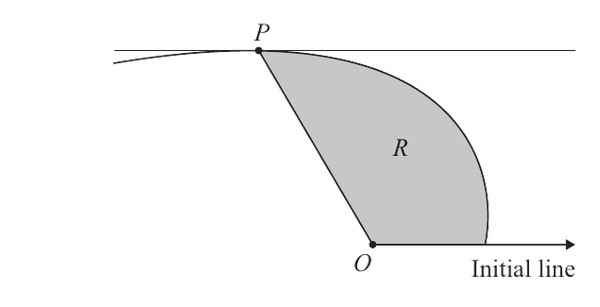
Figure 1
In this question you must show all stages of your working.
Solutions relying entirely on calculator technology are not acceptable.

Figure 1 shows a sketch of part of the curve with polar equation

r=3+tanθ20θ<π\begin{align*} r=\sqrt3+\tan\frac{\theta}{2} \qquad 0\leqslant\theta<\pi \end{align*}

The tangent to the curve at the point PP is parallel to the initial line.

(a) Using the identity tanθ2=1cosθsinθ\tan\frac{\theta}{2}=\frac{1-\cos\theta}{\sin\theta} or otherwise, determine the exact value of θ\theta at PP.

(4)

The region RR, shown shaded in Figure 1, is bounded by the initial line, the curve and the line OPOP, where OO is the pole.

(b) Use algebraic integration to determine the exact area of RR, giving your answer in the form pln2+qπ+rp\ln2+q\pi+r where pp, qq and rr are constants.

(6)

解答

(a)

解法一

思路

展开

切线平行于 initial line,表示该点的切线是水平的,所以可令 dydθ=0\frac{\mathrm{d}y}{\mathrm{d}\theta}=0。极坐标中 y=rsinθy=r\sin\theta,题目给的半角公式正好能把 yy 化得很简单。

答题过程

展开

Since

y=rsinθ,\begin{align*} y=r\sin\theta, \end{align*}

we have

y=(3+tanθ2)sinθ=(3+1cosθsinθ)sinθ=3sinθ+1cosθ\begin{align*} y ={}& \left(\sqrt3+\tan\frac{\theta}{2}\right)\sin\theta\\[3mm] ={}& \left(\sqrt3+\frac{1-\cos\theta}{\sin\theta}\right)\sin\theta\\[3mm] ={}& \sqrt3\sin\theta+1-\cos\theta \end{align*}

Differentiate:

dydθ=3cosθ+sinθ\begin{align*} \frac{\mathrm{d}y}{\mathrm{d}\theta} ={}& \sqrt3\cos\theta+\sin\theta \end{align*}

The tangent at PP is parallel to the initial line, so

3cosθ+sinθ=0sinθ=3cosθtanθ=3\begin{align*} \sqrt3\cos\theta+\sin\theta ={}& 0\\[2mm] \sin\theta ={}& -\sqrt3\cos\theta\\[2mm] \tan\theta ={}& -\sqrt3 \end{align*}

Since 0θ<π0\leqslant\theta<\pi, the solution is in the second quadrant. Hence

θ=2π3\begin{align*} \boxed{\theta=\frac{2\pi}{3}} \end{align*}

(b)

解法一

思路

展开

区域由 initial line、曲线和 OPOP 围成,所以面积是

1202π/3r2dθ\begin{align*} \frac12\int_0^{2\pi/3}r^2\,\mathrm{d}\theta \end{align*}

关键是把 tan2θ2\tan^2\frac{\theta}{2} 改成 sec2θ21\sec^2\frac{\theta}{2}-1,这样就能直接积分。

答题过程

展开

The required area is

Area=1202π/3(3+tanθ2)2dθ\begin{align*} \text{Area} ={}& \frac12\int_0^{2\pi/3} \left(\sqrt3+\tan\frac{\theta}{2}\right)^2 \,\mathrm{d}\theta \end{align*}

Expand the integrand:

(3+tanθ2)2=3+23tanθ2+tan2θ2=3+23tanθ2+sec2θ21=2+23tanθ2+sec2θ2\begin{align*} \left(\sqrt3+\tan\frac{\theta}{2}\right)^2 ={}& 3+2\sqrt3\tan\frac{\theta}{2} +\tan^2\frac{\theta}{2}\\[3mm] ={}& 3+2\sqrt3\tan\frac{\theta}{2} +\sec^2\frac{\theta}{2}-1\\[3mm] ={}& 2+2\sqrt3\tan\frac{\theta}{2} +\sec^2\frac{\theta}{2} \end{align*}

Therefore

Area=1202π/3(2+23tanθ2+sec2θ2)dθ\begin{align*} \text{Area} ={}& \frac12\int_0^{2\pi/3} \left( 2+2\sqrt3\tan\frac{\theta}{2} +\sec^2\frac{\theta}{2} \right)\,\mathrm{d}\theta \end{align*}

Integrate:

(2+23tanθ2+sec2θ2)dθ=2θ43ln(cosθ2)+2tanθ2\begin{align*} \int \left( 2+2\sqrt3\tan\frac{\theta}{2} +\sec^2\frac{\theta}{2} \right)\,\mathrm{d}\theta ={}& 2\theta -4\sqrt3\ln\left(\cos\frac{\theta}{2}\right) +2\tan\frac{\theta}{2} \end{align*}

So

Area=12[2θ43ln(cosθ2)+2tanθ2]02π/3=12[4π343ln(cosπ3)+2tanπ3]=12[4π343ln12+23]=23ln2+2π3+3\begin{align*} \text{Area} ={}& \frac12\left[ 2\theta -4\sqrt3\ln\left(\cos\frac{\theta}{2}\right) +2\tan\frac{\theta}{2} \right]_0^{2\pi/3}\\[3mm] ={}& \frac12\left[ \frac{4\pi}{3} -4\sqrt3\ln\left(\cos\frac{\pi}{3}\right) +2\tan\frac{\pi}{3} \right]\\[3mm] ={}& \frac12\left[ \frac{4\pi}{3} -4\sqrt3\ln\frac12 +2\sqrt3 \right]\\[3mm] ={}& \boxed{ 2\sqrt3\ln2+\frac{2\pi}{3}+\sqrt3 } \end{align*}