题目
Problem
8.
A transformation T T T z z z z = x + i y z=x+\mathrm{i}y z = x + i y w w w w = u + i v w=u+\mathrm{i}v w = u + i v
w = ( 3 − i ) ( z − 2 ) z + 2 z ≠ − 2 \begin{align*}
w=\frac{(\sqrt3-\mathrm{i})(z-2)}{z+2}
\qquad z\neq -2
\end{align*} w = z + 2 ( 3 − i ) ( z − 2 ) z = − 2 (a) Show that the real axis in the z z z T T T
v = − 1 3 u \begin{align*}
v=-\frac1{\sqrt3}u
\end{align*} v = − 3 1 u in the w w w
(3)
(b) Show that the circle in the z z z ∣ z ∣ = 2 |z|=2 ∣ z ∣ = 2 T T T w w w
(5)
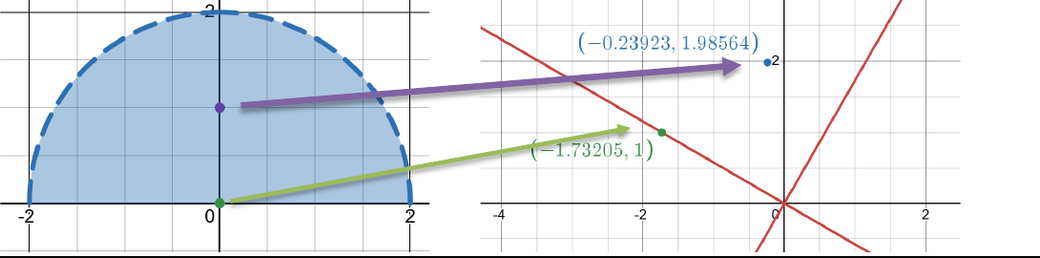
The region R R R z z z
{ z ∈ C : ∣ z ∣ < 2 } ∩ { z ∈ C : Im z > 0 } \begin{align*}
\{z\in\mathbb{C}:|z|<2\}
\cap
\{z\in\mathbb{C}:\operatorname{Im}z>0\}
\end{align*} { z ∈ C : ∣ z ∣ < 2 } ∩ { z ∈ C : Im z > 0 } (c) Determine the image of R R R T T T
{ w ∈ C : α < arg w < β } \begin{align*}
\{w\in\mathbb{C}:\alpha<\arg w<\beta\}
\end{align*} { w ∈ C : α < arg w < β } where α \alpha α β \beta β π \pi π
(5)
题目中文翻译
从 z z z w w w T T T
w = ( 3 − i ) ( z − 2 ) z + 2 , z ≠ − 2 , \begin{align*}
w=&\,\frac{(\sqrt3-\mathrm{i})(z-2)}{z+2},
\qquad z\ne-2,
\end{align*} w = z + 2 ( 3 − i ) ( z − 2 ) , z = − 2 , 其中 z = x + i y z=x+\mathrm{i}y z = x + i y w = u + i v w=u+\mathrm{i}v w = u + i v
(a) 证明 z z z T T T w w w
v = − 1 3 u \begin{align*}
v=-\frac1{\sqrt3}u
\end{align*} v = − 3 1 u 的直线。
(3)
(b) 证明 z z z ∣ z ∣ = 2 |z|=2 ∣ z ∣ = 2 T T T w w w
(5)
z z z R R R
{ z ∈ C : ∣ z ∣ < 2 } ∩ { z ∈ C : Im z > 0 } . \begin{align*}
&\,\{z\in\mathbb C:|z|<2\}\\[2mm]
&\,\hspace{2pt}\cap\{z\in\mathbb C:\operatorname{Im}z>0\}.
\end{align*} { z ∈ C : ∣ z ∣ < 2 } ∩ { z ∈ C : Im z > 0 } . (c) 求 R R R T T T
{ w ∈ C : α < arg w < β } \begin{align*}
\{w\in\mathbb C:\alpha<\arg w<\beta\}
\end{align*} { w ∈ C : α < arg w < β } 的形式,其中 α \alpha α β \beta β π \pi π
(5)
解答
(a)
解法一
思路
展开
实轴上的点可写成 z = x z=x z = x x x x 3 − i \sqrt3-\mathrm{i} 3 − i x − 2 x + 2 \frac{x-2}{x+2} x + 2 x − 2 u u u v v v
答题过程
展开
On the real axis in the z z z
z = x \begin{align*}
z=x
\end{align*} z = x where x x x
w = ( 3 − i ) ( x − 2 ) x + 2 = 3 ( x − 2 x + 2 ) − i ( x − 2 x + 2 ) \begin{align*}
w
=&\,
\frac{(\sqrt3-\mathrm{i})(x-2)}{x+2}\\[3mm]
=&\,
\sqrt3\bigg(\frac{x-2}{x+2}\bigg)
-\mathrm{i}\bigg(\frac{x-2}{x+2}\bigg)
\end{align*} w = = x + 2 ( 3 − i ) ( x − 2 ) 3 ( x + 2 x − 2 ) − i ( x + 2 x − 2 ) Since w = u + i v w=u+\mathrm{i}v w = u + i v
u = 3 ( x − 2 x + 2 ) , v = − ( x − 2 x + 2 ) \begin{align*}
u
=&\,
\sqrt3\bigg(\frac{x-2}{x+2}\bigg),\\
v
=&\,
-\bigg(\frac{x-2}{x+2}\bigg)
\end{align*} u = v = 3 ( x + 2 x − 2 ) , − ( x + 2 x − 2 ) Therefore
v = − 1 3 u \begin{align*}
v
=&\,
-\frac1{\sqrt3}u
\end{align*} v = − 3 1 u as required.
解法二
思路
展开
先把变换反解为 z z z w w w Im z = 0 \operatorname{Im}z=0 Im z = 0
答题过程
展开
Rearrange the transformation:
w ( z + 2 ) = ( 3 − i ) ( z − 2 ) , z ( w − 3 + i ) = − 2 w − 2 ( 3 − i ) . \begin{align*}
w(z+2)=&\,(\sqrt3-\mathrm{i})(z-2),\\[3mm]
z(w-\sqrt3+\mathrm{i})=&\,-2w-2(\sqrt3-\mathrm{i}).
\end{align*} w ( z + 2 ) = z ( w − 3 + i ) = ( 3 − i ) ( z − 2 ) , − 2 w − 2 ( 3 − i ) . Hence, putting w = u + i v w=u+\mathrm{i}v w = u + i v
z = − 2 w + 3 − i w − 3 + i = − 2 ( u + 3 ) + i ( v − 1 ) ( u − 3 ) + i ( v + 1 ) . \begin{align*}
z=&\,-2\frac{w+\sqrt3-\mathrm{i}}{w-\sqrt3+\mathrm{i}}\\[3mm]
=&\,-2\frac{(u+\sqrt3)+\mathrm{i}(v-1)}
{(u-\sqrt3)+\mathrm{i}(v+1)}.
\end{align*} z = = − 2 w − 3 + i w + 3 − i − 2 ( u − 3 ) + i ( v + 1 ) ( u + 3 ) + i ( v − 1 ) . Multiply numerator and denominator by ( u − 3 ) − i ( v + 1 ) (u-\sqrt3)-\mathrm{i}(v+1) ( u − 3 ) − i ( v + 1 )
D = ( u − 3 ) 2 + ( v + 1 ) 2 > 0. \begin{align*}
D=(u-\sqrt3)^2+(v+1)^2>0.
\end{align*} D = ( u − 3 ) 2 + ( v + 1 ) 2 > 0. Extracting the imaginary part gives
Im z = − 2 D [ ( v − 1 ) ( u − 3 ) − ( u + 3 ) ( v + 1 ) ] = − 2 D ( − 2 u − 2 3 v ) = 4 ( u + 3 v ) D . \begin{align*}
\operatorname{Im}z
=&\,-\frac{2}{D}\big[(v-1)(u-\sqrt3)\\[3mm]
&\,\hspace{2pt}-(u+\sqrt3)(v+1)\big]\\[3mm]
=&\,-\frac{2}{D}(-2u-2\sqrt3v)\\[3mm]
=&\,\frac{4(u+\sqrt3v)}{D}.
\end{align*} Im z = = = − D 2 [ ( v − 1 ) ( u − 3 ) − ( u + 3 ) ( v + 1 ) ] − D 2 ( − 2 u − 2 3 v ) D 4 ( u + 3 v ) . On the real axis, Im z = 0 \operatorname{Im}z=0 Im z = 0
u + 3 v = 0 , v = − 1 3 u . \begin{align*}
u+\sqrt3v=&\,0,\\[3mm]
v=&\,\boxed{-\frac1{\sqrt3}u}.
\end{align*} u + 3 v = v = 0 , − 3 1 u .
(b)
解法一
思路
展开
要把 ∣ z ∣ = 2 |z|=2 ∣ z ∣ = 2 w w w z z z w w w ∣ z ∣ = 2 |z|=2 ∣ z ∣ = 2 w = u + i v w=u+\mathrm{i}v w = u + i v
答题过程
展开
Start with
w = ( 3 − i ) ( z − 2 ) z + 2 \begin{align*}
w
=&\,
\frac{(\sqrt3-\mathrm{i})(z-2)}{z+2}
\end{align*} w = z + 2 ( 3 − i ) ( z − 2 ) Rearrange:
w ( z + 2 ) = ( 3 − i ) ( z − 2 ) w z + 2 w = ( 3 − i ) z − 2 ( 3 − i ) z ( w − 3 + i ) = − 2 w − 2 ( 3 − i ) \begin{align*}
w(z+2)
=&\,
(\sqrt3-\mathrm{i})(z-2)\\[2mm]
wz+2w
=&\,
(\sqrt3-\mathrm{i})z-2(\sqrt3-\mathrm{i})\\[2mm]
z(w-\sqrt3+\mathrm{i})
=&\,
-2w-2(\sqrt3-\mathrm{i})
\end{align*} w ( z + 2 ) = w z + 2 w = z ( w − 3 + i ) = ( 3 − i ) ( z − 2 ) ( 3 − i ) z − 2 ( 3 − i ) − 2 w − 2 ( 3 − i ) Hence
z = − 2 w − 2 ( 3 − i ) w − 3 + i \begin{align*}
z
=&\,
\frac{-2w-2(\sqrt3-\mathrm{i})}
{w-\sqrt3+\mathrm{i}}
\end{align*} z = w − 3 + i − 2 w − 2 ( 3 − i ) Use ∣ z ∣ = 2 |z|=2 ∣ z ∣ = 2
∣ − 2 w − 2 ( 3 − i ) w − 3 + i ∣ = 2 \begin{align*}
\Big|
\frac{-2w-2(\sqrt3-\mathrm{i})}
{w-\sqrt3+\mathrm{i}}
\Big|
=&\,
2
\end{align*} w − 3 + i − 2 w − 2 ( 3 − i ) = 2 Divide by 2 2 2
∣ w + 3 − i ∣ = ∣ w − 3 + i ∣ \begin{align*}
\Big|w+\sqrt3-\mathrm{i}\Big|
=&\,
\Big|w-\sqrt3+\mathrm{i}\Big|
\end{align*} w + 3 − i = w − 3 + i Let w = u + i v w=u+\mathrm{i}v w = u + i v
∣ w + 3 − i ∣ 2 = ( u + 3 ) 2 + ( v − 1 ) 2 \begin{align*}
\Big|w+\sqrt3-\mathrm{i}\Big|^2
=&\,
(u+\sqrt3)^2+(v-1)^2
\end{align*} w + 3 − i 2 = ( u + 3 ) 2 + ( v − 1 ) 2 and
∣ w − 3 + i ∣ 2 = ( u − 3 ) 2 + ( v + 1 ) 2 \begin{align*}
\Big|w-\sqrt3+\mathrm{i}\Big|^2
=&\,
(u-\sqrt3)^2+(v+1)^2
\end{align*} w − 3 + i 2 = ( u − 3 ) 2 + ( v + 1 ) 2 So
( u + 3 ) 2 + ( v − 1 ) 2 = ( u − 3 ) 2 + ( v + 1 ) 2 u 2 + 2 3 u + 3 + v 2 − 2 v + 1 = u 2 − 2 3 u + 3 + v 2 + 2 v + 1 4 3 u = 4 v \begin{align*}
(u+\sqrt3)^2+(v-1)^2
=&\,
(u-\sqrt3)^2+(v+1)^2\\[3mm]
u^2+2\sqrt3u+3+v^2-2v+1
=&\,
u^2-2\sqrt3u+3+v^2+2v+1\\[3mm]
4\sqrt3u
=&\,
4v
\end{align*} ( u + 3 ) 2 + ( v − 1 ) 2 = u 2 + 2 3 u + 3 + v 2 − 2 v + 1 = 4 3 u = ( u − 3 ) 2 + ( v + 1 ) 2 u 2 − 2 3 u + 3 + v 2 + 2 v + 1 4 v Therefore the image is the line
v = 3 u \begin{align*}
\boxed{v=\sqrt3u}
\end{align*} v = 3 u
解法二
思路
展开
从
∣ w + 3 − i ∣ = ∣ w − 3 + i ∣ \begin{align*}
\Big|w+\sqrt3-\mathrm{i}\Big|
=
\Big|w-\sqrt3+\mathrm{i}\Big|
\end{align*} w + 3 − i = w − 3 + i 可以看出,w w w ( − 3 , 1 ) (-\sqrt3,1) ( − 3 , 1 ) ( 3 , − 1 ) (\sqrt3,-1) ( 3 , − 1 )
答题过程
展开
As in the first method,
z = − 2 w − 2 ( 3 − i ) w − 3 + i \begin{align*}
z
=&\,
\frac{-2w-2(\sqrt3-\mathrm{i})}
{w-\sqrt3+\mathrm{i}}
\end{align*} z = w − 3 + i − 2 w − 2 ( 3 − i ) Using ∣ z ∣ = 2 |z|=2 ∣ z ∣ = 2
∣ w + 3 − i ∣ = ∣ w − 3 + i ∣ \begin{align*}
\Big|w+\sqrt3-\mathrm{i}\Big|
=&\,
\Big|w-\sqrt3+\mathrm{i}\Big|
\end{align*} w + 3 − i = w − 3 + i This means that w w w
− 3 + i and 3 − i \begin{align*}
-\sqrt3+\mathrm{i}
\qquad \text{and} \qquad
\sqrt3-\mathrm{i}
\end{align*} − 3 + i and 3 − i So the locus is the perpendicular bisector of the segment joining
( − 3 , 1 ) and ( 3 , − 1 ) \begin{align*}
(-\sqrt3,1)
\qquad \text{and} \qquad
(\sqrt3,-1)
\end{align*} ( − 3 , 1 ) and ( 3 , − 1 ) The midpoint is ( 0 , 0 ) (0,0) ( 0 , 0 )
− 1 − 1 3 − ( − 3 ) = − 1 3 \begin{align*}
\frac{-1-1}{\sqrt3-(-\sqrt3)}
=&\,
-\frac1{\sqrt3}
\end{align*} 3 − ( − 3 ) − 1 − 1 = − 3 1 Thus the perpendicular slope is 3 \sqrt3 3
v = 3 u \begin{align*}
\boxed{v=\sqrt3u}
\end{align*} v = 3 u
(c)
解法一
思路
展开
R R R ∣ z ∣ = 2 |z|=2 ∣ z ∣ = 2 z = i z=\mathrm{i} z = i
答题过程
展开
From part (b), the circle ∣ z ∣ = 2 |z|=2 ∣ z ∣ = 2
v = 3 u \begin{align*}
v=\sqrt3u
\end{align*} v = 3 u This line has argument
arg w = π 3 \begin{align*}
\arg w=\frac{\pi}{3}
\end{align*} arg w = 3 π From part (a), the real axis maps to
v = − 1 3 u \begin{align*}
v=-\frac1{\sqrt3}u
\end{align*} v = − 3 1 u This line has possible arguments
− π 6 or 5 π 6 \begin{align*}
-\frac{\pi}{6}
\qquad \text{or} \qquad
\frac{5\pi}{6}
\end{align*} − 6 π or 6 5 π To choose the correct side of the region, use a point inside R R R z = i z=\mathrm{i} z = i
w = ( 3 − i ) ( i − 2 ) i + 2 = 4 − 3 3 5 + i 3 + 4 3 5 \begin{align*}
w
=&\,
\frac{(\sqrt3-\mathrm{i})(\mathrm{i}-2)}{\mathrm{i}+2}\\[4mm]
=&\,
\frac{4-3\sqrt3}{5}
+\mathrm{i}\frac{3+4\sqrt3}{5}
\end{align*} w = = i + 2 ( 3 − i ) ( i − 2 ) 5 4 − 3 3 + i 5 3 + 4 3 This point lies in the second quadrant in the w w w R R R π 3 \frac{\pi}{3} 3 π 5 π 6 \frac{5\pi}{6} 6 5 π
Therefore
{ w ∈ C : π 3 < arg w < 5 π 6 } \begin{align*}
\boxed{
\{w\in\mathbb{C}:\frac{\pi}{3}<\arg w<\frac{5\pi}{6}\}
}
\end{align*} { w ∈ C : 3 π < arg w < 6 5 π }
解法二
思路
展开
也可以把区域的两个条件分别转成 u , v u,v u , v Im z > 0 \operatorname{Im}z>0 Im z > 0
答题过程
展开
From the inverse transformation,
z = − 2 w + 3 − i w − 3 + i . \begin{align*}
z=-2\frac{w+\sqrt3-\mathrm{i}}{w-\sqrt3+\mathrm{i}}.
\end{align*} z = − 2 w − 3 + i w + 3 − i . The condition ∣ z ∣ < 2 |z|<2 ∣ z ∣ < 2
∣ w + 3 − i ∣ < ∣ w − 3 + i ∣ , ( u + 3 ) 2 + ( v − 1 ) 2 < ( u − 3 ) 2 + ( v + 1 ) 2 . \begin{align*}
|w+\sqrt3-\mathrm{i}|<&\,|w-\sqrt3+\mathrm{i}|,\\[3mm]
(u+\sqrt3)^2+(v-1)^2
<&\,(u-\sqrt3)^2+(v+1)^2.
\end{align*} ∣ w + 3 − i ∣ < ( u + 3 ) 2 + ( v − 1 ) 2 < ∣ w − 3 + i ∣ , ( u − 3 ) 2 + ( v + 1 ) 2 . Cancelling the square and constant terms gives
4 3 u − 4 v < 0 , v > 3 u . \begin{align*}
4\sqrt3u-4v<&\,0,\\[3mm]
v>&\,\sqrt3u.
\end{align*} 4 3 u − 4 v < v > 0 , 3 u . Also, as calculated in part (a),
Im z = 4 ( u + 3 v ) ( u − 3 ) 2 + ( v + 1 ) 2 . \begin{align*}
\operatorname{Im}z
=&\,\frac{4(u+\sqrt3v)}
{(u-\sqrt3)^2+(v+1)^2}.
\end{align*} Im z = ( u − 3 ) 2 + ( v + 1 ) 2 4 ( u + 3 v ) . The denominator is positive, so Im z > 0 \operatorname{Im}z>0 Im z > 0
u + 3 v > 0 , v > − 1 3 u . \begin{align*}
u+\sqrt3v>&\,0,\\[3mm]
v>&\,-\frac1{\sqrt3}u.
\end{align*} u + 3 v > v > 0 , − 3 1 u . The intersection is the region above both lines, between their upper rays of arguments π 3 \frac\pi3 3 π 5 π 6 \frac{5\pi}6 6 5 π
{ w ∈ C : π 3 < arg w < 5 π 6 } . \begin{align*}
\boxed{\bigg\{w\in\mathbb C:
\frac\pi3<\arg w<\frac{5\pi}6\bigg\}}.
\end{align*} { w ∈ C : 3 π < arg w < 6 5 π } .