Skip to content
CalcGospel 國際數學圖譜
返回

IAL 2025 June A Q8

A Level / Edexcel / FP2

IAL 2025 June A Paper · Question 8

In this question you must show all stages of your working.
Solutions relying entirely on calculator technology are not acceptable.

Given that z=cosθ+isinθz = \cos\theta + \mathrm{i}\sin\theta

(a) show that, for nZn \in \mathbb{Z}

zn+1zn=2cosnθ\begin{align*} z^n + \frac{1}{z^n} = 2\cos n\theta \end{align*}
(2)

(b) Hence show that

cos4θ=18(cos4θ+acos2θ+b)\begin{align*} \cos^4\theta = \frac{1}{8}(\cos 4\theta + a\cos 2\theta + b) \end{align*}

where aa and bb are integers to be determined.

(4)

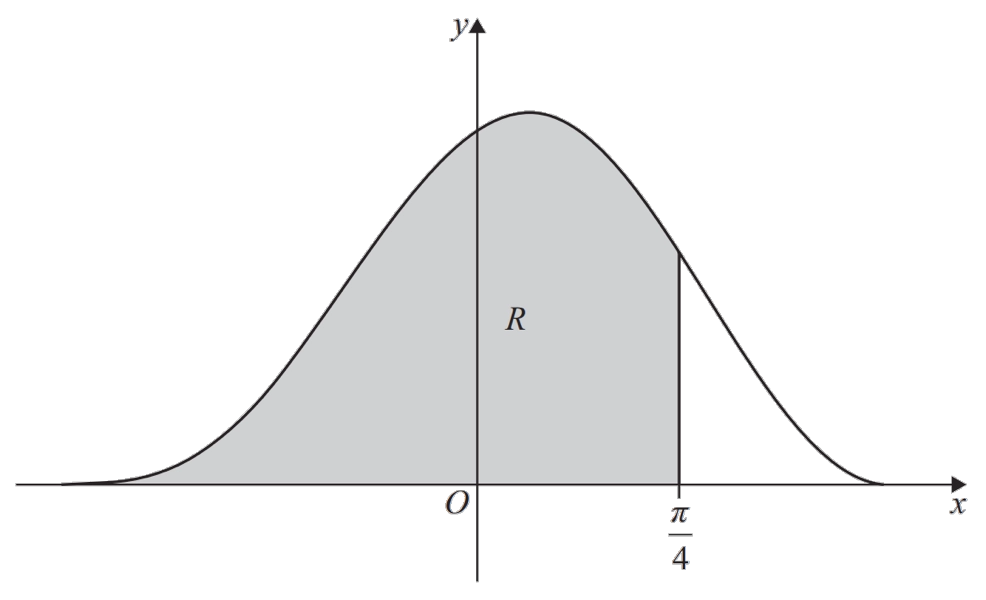
Figure 4

Figure 4 shows a sketch of the curve with equation

y=cos2x1+sinxπ2xπ2\begin{align*} y = \cos^2 x\sqrt{1 + \sin x} \qquad -\frac{\pi}{2} \leqslant x \leqslant \frac{\pi}{2} \end{align*}

The region RR , shown shaded in Figure 4, is bounded by the curve, the xx-axis and the line with equation x=π4x = \dfrac{\pi}{4}

The region RR is rotated through 2π2\pi radians about the xx-axis to form a solid of revolution.

(c) Use the answer to part (b) and algebraic integration to determine the exact volume of this solid.

Give the answer in the form π160(p+qπ+r2)\frac{\pi}{160}(p + q\pi + r\sqrt{2}\,) where pp , qq and rr are integers.

(6)

解答

(a)

By De Moivre’s Theorem, for z=cosθ+isinθz = \cos\theta + i\sin\theta:

zn=cos(nθ)+isin(nθ)\begin{align*} z^n = &\,\cos(n\theta) + i\sin(n\theta) \end{align*}

And for the reciprocal:

1zn=zn=cos(nθ)+isin(nθ)=cos(nθ)isin(nθ)\begin{align*} \frac{1}{z^n} = z^{-n} = &\,\cos(-n\theta) + i\sin(-n\theta)\\[4mm] = &\,\cos(n\theta) - i\sin(n\theta) \end{align*}

Adding these two equations:

zn+1zn=(cos(nθ)+isin(nθ))+(cos(nθ)isin(nθ))=2cos(nθ)\begin{align*} z^n + \frac{1}{z^n} = &\,(\cos(n\theta) + i\sin(n\theta)) + (\cos(n\theta) - i\sin(n\theta))\\[4mm] = &\,2\cos(n\theta) \end{align*}

(b)

Using the binomial expansion on (z+1z)4\left( z + \frac{1}{z} \right)^4:

(z+1z)4=z4+4z3(1z)+6z2(1z)2+4z(1z)3+(1z)4=z4+4z2+6+4z2+1z4=(z4+1z4)+4(z2+1z2)+6\begin{align*} \left( z + \frac{1}{z} \right)^4 = &\,z^4 + 4z^3\left(\frac{1}{z}\right) + 6z^2\left(\frac{1}{z}\right)^2 + 4z\left(\frac{1}{z}\right)^3 + \left(\frac{1}{z}\right)^4\\[4mm] = &\,z^4 + 4z^2 + 6 + \frac{4}{z^2} + \frac{1}{z^4}\\[4mm] = &\,\left( z^4 + \frac{1}{z^4} \right) + 4\left( z^2 + \frac{1}{z^2} \right) + 6 \end{align*}

Using the result from (a), where zn+1zn=2cos(nθ)z^n + \frac{1}{z^n} = 2\cos(n\theta), we can substitute:

(2cosθ)4=(2cos4θ)+4(2cos2θ)+616cos4θ=2cos4θ+8cos2θ+6cos4θ=116(2cos4θ+8cos2θ+6)=18(cos4θ+4cos2θ+3)\begin{align*} (2\cos\theta)^4 = &\,(2\cos 4\theta) + 4(2\cos 2\theta) + 6\\[4mm] 16\cos^4\theta = &\,2\cos 4\theta + 8\cos 2\theta + 6\\[4mm] \cos^4\theta = &\,\frac{1}{16}(2\cos 4\theta + 8\cos 2\theta + 6)\\[4mm] = &\,\frac{1}{8}(\cos 4\theta + 4\cos 2\theta + 3) \end{align*}

This gives the required form, with a=4a=4 and b=3b=3.

(c)

The volume VV of the solid of revolution formed by rotating the curve about the xx-axis is:

V=ππ2π4y2dx=ππ2π4(cos2x1+sinx)2dx=ππ2π4cos4x(1+sinx)dx=ππ2π4(cos4x+cos4xsinx)dx\begin{align*} V = &\,\pi \int_{-\frac{\pi}{2}}^{\frac{\pi}{4}} y^2 \,\mathrm{d}x\\[4mm] = &\,\pi \int_{-\frac{\pi}{2}}^{\frac{\pi}{4}} \left( \cos^2 x \sqrt{1 + \sin x} \right)^2 \,\mathrm{d}x\\[4mm] = &\,\pi \int_{-\frac{\pi}{2}}^{\frac{\pi}{4}} \cos^4 x (1 + \sin x) \,\mathrm{d}x\\[4mm] = &\,\pi \int_{-\frac{\pi}{2}}^{\frac{\pi}{4}} (\cos^4 x + \cos^4 x \sin x) \,\mathrm{d}x \end{align*}

Using the identity from (b), we replace cos4x\cos^4 x:

cos4xdx=18(cos4x+4cos2x+3)dx=18(14sin4x+2sin2x+3x)\begin{align*} \int \cos^4 x \,\mathrm{d}x = &\,\int \frac{1}{8}(\cos 4x + 4\cos 2x + 3) \,\mathrm{d}x\\[4mm] = &\,\frac{1}{8}\left( \frac{1}{4}\sin 4x + 2\sin 2x + 3x \right) \end{align*}

For the second part of the integral:

cos4xsinxdx=15cos5x\begin{align*} \int \cos^4 x \sin x \,\mathrm{d}x = &\,-\frac{1}{5}\cos^5 x \end{align*}

Combining these, the indefinite integral is:

I=π[18(14sin4x+2sin2x+3x)15cos5x]π2π4\begin{align*} I = &\,\pi \left[ \frac{1}{8}\left( \frac{1}{4}\sin 4x + 2\sin 2x + 3x \right) - \frac{1}{5}\cos^5 x \right]_{-\frac{\pi}{2}}^{\frac{\pi}{4}} \end{align*}

Now, evaluate at the upper limit x=π4x = \frac{\pi}{4}:

π(18(14sin(π)+2sin(π2)+3(π4))15cos5(π4))=π(18(0+2+3π4)15(22)5)=π(14+3π3215(4232))=π(14+3π32240)\begin{align*} &\,\pi \left( \frac{1}{8} \left( \frac{1}{4}\sin(\pi) + 2\sin\left(\frac{\pi}{2}\right) + 3\left(\frac{\pi}{4}\right) \right) - \frac{1}{5}\cos^5\left(\frac{\pi}{4}\right) \right)\\[4mm] = &\,\pi \left( \frac{1}{8} \left( 0 + 2 + \frac{3\pi}{4} \right) - \frac{1}{5}\left(\frac{\sqrt{2}}{2}\right)^5 \right)\\[4mm] = &\,\pi \left( \frac{1}{4} + \frac{3\pi}{32} - \frac{1}{5}\left(\frac{4\sqrt{2}}{32}\right) \right)\\[4mm] = &\,\pi \left( \frac{1}{4} + \frac{3\pi}{32} - \frac{\sqrt{2}}{40} \right) \end{align*}

Evaluate at the lower limit x=π2x = -\frac{\pi}{2}:

π(18(14sin(2π)+2sin(π)+3(π2))15cos5(π2))=π(18(0+03π2)0)=3π16π\begin{align*} &\,\pi \left( \frac{1}{8} \left( \frac{1}{4}\sin(-2\pi) + 2\sin(-\pi) + 3\left(-\frac{\pi}{2}\right) \right) - \frac{1}{5}\cos^5\left(-\frac{\pi}{2}\right) \right)\\[4mm] = &\,\pi \left( \frac{1}{8} \left( 0 + 0 - \frac{3\pi}{2} \right) - 0 \right)\\[4mm] = &\,-\frac{3\pi}{16} \pi \end{align*}

Subtract the lower limit value from the upper limit value:

V=π(14+3π32240(3π16))=π(14+3π32+6π32240)=π(14+9π32240)\begin{align*} V = &\,\pi \left( \frac{1}{4} + \frac{3\pi}{32} - \frac{\sqrt{2}}{40} - \left( -\frac{3\pi}{16} \right) \right)\\[4mm] = &\,\pi \left( \frac{1}{4} + \frac{3\pi}{32} + \frac{6\pi}{32} - \frac{\sqrt{2}}{40} \right)\\[4mm] = &\,\pi \left( \frac{1}{4} + \frac{9\pi}{32} - \frac{\sqrt{2}}{40} \right) \end{align*}

To write this over a common denominator of 160160:

14=40160,9π32=45π160,240=42160\begin{align*} \frac{1}{4} = \frac{40}{160}, \quad \frac{9\pi}{32} = \frac{45\pi}{160}, \quad \frac{\sqrt{2}}{40} = \frac{4\sqrt{2}}{160} \end{align*}

Thus, the volume is:

V=π160(40+45π42)\begin{align*} V = &\,\frac{\pi}{160} \left( 40 + 45\pi - 4\sqrt{2} \right) \end{align*}