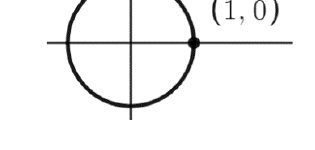
A complex number z is represented by the point P on an Argand diagram where ∣z∣=1
(a) Sketch the locus of P as z varies.
(1)
The transformation T from the z-plane, where z=x+iy, to the w-plane, where w=u+iv, is given by
w=z+19iz−iz=−1
Given that the image under T of the locus of P in the z-plane, where z=−1, is the line l in the w-plane,
(b) determine, in simplest form, a Cartesian equation for l
(5)
解答
(a)
解法一
思路
展开
∣z∣=1 表示点到原点的距离恒为 1,所以轨迹是以原点为圆心、半径为 1 的圆。
答题过程
展开
The locus ∣z∣=1 is a circle centered at the origin O with radius 1 on the Argand diagram.
(b)
解法一
思路
展开
先把 z 用 w 表示。由于原轨迹是 ∣z∣=1,代入后会得到一个“到两个固定点距离相等”的式子,所以像是两点连线的垂直平分线。
答题过程
展开
From
w=z+19iz−i,
make z the subject:
w(z+1)=wz+w=z(w−9i)=z=9iz−i9iz−i−w−iw−9i−w−i
Since ∣z∣=1,
w−9i−w−i=∣−w−i∣=∣w+i∣=1∣w−9i∣∣w−9i∣
This means that w is equidistant from −i and 9i. Their midpoint is 4i, and the segment joining them is vertical, so the perpendicular bisector is horizontal: