Skip to content
CalcGospel 國際數學圖譜
返回

IAL 2022 Jan FP3 Q2

A Level / Edexcel / FP3

IAL 2022 Jan Paper · Question 2

题目

Problem

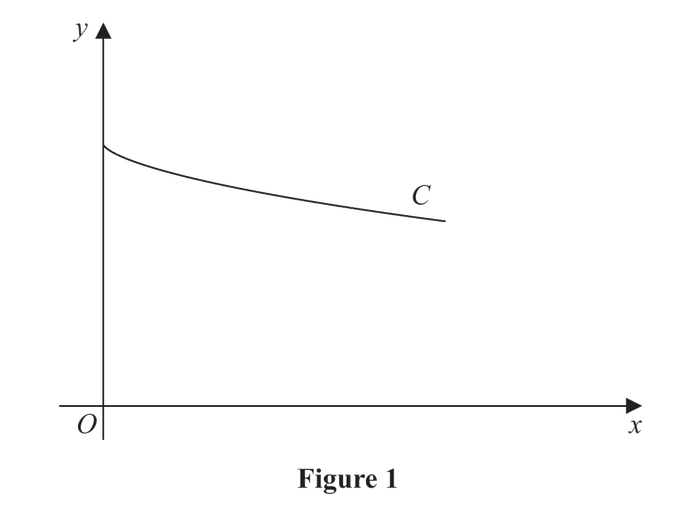
Figure 1 shows a sketch of the curve CC with parametric equations

x=ln(secθ+tanθ)sinθ,y=cosθ,0θπ4x=\ln(\sec\theta+\tan\theta)-\sin\theta, \qquad y=\cos\theta, \qquad 0\le\theta\le\frac{\pi}{4}

The curve CC is rotated through 2π2\pi radians about the xx-axis and is used to form a solid of revolution SS.

Using calculus, show that the total surface area of SS is given by

π2(p+q2)\frac{\pi}{2}(p+q\sqrt2)

where pp and qq are integers to be determined.

(8)
题目中文翻译

图 1 给出了曲线 CC 的示意图,其参数方程为

x=ln(secθ+tanθ)sinθ,y=cosθ,0θπ4x=\ln(\sec\theta+\tan\theta)-\sin\theta, \qquad y=\cos\theta, \qquad 0\le\theta\le\frac{\pi}{4}

曲线 CCxx 轴旋转 2π2\pi 弧度,形成旋转体 SS

利用微积分证明,SS 的总表面积为

π2(p+q2)\frac{\pi}{2}(p+q\sqrt2)

其中 ppqq 为待定整数。

解答

解法一:使用参数曲线的弧长元素

思路

展开

先分别求 dxdθ\frac{\mathrm{d}x}{\mathrm{d}\theta}dydθ\frac{\mathrm{d}y}{\mathrm{d}\theta},化简参数曲线的弧长因子。曲面侧面积由 2πyds2\pi\int y\,\mathrm{d}s 求得;题目问的是总表面积,所以还必须加上两端半径分别为 1112\frac1{\sqrt2} 的圆面面积。

答题过程

展开

First,

dxdθ=secθtanθ+sec2θsecθ+tanθcosθ=secθcosθ=sin2θcosθ,\begin{align*} \frac{\mathrm{d}x}{\mathrm{d}\theta} =&\,\frac{\sec\theta\tan\theta+\sec^2\theta} {\sec\theta+\tan\theta}-\cos\theta \\ =&\,\sec\theta-\cos\theta \\ =&\,\frac{\sin^2\theta}{\cos\theta}, \end{align*}

and

dydθ=sinθ.\frac{\mathrm{d}y}{\mathrm{d}\theta}=-\sin\theta.

Since 0θπ40\le\theta\le\frac\pi4,

(dxdθ)2+(dydθ)2=sin4θcos2θ+sin2θ=sin2θcos2θ=tanθ.\begin{align*} \sqrt{\bigg(\frac{\mathrm{d}x}{\mathrm{d}\theta}\bigg)^2 +\bigg(\frac{\mathrm{d}y}{\mathrm{d}\theta}\bigg)^2} =&\,\sqrt{\frac{\sin^4\theta}{\cos^2\theta} +\sin^2\theta} \\ =&\,\sqrt{\frac{\sin^2\theta}{\cos^2\theta}} \\ =&\,\tan\theta. \end{align*}

Therefore, the curved surface area is

AC=2π0π/4y(dxdθ)2+(dydθ)2dθ=2π0π/4cosθtanθdθ=2π0π/4sinθdθ=2π[cosθ]0π/4=2π(112).\begin{align*} A_C =&\,2\pi\int_0^{\pi/4} y\sqrt{\bigg(\frac{\mathrm{d}x}{\mathrm{d}\theta}\bigg)^2 +\bigg(\frac{\mathrm{d}y}{\mathrm{d}\theta}\bigg)^2} \,\mathrm{d}\theta \\ =&\,2\pi\int_0^{\pi/4}\cos\theta\tan\theta \,\mathrm{d}\theta \\ =&\,2\pi\int_0^{\pi/4}\sin\theta \,\mathrm{d}\theta \\ =&\,2\pi\bigl[-\cos\theta\bigr]_0^{\pi/4} \\ =&\,2\pi\bigg(1-\frac1{\sqrt2}\bigg). \end{align*}

The radii of the two circular ends are

y(0)=1,y(π4)=12.y(0)=1, \qquad y\bigg(\frac\pi4\bigg)=\frac1{\sqrt2}.

Hence the total surface area is

A=2π(112)+π(1)2+π(12)2=7π2π2=π2(722).\begin{align*} A =&\,2\pi\bigg(1-\frac1{\sqrt2}\bigg) +\pi(1)^2+\pi\bigg(\frac1{\sqrt2}\bigg)^2 \\ =&\,\frac{7\pi}{2}-\pi\sqrt2 \\ =&\,\boxed{\frac\pi2\bigl(7-2\sqrt2\bigr)}. \end{align*}

Thus p=7p=7 and q=2q=-2.

解法二:使用 dydx\frac{\mathrm{d}y}{\mathrm{d}x} 形式

思路

展开

官方评分资料也允许使用 2πy1+(dydx)2dx2\pi\int y\sqrt{1+(\frac{\mathrm{d}y}{\mathrm{d}x})^2}\,\mathrm{d}x。把 dx\mathrm{d}x 换回参数 θ\theta 后,根式与 dxdθ\frac{\mathrm{d}x}{\mathrm{d}\theta} 的乘积仍化成 tanθ\tan\theta,再补上两个端面。

答题过程

展开

From

dxdθ=sin2θcosθ\frac{\mathrm{d}x}{\mathrm{d}\theta} =\frac{\sin^2\theta}{\cos\theta}

and

dydθ=sinθ,\frac{\mathrm{d}y}{\mathrm{d}\theta}=-\sin\theta,

we have

dydx=cosθsinθ.\frac{\mathrm{d}y}{\mathrm{d}x} =-\frac{\cos\theta}{\sin\theta}.

Therefore,

1+(dydx)2dxdθ=1+cos2θsin2θsin2θcosθ=1sinθsin2θcosθ=tanθ.\begin{align*} &\,\sqrt{1+\bigg(\frac{\mathrm{d}y}{\mathrm{d}x}\bigg)^2} \frac{\mathrm{d}x}{\mathrm{d}\theta} \\ =&\,\sqrt{1+\frac{\cos^2\theta}{\sin^2\theta}} \frac{\sin^2\theta}{\cos\theta} \\ =&\,\frac1{\sin\theta} \frac{\sin^2\theta}{\cos\theta} \\ =&\,\tan\theta. \end{align*}

Thus the curved surface area is

AC=2π0π/4y1+(dydx)2dxdθdθ=2π0π/4sinθdθ=2π(112).\begin{align*} A_C =&\,2\pi\int_0^{\pi/4} y\sqrt{1+\bigg(\frac{\mathrm{d}y}{\mathrm{d}x}\bigg)^2} \frac{\mathrm{d}x}{\mathrm{d}\theta}\,\mathrm{d}\theta \\ =&\,2\pi\int_0^{\pi/4}\sin\theta\,\mathrm{d}\theta \\ =&\,2\pi\bigg(1-\frac1{\sqrt2}\bigg). \end{align*}

Adding the two circular ends gives

A=AC+π+π2=π2(722).\begin{align*} A =&\,A_C+\pi+\frac\pi2 \\ =&\,\boxed{\frac\pi2\bigl(7-2\sqrt2\bigr)}. \end{align*}

Therefore, p=7p=7 and q=2q=-2.