Skip to content
CalcGospel 國際數學圖譜
返回

IAL 2024 Jan FP3 Q7

A Level / Edexcel / FP3

IAL 2024 Jan Paper · Question 7

题目

Problem

y=arccos(sechx)x>0y=\operatorname{arccos}(\operatorname{sech}x)\qquad x>0

(a) Show that

dydx=sechx\frac{dy}{dx}=\operatorname{sech}x

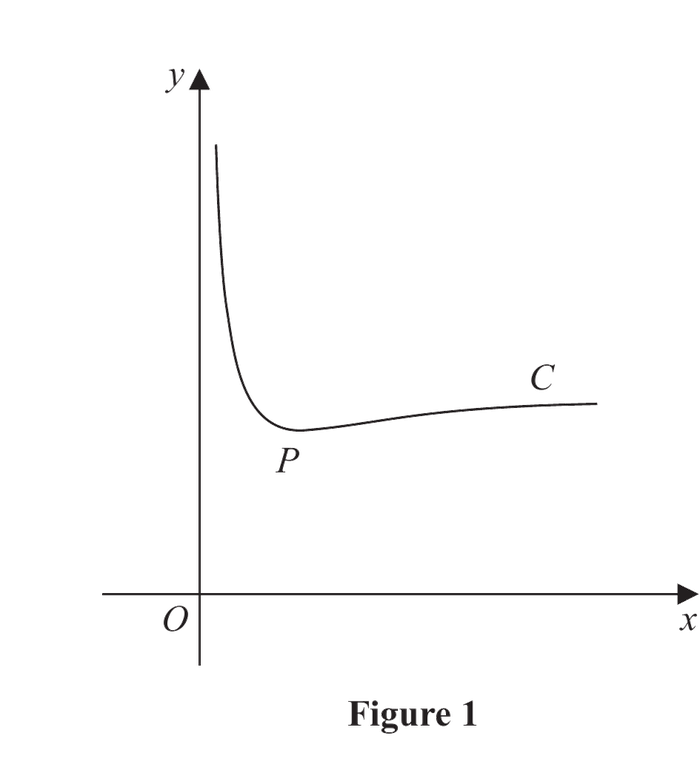
Figure 1 shows a sketch of part of the curve CC with equation y=f(x)y=f(x) where

f(x)=arccos(sechx)+cothxx>0f(x)=\operatorname{arccos}(\operatorname{sech}x)+\coth x \qquad x>0

The point PP is a minimum turning point of CC

(b) Show that the xx coordinate of PP is ln(q+q)\ln(q+\sqrt q) where q=12(1+k)q=\frac12(1+\sqrt{k}) and kk is an integer to be determined.

(9)
题目中文翻译 y=arccos(sechx)x>0y=\operatorname{arccos}(\operatorname{sech}x)\qquad x>0

(a) 证明

dydx=sechx\frac{dy}{dx}=\operatorname{sech}x

图 1 给出了曲线 CC 的一部分草图,其方程为 y=f(x)y=f(x),其中

f(x)=arccos(sechx)+cothxx>0f(x)=\operatorname{arccos}(\operatorname{sech}x)+\coth x \qquad x>0

PPCC 的一个极小转折点

(b) 证明 PPxx 坐标为 ln(q+q)\ln(q+\sqrt q),其中 q=12(1+k)q=\frac12(1+\sqrt{k}),且 kk 为待定整数。

解答

(a)

解法一:直接使用链式法则

思路

展开

对复合函数直接求导,再用 1sech2x=tanh2x1-\operatorname{sech}^2x=\tanh^2x 化简根式。条件 x>0x>0 保证 tanhx>0\tanh x>0,所以 tanh2x=tanhx\sqrt{\tanh^2x}=\tanh x,不能遗漏这一符号判断。

答题过程

展开

Using the chain rule,

dydx=11sech2x(sechxtanhx)=sechxtanhx1sech2x.\begin{align*} \frac{\mathrm{d}y}{\mathrm{d}x} =&\,-\frac{1}{ \sqrt{1-\operatorname{sech}^2x}} \bigl(-\operatorname{sech}x\tanh x\bigr) \\ =&\,\frac{\operatorname{sech}x\tanh x} {\sqrt{1-\operatorname{sech}^2x}}. \end{align*}

Since

1sech2x=tanh2x1-\operatorname{sech}^2x=\tanh^2x

and x>0x>0, we have tanhx>0\tanh x>0. Hence

1sech2x=tanhx.\sqrt{1-\operatorname{sech}^2x}=\tanh x.

Therefore,

dydx=sechx.\boxed{ \frac{\mathrm{d}y}{\mathrm{d}x} =\operatorname{sech}x }.

解法二:隐式求导

思路

展开

先把反余弦关系改写为 cosy=sechx\cos y=\operatorname{sech}x,再隐式求导。由 x>0x>0 可知 0<y<π/20<y<\pi/2,因此 siny\sin ytanhx\tanh x 都为正,可以从平方恒等式确定 siny=tanhx\sin y=\tanh x

答题过程

展开

The equation may be written as

cosy=sechx.\cos y=\operatorname{sech}x.

Differentiating implicitly,

sinydydx=sechxtanhx.-\sin y\frac{\mathrm{d}y}{\mathrm{d}x} =-\operatorname{sech}x\tanh x.

Also,

sin2y=1cos2y=1sech2x=tanh2x.\begin{align*} \sin^2y =&\,1-\cos^2y \\ =&\,1-\operatorname{sech}^2x \\ =&\,\tanh^2x. \end{align*}

For x>0x>0, both sinysin y and tanhx\tanh x are positive, so

siny=tanhx.\sin y=\tanh x.

Substituting this into the differentiated equation gives

tanhxdydx=sechxtanhx.-\tanh x\frac{\mathrm{d}y}{\mathrm{d}x} =-\operatorname{sech}x\tanh x.

Since tanhx0\tanh x\ne0 for x>0x>0,

dydx=sechx.\boxed{ \frac{\mathrm{d}y}{\mathrm{d}x} =\operatorname{sech}x }.

(b)

解法一

思路

展开

利用 (a) 的结果对 f(x)f(x) 求导,并令极小转折点处的导数为零。把所得双曲函数方程改写成关于 coshx\cosh x 的二次方程;取符合 x>0x>0 的正根后,再使用 arcosh\operatorname{arcosh} 的对数形式,并借助二次方程本身把根号内化成 qq

答题过程

展开

From part (a),

f(x)=sechxcosech2x.\begin{align*} f'(x) =&\,\operatorname{sech}x -\operatorname{cosech}^2x. \end{align*}

At the turning point PP, f(x)=0f'(x)=0. Thus

sechx=cosech2x,1coshx=1sinh2x,sinh2x=coshx.\begin{align*} \operatorname{sech}x =&\,\operatorname{cosech}^2x, \\ \frac1{\cosh x} =&\,\frac1{\sinh^2x}, \\ \sinh^2x =&\,\cosh x. \end{align*}

Using sinh2x=cosh2x1\sinh^2x=\cosh^2x-1,

cosh2xcoshx1=0.\cosh^2x-\cosh x-1=0.

Hence

coshx=1±52.\cosh x=\frac{1\pm\sqrt5}{2}.

Since x>0x>0, coshx>1\cosh x>1, so

coshx=1+52.\cosh x=\frac{1+\sqrt5}{2}.

Let

q=1+52.q=\frac{1+\sqrt5}{2}.

Then q2q1=0q^2-q-1=0, so q21=qq^2-1=q. Therefore,

x=arcoshq=ln(q+q21)=ln(q+q).\begin{align*} x =&\,\operatorname{arcosh}q \\ =&\,\ln\bigl(q+\sqrt{q^2-1}\bigr) \\ =&\,\ln(q+\sqrt q). \end{align*}

Thus the xx coordinate of PP is

x=ln(q+q).\boxed{x=\ln(q+\sqrt q)}.

Here

q=12(1+k),k=5.q=\frac12(1+\sqrt k), \qquad \boxed{k=5}.