题目
Problem
In this question you must show all stages of your working.
Solutions relying entirely on calculator technology are not acceptable.
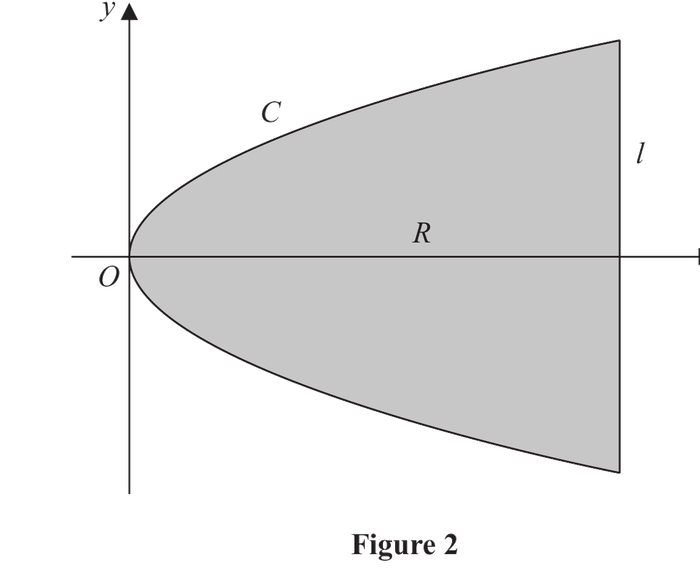
Figure 2 shows a sketch of part of the curve C with equation y2=8x and part of the line l with equation x=18
The region R, shown shaded in Figure 2, is bounded by C and l
(a) Show that the perimeter of R is given by
α+2∫0β1+16y2dy
where α and β are positive constants to be determined.
(b) Use the substitution y=4sinhu and algebraic integration to determine the exact perimeter of R, giving your answer in simplest form.
(9)
题目中文翻译
本题中你必须写出所有解题步骤。
完全依赖计算器技术的解法不予接受。
图 2 给出了曲线 C 的一部分草图,其方程为 y2=8x,以及直线 l 的一部分,其方程为 x=18
所示阴影区域 R 由 C 与 l 围成
(a) 证明 R 的周长可表示为
α+2∫0β1+16y2dy
其中 α 和 β 为待定正数。
(b) 使用代换 y=4sinhu 以及代数积分求 R 的精确周长,答案写成最简形式。
解答
(a)
解法一
思路
展开
把抛物线写成 x=y2/8,以 y 为变量使用弧长公式。直线 x=18 与抛物线交于 y=±12;边界包括长度为 24 的竖直线段,以及关于 x 轴对称的两段抛物线弧。
答题过程
展开
From y2=8x,
x=8y2,dydx=4y.
At x=18,
y2=8(18)=144,
so the points of intersection have y=±12. The vertical part of the boundary therefore has length
12−(−12)=24.
The length of the upper curved part is
∫0121+(dydx)2dy=∫0121+16y2dy.
By symmetry, the two curved parts have equal length. Hence
Perimeter(R)=+242∫0121+16y2dy.
Therefore,
α=24,β=12.
(b)
解法一:使用双角恒等式积分
思路
展开
按照题目指定令 y=4sinhu。根式化为 coshu,并与 dy=4coshudu 合并成 4cosh2u;再用双角恒等式积分。上限由 sinhU=3 确定。
答题过程
展开
Let
y=4sinhu.
Then
dy=4coshudu.
When y=0, u=0. When y=12, let u=U, where
sinhU=3.
Thus
U=arsinh3=ln(3+10).
Let
J=∫0121+16y2dy.
Since coshu>0,
1+sinh2u=coshu.
Therefore,
J===4∫0Ucosh2udu4∫0U21+cosh2udu[2u+sinh2u]0U.
Also,
coshU==sinh2U==1+sinh2U10,2sinhUcoshU610.
Hence
J=610+2ln(3+10).
Using part (a),
Perimeter(R)==+24+2J24+12104ln(3+10).
Therefore, the exact perimeter is
24+1210+4ln(3+10).
解法二:展开为指数函数积分
思路
展开
仍使用题目指定的双曲正弦代换,但将 cosh2u 展开为指数函数后逐项积分。利用 eU=3+10 与 e−U=10−3 化简端点值。
答题过程
展开
As in the first method, set y=4sinhu and
U=arsinh3=ln(3+10).
Then
J=4∫0Ucosh2udu.
Using the exponential definition of coshu,
4cosh2u==(eu+e−u)2e2u+2+e−2u.
Therefore,
J===∫0U(e2u+2+e−2u)du[21e2u+2u−21e−2u]0U21(e2U−e−2U)+2U.
Since
eU=3+10,e−U=10−3,
we have
e2U−e−2U===(eU−e−U)(eU+e−U)6(210)1210.
Thus
J=610+2ln(3+10).
Consequently,
Perimeter(R)=24+1210+4ln(3+10).