题目
Problem
In this question you must show all stages of your working.
Solutions relying on calculator technology are not acceptable.
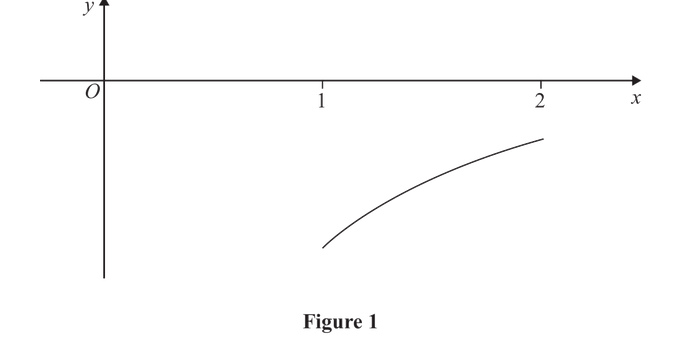
Figure 1 shows the curve with equation
y=ln(tanh2x)1≤x≤2
(a) Show that the length, s, of the curve is given by
s=∫12cothxdx
(b) Hence show that
s=ln(e+e1)
(8)
题目中文翻译
本题中你必须写出所有解题步骤。
完全依赖计算器技术的解法不予接受。
图 1 给出了曲线,其方程为
y=ln(tanh2x)1≤x≤2
(a) 证明曲线长度 s 满足
s=∫12cothxdx
(b) 因此证明
s=ln(e+e1)
解答
(a)
解法一
思路
展开
先对 y=ln(tanh(x/2)) 求导,并用二倍角公式把导数化为 cosechx。代入弧长公式后,再用 1+cosech2x=coth2x;由于区间内 cothx>0,开平方后就是 cothx。
答题过程
展开
Differentiating,
dxdy===tanh(x/2)1⋅21sech22x2sinh(x/2)cosh(x/2)1sinhx1=cosechx.
The arc length is therefore
s===∫121+(dxdy)2dx∫121+cosech2xdx∫12coth2xdx.
Since 1⩽x⩽2, cothx>0. Hence
s=∫12cothxdx.
(b)
解法一
思路
展开
承接 (a),利用 dxdln(sinhx)=cothx 完成积分。代入上下限后,再用 sinh2x=2sinhxcoshx 约去 sinh1,即可直接得到题设形式。
答题过程
展开
Using the result from part (a),
s===∫12cothxdx[ln(sinhx)]12ln(sinh1sinh2).
Since sinh2=2sinh1cosh1,
sinh1sinh2=2cosh1=e+e1.
Therefore,
s=ln(e+e1).