题目
Problem
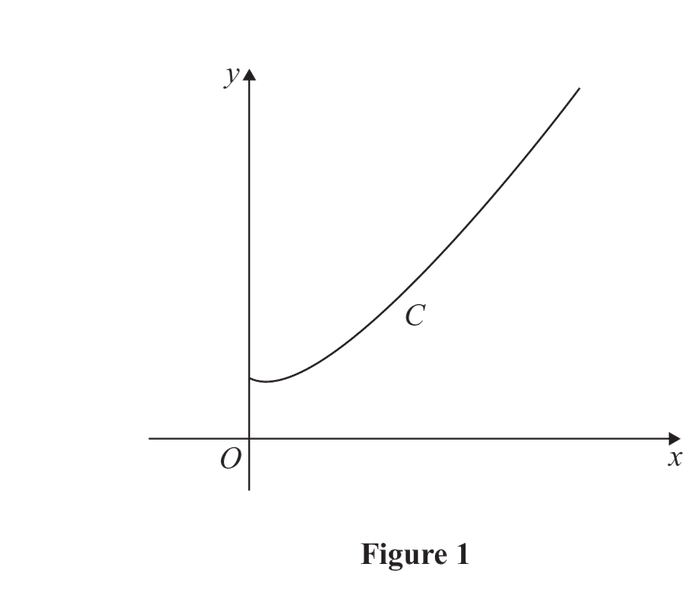
Figure 1
In this question you must show all stages of your working.
Solutions relying entirely on calculator technology are not acceptable.
Figure 1 shows a sketch of the curve C defined by the parametric equations
x = ( 2 t + 3 ) 3 / 2 y = 3 2 t 2 + 3 t + 6 − 3 2 ≤ t ≤ 3 x = (2t+3)^{3/2}
\qquad
y = \frac{3}{2}t^2 + 3t + 6
\qquad
-\frac{3}{2} \le t \le 3 x = ( 2 t + 3 ) 3/2 y = 2 3 t 2 + 3 t + 6 − 2 3 ≤ t ≤ 3 (a) Show that
( d x d t ) 2 + ( d y d t ) 2 = a ( t + 2 ) 2 \left(\frac{dx}{dt}\right)^2 + \left(\frac{dy}{dt}\right)^2 = a(t+2)^2 ( d t d x ) 2 + ( d t d y ) 2 = a ( t + 2 ) 2 where a a a
Hence, using algebraic integration, determine
(b) the exact length of C,
(c) the exact area of the surface generated when C is rotated through 360º about the
x-axis, giving your answer in the form k π k\pi k π k k k
(4)
(3)
(4)
题目中文翻译
图 1
在本题中,你必须写出所有解题步骤。
完全依赖计算器技术求解是不可以的。
图 1 展示了曲线 C 的草图,其参数方程为
x = ( 2 t + 3 ) 3 / 2 y = 3 2 t 2 + 3 t + 6 − 3 2 ≤ t ≤ 3 x = (2t+3)^{3/2}
\qquad
y = \frac{3}{2}t^2 + 3t + 6
\qquad
-\frac{3}{2} \le t \le 3 x = ( 2 t + 3 ) 3/2 y = 2 3 t 2 + 3 t + 6 − 2 3 ≤ t ≤ 3 (a) 证明
( d x d t ) 2 + ( d y d t ) 2 = a ( t + 2 ) 2 \left(\frac{dx}{dt}\right)^2 + \left(\frac{dy}{dt}\right)^2 = a(t+2)^2 ( d t d x ) 2 + ( d t d y ) 2 = a ( t + 2 ) 2 其中 a a a
由此,利用代数积分求
(b) C 的精确长度,
(c) C 绕 x 轴旋转 360º 所生成曲面的精确面积,答案写成 k π k\pi k π k k k
解答
(a)
解法一
思路
展开
分别对两个参数方程关于 t t t t t t ( t + 2 ) 2 (t+2)^2 ( t + 2 ) 2 a a a
答题过程
展开
Differentiating the parametric equations,
d x d t = 3 2 ( 2 t + 3 ) 1 / 2 ( 2 ) = 3 ( 2 t + 3 ) 1 / 2 , d y d t = 3 t + 3. \begin{align*}
\frac{\mathrm dx}{\mathrm dt}
=&\,\frac32(2t+3)^{1/2}(2)\\
=&\,3(2t+3)^{1/2},\\
\frac{\mathrm dy}{\mathrm dt}
=&\,3t+3.
\end{align*} d t d x = = d t d y = 2 3 ( 2 t + 3 ) 1/2 ( 2 ) 3 ( 2 t + 3 ) 1/2 , 3 t + 3. Therefore,
( d x d t ) 2 + ( d y d t ) 2 = 9 ( 2 t + 3 ) + ( 3 t + 3 ) 2 = 18 t + 27 + 9 ( t + 1 ) 2 = 9 t 2 + 36 t + 36 = 9 ( t + 2 ) 2 . \begin{align*}
&\,\left(\frac{\mathrm dx}{\mathrm dt}\right)^2
+\left(\frac{\mathrm dy}{\mathrm dt}\right)^2\\
=&\,9(2t+3)+(3t+3)^2\\
=&\,18t+27+9(t+1)^2\\
=&\,9t^2+36t+36\\
=&\,9(t+2)^2.
\end{align*} = = = = ( d t d x ) 2 + ( d t d y ) 2 9 ( 2 t + 3 ) + ( 3 t + 3 ) 2 18 t + 27 + 9 ( t + 1 ) 2 9 t 2 + 36 t + 36 9 ( t + 2 ) 2 . Hence
a = 9 . \boxed{a=9}. a = 9 .
(b)
解法一
思路
展开
承接 (a),参数曲线的弧长因子是平方和的平方根。由于 − 3 2 ⩽ t ⩽ 3 -\frac32\leqslant t\leqslant3 − 2 3 ⩽ t ⩽ 3 t + 2 > 0 t+2>0 t + 2 > 0 9 ( t + 2 ) 2 = 3 ( t + 2 ) \sqrt{9(t+2)^2}=3(t+2) 9 ( t + 2 ) 2 = 3 ( t + 2 )
答题过程
展开
From part (a),
d s d t = 9 ( t + 2 ) 2 = 3 ∣ t + 2 ∣ = 3 ( t + 2 ) , \begin{align*}
\frac{\mathrm ds}{\mathrm dt}
=&\,\sqrt{9(t+2)^2}\\
=&\,3|t+2|\\
=&\,3(t+2),
\end{align*} d t d s = = = 9 ( t + 2 ) 2 3∣ t + 2∣ 3 ( t + 2 ) , because t + 2 > 0 t+2>0 t + 2 > 0
L = ∫ − 3 / 2 3 3 ( t + 2 ) d t = 3 [ t 2 2 + 2 t ] − 3 / 2 3 = 3 [ 21 2 − ( 9 8 − 3 ) ] = 3 ( 99 8 ) = 297 8 . \begin{align*}
L
=&\,\int_{-3/2}^{3}3(t+2)\,\mathrm dt\\
=&\,3\left[\frac{t^2}{2}+2t\right]_{-3/2}^{3}\\
=&\,3\left[
\frac{21}{2}-\left(\frac98-3\right)
\right]\\
=&\,3\left(\frac{99}{8}\right)\\
=&\,\boxed{\frac{297}{8}}.
\end{align*} L = = = = = ∫ − 3/2 3 3 ( t + 2 ) d t 3 [ 2 t 2 + 2 t ] − 3/2 3 3 [ 2 21 − ( 8 9 − 3 ) ] 3 ( 8 99 ) 8 297 .
(c)
解法一
思路
展开
曲线绕 x x x 2 π ∫ y d s d t d t 2\pi\int y\,\frac{\mathrm ds}{\mathrm dt}\,\mathrm dt 2 π ∫ y d t d s d t y y y
答题过程
展开
The surface area generated is
S = 2 π ∫ − 3 / 2 3 y d s d t d t = 6 π ∫ − 3 / 2 3 ( 3 2 t 2 + 3 t + 6 ) ( t + 2 ) d t . \begin{align*}
S
=&\,2\pi\int_{-3/2}^{3}
y\frac{\mathrm ds}{\mathrm dt}\,\mathrm dt\\
=&\,6\pi\int_{-3/2}^{3}
\left(\frac32t^2+3t+6\right)
(t+2)\,\mathrm dt.
\end{align*} S = = 2 π ∫ − 3/2 3 y d t d s d t 6 π ∫ − 3/2 3 ( 2 3 t 2 + 3 t + 6 ) ( t + 2 ) d t . Expanding the integrand,
( 3 2 t 2 + 3 t + 6 ) ( t + 2 ) = 3 2 t 3 + 6 t 2 + 12 t + 12. \left(\frac32t^2+3t+6\right)(t+2)
=\frac32t^3+6t^2+12t+12. ( 2 3 t 2 + 3 t + 6 ) ( t + 2 ) = 2 3 t 3 + 6 t 2 + 12 t + 12. Therefore,
S = 6 π [ 3 8 t 4 + 2 t 3 + 6 t 2 + 12 t ] − 3 / 2 3 . \begin{align*}
S
=&\,6\pi\left[
\frac38t^4+2t^3+6t^2+12t
\right]_{-3/2}^{3}.
\end{align*} S = 6 π [ 8 3 t 4 + 2 t 3 + 6 t 2 + 12 t ] − 3/2 3 . At the upper limit,
3 8 ( 3 ) 4 + 2 ( 3 ) 3 + 6 ( 3 ) 2 + 12 ( 3 ) = 243 8 + 54 + 54 + 36 = 1395 8 . \begin{align*}
&\,\frac38(3)^4+2(3)^3+6(3)^2+12(3)\\
=&\,\frac{243}{8}+54+54+36\\
=&\,\frac{1395}{8}.
\end{align*} = = 8 3 ( 3 ) 4 + 2 ( 3 ) 3 + 6 ( 3 ) 2 + 12 ( 3 ) 8 243 + 54 + 54 + 36 8 1395 . At the lower limit,
3 8 ( − 3 2 ) 4 + 2 ( − 3 2 ) 3 + 6 ( − 3 2 ) 2 + 12 ( − 3 2 ) = 243 128 − 27 4 + 27 2 − 18 = − 1197 128 . \begin{align*}
&\,\frac38\left(-\frac32\right)^4
+2\left(-\frac32\right)^3\\
&\,\hspace{2pt}
+6\left(-\frac32\right)^2
+12\left(-\frac32\right)\\
=&\,\frac{243}{128}-\frac{27}{4}
+\frac{27}{2}-18\\
=&\,-\frac{1197}{128}.
\end{align*} = = 8 3 ( − 2 3 ) 4 + 2 ( − 2 3 ) 3 + 6 ( − 2 3 ) 2 + 12 ( − 2 3 ) 128 243 − 4 27 + 2 27 − 18 − 128 1197 . Hence
S = 6 π ( 1395 8 + 1197 128 ) = 6 π ( 23517 128 ) = 70551 π 64 . \begin{align*}
S
=&\,6\pi\left(
\frac{1395}{8}+\frac{1197}{128}
\right)\\
=&\,6\pi\left(\frac{23517}{128}\right)\\
=&\,\boxed{\frac{70551\pi}{64}}.
\end{align*} S = = = 6 π ( 8 1395 + 128 1197 ) 6 π ( 128 23517 ) 64 70551 π .