题目
Problem
5.
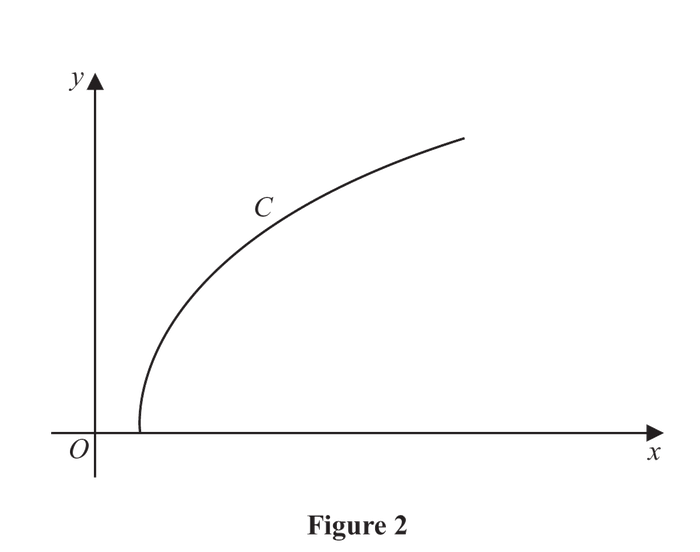
In this question you must show all stages of your working.
Solutions relying on calculator technology are not acceptable.
Figure 2 shows a sketch of the curve C defined by the parametric equations
x=y=cosh2t4sinht0⩽t⩽23
(a) Show that
(dtdx)2+(dtdy)2=mcoshnt
where m and n are integers to be determined.
(5)
(b) Use algebraic integration to determine the exact length of C.
Give the answer in the form a+sinhb where a and b are integers to be found.
(3)
(c) Use algebraic integration to determine the exact area of the surface formed when C
is rotated through 360° about the x-axis.
Give the answer in simplest form in terms of hyperbolic functions.
(4)
题目中文翻译
在本题中,你必须写出所有解题步骤。
不能依赖计算器技术求解。
图 2 展示了曲线 C 的草图,其参数方程为
x=y=cosh2t4sinht0⩽t⩽23
(a) 证明
(dtdx)2+(dtdy)2=mcoshnt
其中 m 和 n 为待定整数。
(5)
(b) 用代数积分求曲线 C 的精确长度。
答案写成 a+sinhb 的形式,其中 a 和 b 为待求整数。
(3)
(c) 用代数积分求曲线 C 绕 x 轴旋转 360° 所形成曲面的精确面积。
答案用双曲函数表示,并化到最简形式。
(4)
解答
(a)
解法一
思路
展开
先分别求参数方程关于 t 的导数。平方相加后,用 sinh2t=2sinhtcosht,再以 sinh2t+1=cosh2t 合并成单项式,由此读出 m,n。
答题过程
展开
Differentiating with respect to t,
dtdx=2sinh2t
and
dtdy=4cosht.
Hence
(dtdx)2+(dtdy)2====4sinh22t+16cosh2t16sinh2tcosh2t+16cosh2t16cosh2t(sinh2t+1)16cosh4t.
Therefore,
m=16,n=4.
(b)
解法一
思路
展开
参数曲线弧长为 ∫(dx/dt)2+(dy/dt)2dt。由 (a),平方根在给定区间上是 4cosh2t;再用二倍角公式 2cosh2t=1+cosh2t 化成可直接积分的形式。
答题过程
展开
Using the result from part (a), the length of C is
L=====∫03/2(dtdx)2+(dtdy)2dt∫03/24cosh2tdt∫03/22(1+cosh2t)dt[2t+sinh2t]03/23+sinh3.
Thus a=3 and b=3.
(c)
解法一
思路
展开
曲线绕 x 轴旋转的曲面面积为 2π∫yds。代入 y=4sinht 和 (a) 得到的 ds/dt=4cosh2t,被积函数含 sinhtcosh2t,令 u=cosht 即可直接积分。
答题过程
展开
The surface area formed by rotation about the x-axis is
S=2π∫03/2y(dtdx)2+(dtdy)2dt.
Therefore,
S====2π∫03/2(4sinht)(4cosh2t)dt32π∫03/2sinhtcosh2tdt332π[cosh3t]03/2332π(cosh323−1).
解法二
思路
展开
也可以用三倍角公式积分。先将 sinhtcosh2t 写成 sinht+sinh3t,再用 sinh3t=3sinht+4sinh3t,把被积函数变成两个可直接积分的双曲函数。
答题过程
展开
Using y=4sinht and the result from part (a),
S==32π∫03/2sinhtcosh2tdt32π∫03/2(sinht+sinh3t)dt.
From the triple-angle identity,
sinh3t=sinht+sinh3t=4sinh3t−3sinht,41(sinht+sinh3t).
Therefore,
S====8π∫03/2(sinht+sinh3t)dt8π[cosht+31cosh3t]03/28π(cosh23+31cosh29−34)38π(3cosh23+cosh29−4).
Using cosh3t=4cosh3t−3cosht, this is equivalently
S==38π(4cosh323−4)332π(cosh323−1).