题目
6.
A small ball is projected vertically upwards with speed from a point that is above horizontal ground. The ball moves freely under gravity until it hits the ground later. By modelling the ball as a particle,
(a) find the value of .
After hitting the ground the ball rebounds vertically and comes to instantaneous rest at the point , after hitting the ground.
(b) Find the height of above the ground.
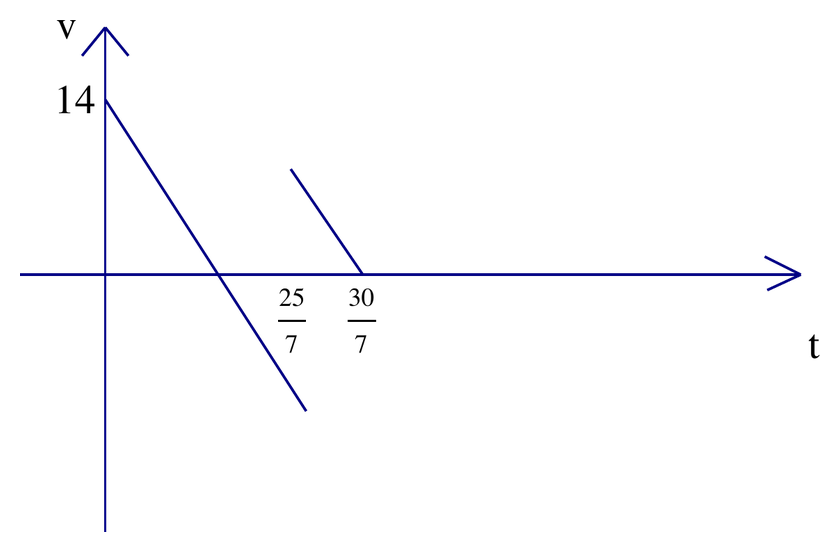
(c) Sketch a velocity-time graph for the motion of the ball from the instant when it was first projected from to the instant when it comes to instantaneous rest at .
[No further calculations are needed in order to draw this sketch.]
题目中文翻译
一个小球从水平地面上方 的 点,以速率 竖直向上抛出。小球仅在重力作用下运动,经过 后撞击地面。将小球视为质点,
(a) 求 的值。
撞击地面后,小球竖直反弹,并在撞击地面后 于 点瞬时静止。
(b) 求 点离地面的高度。
(c) 画出小球从最初在 点被抛出的瞬间,到在 点瞬时静止的瞬间这一运动过程的速度—时间图像草图。
[画此草图无需进一步计算。]
解答
(a)
解法一
思路
展开
以抛出点为位移原点,向上为正。到地面时位移为负,加速度也为负;不要把初始高度直接当成正位移代入。
答题过程
展开
Take upwards as positive. Before impact, , and . Using ,
Therefore
(b)
解法一
思路
展开
反弹后到最高点的末速度为零,已知这段时间,可用不含初速度的位移公式直接求高度。
答题过程
展开
For the upward motion after the rebound, take upwards as positive. With final velocity , acceleration and time ,
解法二
思路
展开
也可以先从末速度为零求反弹初速度,再使用通常的位移公式。
答题过程
展开
Let the upward velocity immediately after rebound be . Then
Hence the height gained is
(c)
解法一
思路
展开
两次自由运动的加速度均为 ,所以速度图像是两条平行的下降直线。碰地反弹使速度瞬间由负变正,不能把两段画成连续直线。
答题过程
展开
Take upwards as positive. Label the horizontal axis (seconds) and the vertical axis ().
The first segment starts at and slopes downwards with constant gradient . It crosses the time axis and continues into negative velocity, ending at .
At , the velocity changes instantaneously to a positive value. From that point, draw a second segment parallel to the first, ending on the time axis at
Show the jump at impact by the separated endpoints; do not join the two segments by an extra solid line.