
题目
8.
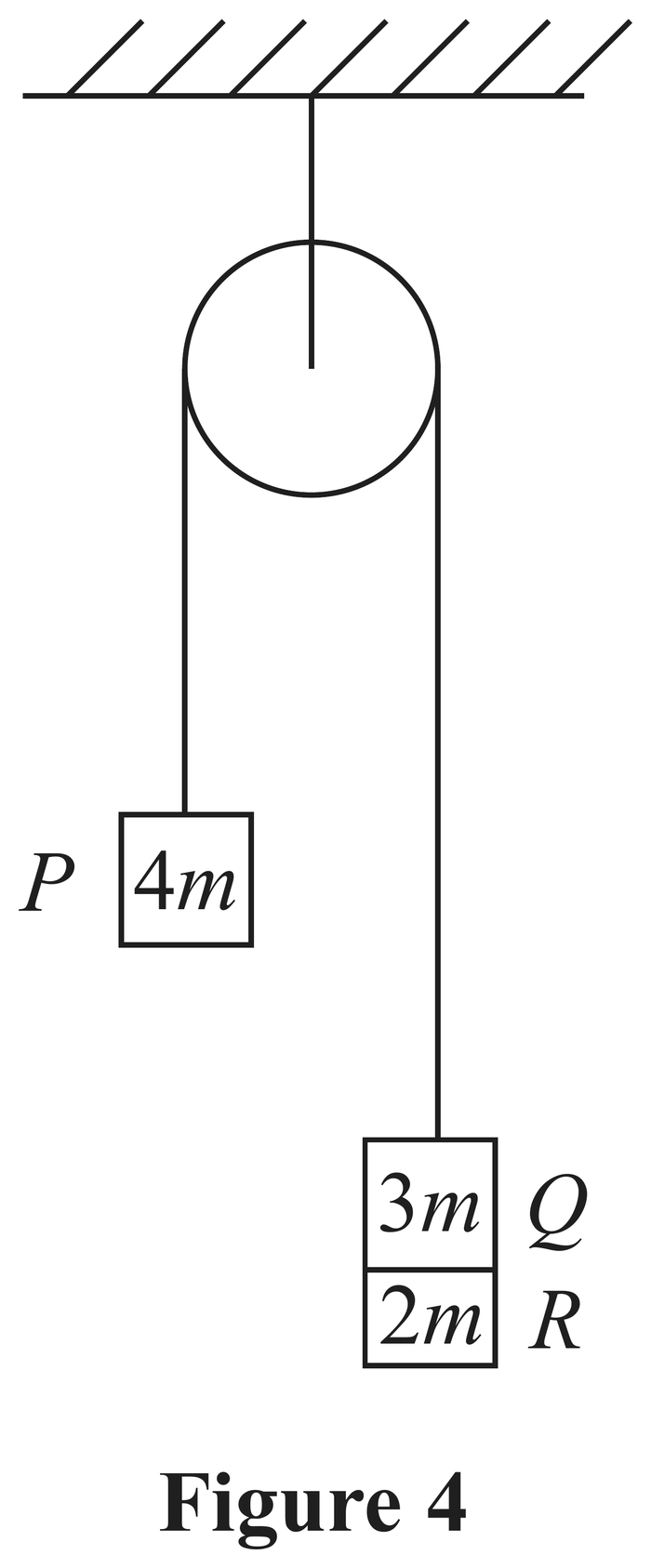
Three particles, , and , have masses , and respectively. Particles and are connected by a light inextensible string that passes over a smooth light fixed pulley. Particle is attached to particle . The system is held at rest with the string taut and the hanging parts of the string vertical, as shown in Figure 4. The system is released from rest.
(a) Find
(i) the acceleration of particle ,
(ii) the tension in the string.
(b) State how you have used the fact that the string is inextensible.
At the instant when particle has moved a distance upwards from its initial position, particle separates from particle and falls away. In the subsequent motion, particles and continue to move and particle does not reach the pulley.
At the instant when particles and separate, particle is at the point , and it continues to move downwards. Particle then comes to instantaneous rest at the point .
(c) Find, in terms of , the distance .
题目中文翻译
三个质点 、 和 的质量分别为 、 和 。质点 和 由一根轻且不可伸长的细绳连接,细绳绕过一个光滑轻质定滑轮。质点 与质点 相连。如图 4 所示,系统被保持静止,细绳绷紧,悬挂部分均竖直。系统从静止释放。
(a) 求
(i) 质点 的加速度,
(ii) 细绳中的张力。
(b) 说明如何使用了“细绳不可伸长”这一条件。
当质点 从初始位置向上移动距离 的瞬间,质点 与质点 分离并落下。在随后的运动中,质点 和 继续运动,且质点 未到达滑轮。
质点 与 分离的瞬间,质点 位于 点,并继续向下运动。随后质点 在 点瞬时静止。
(c) 用 表示距离 。
解答
(a)
解法一
思路
展开
释放前右侧总质量为 ,比 的 大,所以 向上加速。分别对 与 的整体列方程,注意共同加速度与共同张力。
答题过程
展开
(i) The combined mass of and is , so move downwards and moves upwards. Let the acceleration magnitude be and the tension be .
For , taking upwards as positive,
For and together, taking downwards as positive,
Adding the equations gives
(ii) Substituting into (1),
(b)
解法一
思路
展开
不可伸长限制两端位移,从而使两边的速度与加速度大小相同;这里对应的是列方程时使用同一个加速度大小。
答题过程
展开
The particles were taken to have accelerations of the same magnitude while the string remains taut.
(c)
解法一
思路
展开
分离前后是两个不同系统。先求分离瞬间的速率;分离后 仍向下运动,但加速度已向上,所以向下位移公式中的加速度为负。
答题过程
展开
Before separation, the system starts from rest with acceleration magnitude . Since rises through , descends through the same distance. Its speed at separation satisfies
After separation, let be the acceleration of downwards (and of upwards), and let the new tension be . The equations are
Adding them gives
Thus is decelerating as it continues downwards. Let . At its velocity is zero, so
Hence