题目
Problem
4.
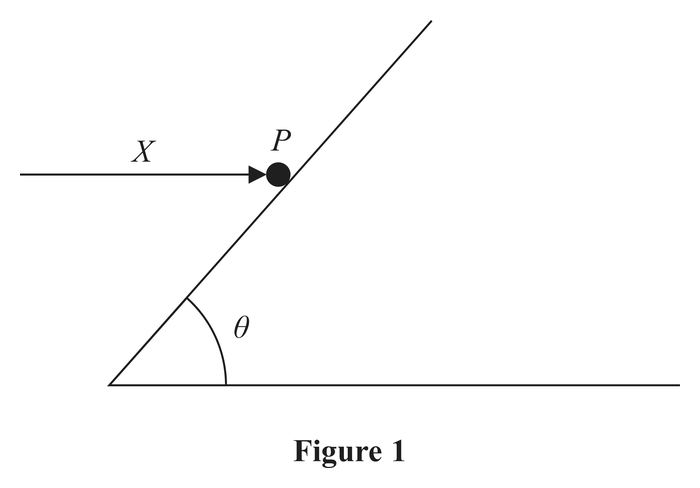
A particle, P, of mass km lies on a fixed rough plane. The plane is inclined to the horizontal at an acute angle θ. A horizontal force of magnitude X acts on P, as shown in Figure 1. The line of action of the force lies in the vertical plane which contains the line of greatest slope of the inclined plane that passes through P. The coefficient of friction between P and the inclined plane is μ.
When X=mg, the particle P is in equilibrium and on the point of sliding down the plane.
(a) Show that
μ=k+tanθktanθ−1
(10)
(b) Deduce that, when k=1, θ must be greater than 45∘.
(2)
题目中文翻译
一个质量为 km 的质点 P 位于固定粗糙斜面上。斜面与水平面成锐角 θ。如图 1 所示,一个大小为 X 的水平力作用在 P 上。该力的作用线位于包含经过 P 点的斜面最大坡度线的竖直平面内。P 与斜面之间的摩擦系数为 μ。
当 X=mg 时,质点 P 处于平衡状态,且恰好要沿斜面向下滑动。
(a) 证明
μ=k+tanθktanθ−1
(10)
(b) 推断:当 k=1 时,θ 必须大于 45∘。
(2)
解答
(a)
解法一
思路
展开
将要向下滑,所以摩擦力沿斜面向上且达到极限值。水平推力不仅有沿斜面向上的分量,也有压向斜面的分量。消去支持力与摩擦力后,再把正弦余弦之比化成正切。
答题过程
展开
Let the normal reaction be R and the limiting friction be F. Since the particle is about to slide down, F acts up the plane and F=μR.
Resolving perpendicular to the plane, with X=mg,
R=kmgcosθ+mgsinθ.
Resolving parallel to the plane,
F+mgcosθ=kmgsinθ,
so
F=mg(ksinθ−cosθ).
Using F=μR and cancelling mg gives
μ(kcosθ+sinθ)=ksinθ−cosθ.
As θ is acute, cosθ>0. Dividing numerator and denominator by cosθ,
μ===kcosθ+sinθksinθ−cosθk+sinθ/cosθksinθ/cosθ−1k+tanθktanθ−1.
解法二
思路
展开
也能沿水平和竖直方向分解。支持力指向左上方,摩擦力沿斜面指向右上方;用极限摩擦关系先消去两个力,再整理。
答题过程
展开
Let R be the normal reaction and F=μR the limiting friction up the plane. Horizontal and vertical equilibrium give
mg+Fcosθ=Rsinθ,
Rcosθ+Fsinθ=kmg.
Substituting F=μR,
mg=R(sinθ−μcosθ),
kmg=R(cosθ+μsinθ).
Multiply the first equation by k and compare with the second. Cancelling the positive reaction R gives
ksinθ−kμcosθ=cosθ+μsinθ.
Collecting terms in μ,
μ(kcosθ+sinθ)=ksinθ−cosθ.
Dividing through and then dividing numerator and denominator by cosθ>0,
μ=k+sinθ/cosθksinθ/cosθ−1=k+tanθktanθ−1.
(b)
解法一
思路
展开
粗糙斜面有 μ>0。代入 k=1 后,先确认分母为正,再推出分子必须为正;锐角区间内正切单调递增。
答题过程
展开
Putting k=1 in (a),
μ=1+tanθtanθ−1>0.
Since 0<θ<90∘, the denominator is positive. Therefore
tanθ−1>0,tanθ>1=tan45∘.
Hence θ>45∘.
